'Hospital staff abandoned my disabled sister'
 Supplied
A man has accused the NHS of having "zero" understanding of the needs of patients with learning disabilities after the "frightening" treatment of his sister in hospital.
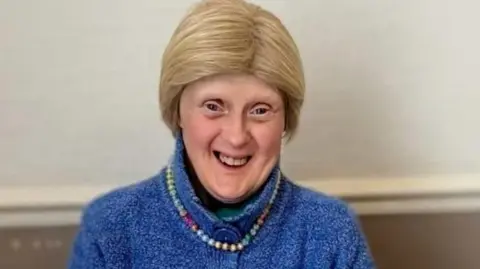
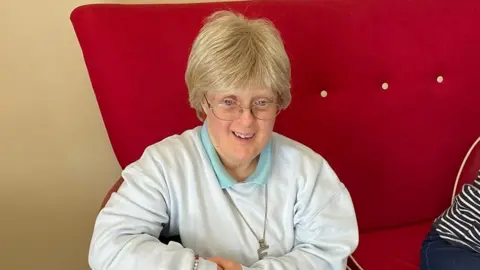
Richard Bell's sister Elizabeth Bell, from Derbyshire, has Down's syndrome but was left alone for an unknown period of time after King's Mill Hospital in Nottinghamshire failed to notify her family she had been discharged following an overnight stay.
She was also not provided with communication support and was left alone to try to express her symptoms to staff, who told her brother he could not accompany her.
Sherwood Forest Hospitals NHS Foundation Trust, which runs the hospital, has apologised to the family.
Under the Equality Act 2010, all disabled people have the right to reasonable adjustments when using public services, including healthcare, and failure to do so could amount to unlawful discrimination.
Elizabeth was taken to hospital earlier this month after staff at the residential home where she lives in Riddings suspected she may be having a seizure.
When Richard, from Alfreton in Derbyshire, arrived he was told by hospital staff he could not accompany Elizabeth for her initial assessment despite the fact she has difficulties communicating, leaving Elizabeth alone to try to do so for nearly an hour with staff.
He said Elizabeth had trouble understanding questions unless simple language was used, and would often guess answers.
Elizabeth's stay at the hospital ended up stretching into two overnight stays when other medical issues emerged, by which time Richard - who is also her carer - was unable to accompany her.
In his absence, he had requested that Elizabeth be referred to a learning disability nurse to assist her, but he said this was not done.
After failed attempts to get through to the ward by phone, Richard eventually travelled to the hospital himself later on the third day of her stay to seek an update.
He said he discovered that Elizabeth had been effectively discharged and left for an unknown period of time alone.
Nobody at the hospital had notified him that Elizabeth needed collecting.
 Supplied
Richard said the experience was "frightening" and he fears his sister has been left distressed.
"We've had a lot of experience with [A&E] over the last few years... communication and understanding with people with a learning disability is absolute zero, it's frightening," he said.
"Derbyshire carers, the ones who have experienced hospital, it's always a problem for all of us... [the staff] cannot communicate. I think they don't have the knowledge to do it.
"We're such a small minority, as carers with someone with a learning disability. We just get overlooked over time.
"I have warned the residential home, she seems OK, but in a week or two weeks' time, there's a very strong chance she will just break down."
Fazilet Hadi, head of policy at the charity Disability Rights UK, said it was "completely unacceptable" Elizabeth had not received the reasonable adjustments she was entitled to by law.
"NHS trusts need to take equality seriously and ensure that they have the policies, processes and training in place to meet the needs of disabled patients," he added.
Phil Bolton, executive chief nurse at Sherwood Forest Hospitals NHS Foundation Trust, said: "We are very sorry to hear about the experience of the patient and their family.
"This is not the standard of care we strive to provide, and we understand how distressing it must have been for them.
"We would welcome the opportunity to speak with the family directly so we can fully understand their concerns and look into them in detail."
By 30 September, all NHS England organisations will be required to have "reasonable adjustment flags" in their IT systems to identify patients in need of more support.
It will provide a marker on a patient's digital health records to help organisations meet their legal duty under the Equality Act 2010 to provide reasonable adjustments for disabled people.
Listen to BBC Radio Derby on Sounds and follow BBC Derby on Facebook, on X, or on Instagram. Send your story ideas to eastmidsnews@bbc.co.uk or via WhatsApp on 0808 100 2210.
