Why are thousands protesting for education reform in India?
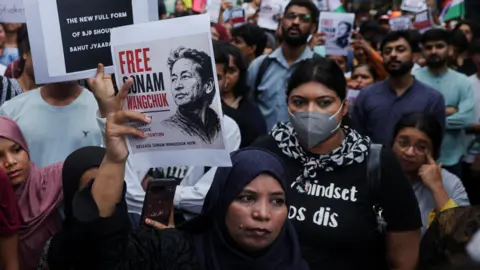
In India, tens of thousands of Gen Z protesters have taken to the streets of the capital Delhi, calling for the resignation of the country's education minister.
Starting as a satirical online movement just a couple of months ago, the Cockroach Janta Party (CJP) is now one of India's most visible youth movements.
Here is what you need to know.
Why did students take to the streets in Delhi?
Despite its humorous origins, the CJP quickly became a lightning rod for disaffected young people in India, where there is high youth unemployment.
Despite its name, it's not a party. The movement is led by Abhijeet Dipke, a 30-year-old political communications strategist and former student at Boston University.
He told the BBC it started as a joke. "I thought we should all come together, maybe just start a platform."
But after offering the option to sign up to the movement through a Google form, he received tens of thousands of responses.
This propelled it forward into becoming a serious protest group, and on 9 July it announced a march to parliament to take place on 20 July. Tens of thousandsturned out in Delhi. Hundreds also attended protests and candle-lit vigils in other cities such as Mumbai, Bengaluru and Goa.
The protest took on added significance because of thetreatment of Sonam Wangchuk, a well-known engineer and activist.
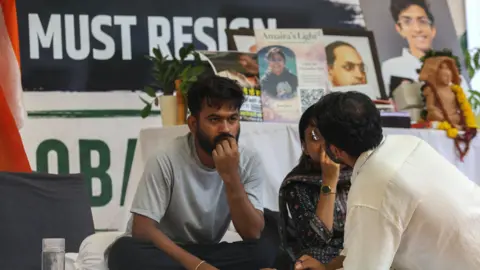
He went on hunger strike on 28 June in support of the CJP at Jantar Mantar, a 300-year-old observatory in central Delhi, which is often the site of protests.
On Saturday, the 59-year-old was forcibly taken to hospital, prompting outrage from CJP supporters and drawing further attention to the protest movement. He has continued fasting in hospital.

 Reuters
Why are they called 'cockroach' protesters?
The name of the Cockroach Janta Party (the Cockroach People's Party) came about in response to comments made by India's Chief Justice, Surya Kant.
During a court hearing in May, he allegedly compared unemployed young people drifting towards journalism and activism to cockroaches and parasites.
He later clarified that he had been referring specifically to people with "fake and bogus degrees", not India's youth more broadly.
The name is a parody of Prime Minister Narendra Modi's Bharatiya Janata Party (BJP), which has been in power since 2014.
Spilling off the internet and into real life, young volunteers to the movement have turned up dressed as cockroaches at clean-up drives and protests.
 Reuters
What does the CJP want?
The CJP is mostly protesting over issues they have with India's education system.
The National Eligibility cum Entrance Test (NEET) is India's main entrance exam for admission to medical colleges across the country.
Nearly 2.28 million candidates sat the exam on 3 May, having studied for months - in some cases years - for the notoriously difficult paper. However, days later, it was cancelled after allegations that the questions had been leaked. A subsequent government inquiry confirmed the leak.
It was a big blow to aspirants, who had to resit the exam under tight security weeks later. Anger over this was one of the reasons the CJP began its protest.
It and families have also alleged that some 20 students died by suicide due to distress after the exam was cancelled.
The NEET exam was also hit by controversies in 2024.
The CJP is calling for the education system to be overhauled, with greater accountability over alleged exam paper leaks and for Education Minister Dharmendra Pradhan to resign.
Following the treatment of Wangchuk over the weekend, CJP leader Abhijeet Dipke also called on Modi to resign.
 EPA
EPAWhat is the impact of the CJP protest?
While it is unclear whether the CJP will achieve its aims of having the education minister removed and the education system overhauled, it has had a major impact on India.
Monday's protest was the largest against Modi's government that the capital had seen in recent years.
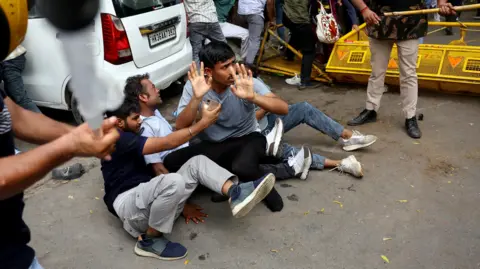
Police tried to disperse the crowd with baton charges and tear gas after protesters tried to push through barricades. Scores of people were injured, including both demonstrators and police personnel.
By the end of the day, officers also dismantled the stage and makeshift tents at Jantar Mantar, the protest's main base near the 300-year-old observatory. But protesters refused to leave.
People have continued to gather at the site around the clock, braving rain as well as Delhi's sweltering heat and humidity.
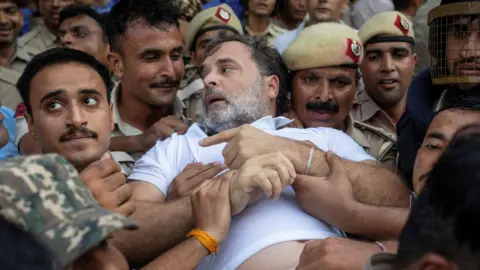
A day after the police crackdown, several leaders of India's main opposition Congress party staged a protest outside Modi's residence, condemning the police action against demonstrators.
Congress MP and leader of the opposition Rahul Gandhi said the party had decided to protest outside Modi's residence because it had not been allowed to raise the issue in parliament.
Congress later shared videos showing Gandhi and other party MPs being detained and taken away in police buses. They were released a few hours later.
 Reuters
Several other opposition leaders have also criticised the police response and demanded accountability.
Meanwhile the education minister - in his first comments since Monday's violence - criticised the Congress for "shamelessly exploiting students as political tools".
"Even after government conveyed its readiness for a comprehensive discussion, the Congress chose political spectacle over democratic debate. Their objective was never solutions for students, it was disruption for political headlines," Pradhan said in a post on X, adding that the government remained committed to addressing students' concerns.
Pradhan, however, did not directly refer to the ongoing protests - and there was no immediate response to his remarks by the CJP.
