Baby loss couple: We were told we'd picked a bad day to give birth

 Laurence Cawley/BBC
Warning: This article contains discussions of stillbirth
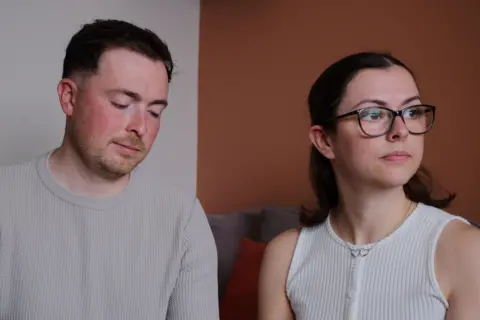
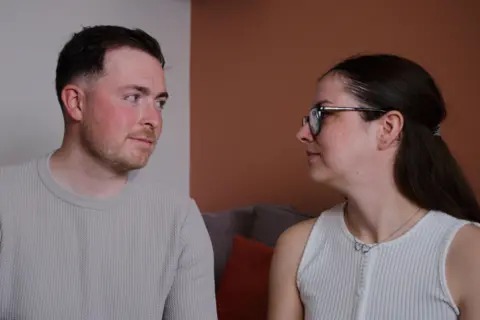
"We were so excited," says Lauryn McCready, remembering the moment she and her husband Andrew learnt they were expecting a baby.
The couple's pregnancy had come in the wake of several miscarriages.
They kept the gender "a surprise", but told friends and family their happy news and spent months preparing their home for the new arrival.
But joy and anticipation turned to despair and grief after mistakes were made during Lauryn's labour and their daughter Lois was stillborn.
Her death was one of 2,341 stillbirths across England and Wales in 2023 which left families devastated.
The couple, from Luton, have now given evidence to the Amos Inquiry, a national review of maternity care, in the hope it drives improvement so that other families do not share their experience.
Following an uncomplicated pregnancy, primary school teacher Lauryn and her husband Andrew, a carpenter, say they "didn't have too much of a plan" beyond an expected vaginal delivery at Luton and Dunstable Hospital.
She says she went in to hospital with a "naive trust" that she was in safe hands and "everything would work out."
More than a week overdue and with contractions that had begun 48 hours earlier, she arrived at the maternity ward at around 22:00 on 4 September, 2023.
The department that evening, she says, was extremely busy.
"You picked a bad day to have a baby," she remembers a midwife told her.
It was an "off the cuff comment", says Andrew, but the phrase haunts them to this day.
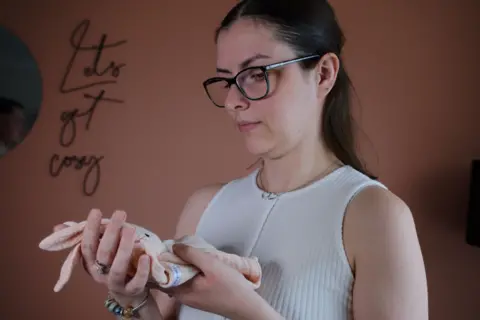
Lauryn spent 28 hours in the maternity triage unit, where the couple claim they overheard nurses discussing staff shortages and a colleague who had not turned up for work.
The baby's heartbeat was monitored and Lauryn had eight vaginal examinations, which showed her labour was not progressing.
At just after 02:00 on 6 September staff detected the baby's heart rate dropping; during a cervical examination Lauryn's waters broke.
After an obstetrician reviewed her case Lauryn was moved onto the labour ward and, according to her medical notes, a call was made at about 03:30 for a Category 1 caeserean section (C-Section), which should take place within 30 minutes.
The couple claim they were never informed of this and the urgency of the operation was then downgraded.
But 45 minutes later, when clinicians could not detect a heart rate, it was decided the baby should be delivered immediately.
- If you've been affected by the issues raised in this story, help and support is available via the BBC Action Line
The couple claim there was then a gear shift in which things went "from zero to a hundred".
Lauryn was rushed into theatre.
She remembers feeling "something was not right" and describes the theatre room as hushed, with "no one was really talking" until "an alarm went off".
Then the room filled with people.
Lauryn remembers asking repeatedly "do you know if it's a girl or a boy?"
Lois was born at 04:26 on 6 September. There was no heartbeat and medics attempted to resuscitate her for 25 minutes.
Unable to see what was happening from the operating table, Lauryn says: "I have moments of remembering things. A lot is a blur."
Andrew says: "The longer it went on, the hope was getting lower. The 25 minutes felt like 25 hours."
The McCreadys were told their daughter was not responding and a decision had been made to stop resuscitation efforts.
"That was a clear moment for me," Lauryn says, "I don't think I said 'no', I think I probably screamed 'No!'."
A post mortem examination found Lois died from a sudden and severe lack of oxygen to her vital organs, likely caused by breathing in her first stool, and the onset of bacterial infection.
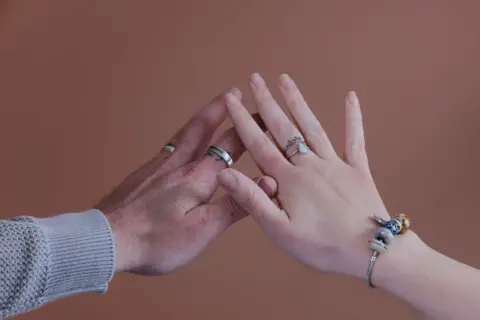
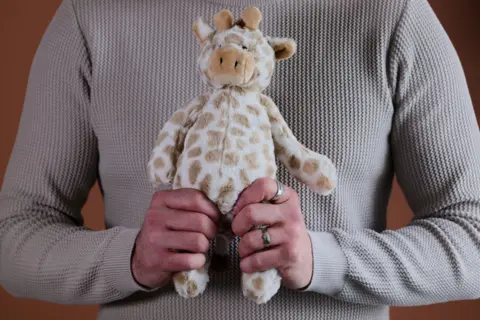
The couple were taken from theatre to a private room back through the labour ward where other women were giving birth.
Lauryn was initially worried the sight of Lois might scare other mothers but says she was told by a nurse that if she held Lois closely "no one will know - they'll think you're like any other mum and baby".
She remembers thinking at the time, "I just want to be like any other mum and baby".
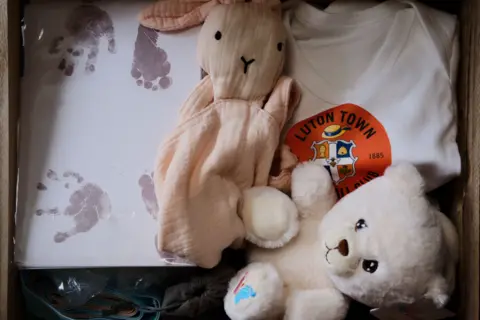
They spent four "precious" days in hospital with Lois where they bathed her, read her books, had casts made of her hands and feet and had family come to visit.
But then they had to say goodbye and return home, and in what should have been their "newborn bubble" they instead "had to plan her funeral".
"It felt like it was just living a nightmare, which was never going to end," Andrew says.
Lauryn remembers coming back to a house "that was full of baby things" which they had to "just put in her room and shut the door" knowing "it would have to be dealt with at some point".
An NHS maternity safety investigation found a number of errors were made in Lauryn's care including:
- A failure to call for a C-section by 02.40am
- Monitoring of Lois' heartbeat
- Recording of risk assessments and using written handovers
- Midwives raising concerns with obstetricians
- Excessive vaginal examinations increasing infection risk
The couple made a medical negligence claim against Bedfordshire Hospitals NHS Foundation Trust, which was settled out of court in 2025. The Trust acknowledged some mistakes, but denied some allegations of care failings.
"It was like they were ripping open a healing wound and just pouring salt on it. It was horrendous", says Andrew.
The trust accepts that had a C-section been performed earlier, "on the balance of probabilities", Lois would have been born alive, but denies she would necessarily have been born healthy.
David Carter, the trust's chief executive, said: "We are truly sorry for their loss and for the mistakes in care that have previously been acknowledged by the Trust."
He added the trust had taken the findings of the independent maternity safety report "extremely seriously" and had an "action plan" to address the problems identified, including:
- Improving care during early labour
- Strengthening risk assessment and record keeping,
- Ensuring a senior doctor reviews women when care is delayed
- Supporting staff confidence to raise concerns
 Laurence Cawley/BBC
The couple gave evidence to the National Maternity and Neonatal Safety Investigation, led by Baroness Valerie Amos out of concern maternity services "aren't being prioritised".
Their experience mirrors issues identified nationally.
Lauryn says it is hard to hear "promises of change" from the trust which runs the Luton and Dunstable only to find "nothing is actually changing", citing the most recent CQC report from January 2026, which again rated maternity services "inadequate".
Inspectors highlighted staff shortages, low morale, a failure to investigate and learn from incidents and delays to performing C-sections and inductions.
Andrew says he believes "it goes beyond midwives and hospital staff... it's a government level problem".
Lauryn wants the findings of the inquiry to be "taken seriously" and supports introducing a UK wide commissioner for maternity services, independent of government - a campaign being led by Made in Chelsea star Louise Thompson.
She also wants better education for pregnant women so they understand their choices and can "advocate for themselves".
Stillbirths in England and Wales are recorded as babies that die at any time from 24 weeks of pregnancy, from both natural causes and clinical errors.
The rate of stillbirths broadly fell between 2000 and 2020 and has since stabilised at a about four in every 1,000 births.
Lauryn says the "one thing she is grateful for" is the "cooling cot", which allowed them to spend time with Lois in hospital.
A CuddleCot or Cold Cot is a specialised medical device to keep stillborn infants cool, provided by donations and "not something every hospital has to have", which is "insane" and "completely baffling" according to the couple.
All families experiencing baby loss should have access to one say the McCreadys, who since Lois' death have raised £7,600 for the charity Abigail's Footsteps, which provides these beds and £24,000 for Tommy's, the baby loss charity.
And while the couple have since had another daughter, Iris, Lois continues to play a vital part in family life.
"She will grow up knowing that she has a big sister," says Lauryn.
"We are a family of four - even though it doesn't look like that, if you see us out or if you see us in pictures."
- Photography: Laurence Cawley/BBC
