Hindu temple sale to Islamic group 'unlawful'

 Ekta Patel
A council's decision to sell the site of the "principal place of worship for Hindus" in the East of England to an Islamic organisation was unlawful and should be quashed, the High Court has been told.
The Bharat Hindu Samaj temple in Peterborough faces having to leave its home since 1986, after the city council sold the freehold of the Rock Road site to the United Kingdom Islamic Mission (UKIM) in February.
The temple claims the council's decision had "significant flaws".
The council and the UKIM are opposing the challenge, with the local authority's barristers telling the court that the temple's arguments "lack merit and ought to be dismissed".
In written submissions, Toby Fisher, for the temple, said it does not criticise the UKIM or its bid.
He said the temple began negotiating with the council in 2017 with a view to transferring some or all of the site.
But the council then invited best and final offers for the site last September after receiving an offer from the UKIM the previous year, with the UKIM pledging to "beat any existing cash offer by up to 5%" while also making clear "that the only religious facilities proposed were for the Muslim community".
Peterborough City Council's cabinet decided to sell the site to UKIM in February.
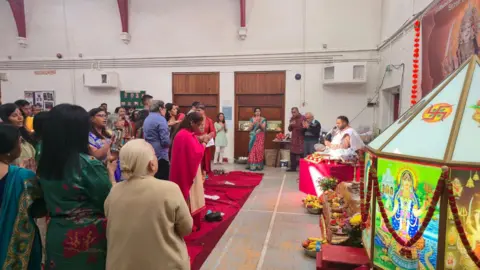 Bharat Hindu Samaj
Fisher said there were "significant flaws in the reasoning of [council] officers" that were "blindly" followed by the cabinet, which meant they "unlawfully delegated the determination of the competitive process to officers".
The barrister also said the council failed to comply with the Equality Act 2010 due to the "dramatic impact" of the temple's closure on Hindus, given that it has no alternative premises and UKIM runs about 40 centres and 60 branches across the country.
Catherine Rowlands, for the council, said in written submissions that there was "nothing before the court that would demonstrate that the cabinet was misled", and that there was "no unlawful delegation" of the decision by councillors to officers.
She said: "Acutely conscious of that property's significance to the claimant, and others as a long-standing place of Hindu worship, the council made its decision only following many years of engagement with the claimant and a transparent, fair and lawful bidding process.
"The evidence before the court demonstrates that the council directed itself appropriately in law, took all material considerations into account, paid due regard to (the Equality Act) in light of the disposal's sensitivities, and adopted a fair procedure."
The hearing before Mr Justice Morris is due to conclude later this week, with a written judgment expected at a later date.
Do you have a story suggestion for Cambridgeshire? Contact us below.
Follow Cambridgeshire news on BBC Sounds, Facebook, Instagram and X.
