The city caught in the middle of an HMO debate

 BBC
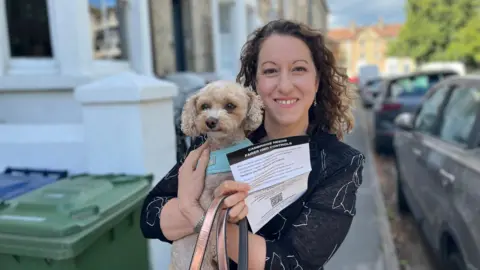
BBCAs Tessa Byars sits in her kitchen, there is a knock at the door. Another thousand leaflets arrive calling for stricter planning controls on houses in multiple occupation (HMO), which she will post through the letterboxes of her fellow Cambridge residents as part of a campaign. But why is Tessa doing this and what could a council deal mean for the campaigners' hopes?
There are nearly 1,000 licensed HMOs in Cambridge, classified as those occupied by five or more people forming two or more separate households, or a purpose-built flat in a block of up to two, also occupied by five or more.
Cambridge is cited as one of the most expensive places to live in the UK and the current Greater Cambridge Housing Strategy acknowledges high prices to buy or rent in the area are "fuelled by high demand".
It says: "There is also a growing 'affordability gap' where middle income households are being squeezed out of the market, with limited housing options for home ownership or in the private rented sector."
Tessa lives on Ross Street, a row of Edwardian terraced housing, which she says is a "very good example of what's wrong with the current system".

Tessa says within 100m of her home there are three HMOs housing between five and seven people each - with two more to come.
"If that isn't an example of over intensification, I actually don't know what is," she says.
She is concerned about the impact of HMOs on the area, including on parking, pavement accessibility, bins and bicycle storage.
"We don't want to stop all HMOs. That's not our campaign. We recognise that there's a need for that," she says.
"But to allow the erosion of existing communities, that's what we're worried about, because if you have a transient population, then you are going to gradually erode the sense of community and social cohesion in the area," she adds.
 PA Media
Tessa is also concerned for those living in HMOs, citing one property on a nearby road having a bedroom in which "you couldn't swing a kitten... never mind a full-grown cat".
A petition with hundreds of signatures calling for planning permission to be required to convert an existing home into a permanent "small" HMO for three or more people, and a threshold of 10% HMO properties within a 100m radius, has been put forward to Labour-led Cambridge City Council.
They are similar regulations that cities such as Oxford and Bristol have already implemented.
The campaign comes at the same time as the terms of a deal between Cambridge's Labour and Liberal Democrats - which saw a Labour council leader appointed after the most recent elections left the authority in no overall control - vowed to look into possible HMO and short-term visitor accommodation controls.
Guest Road in Cambridge sits between Anglia Ruskin University - the city has roughly 35,000 students in total - and the bustling Mill Road, with its restaurants and shops.
Donna Ferguson, from the Guest Road Area Residents' Association, says the group had surveyed the local area and 32 of the 100 properties were HMOs.
"You get all sorts of problems, particularly with bins and people not having enough bins for their rubbish, not having enough space to store more bins and therefore we've had cases where someone's opened their wheelie bin and discovered someone else's rubbish has filled it to the top," she says.
But Ben Beadle, the chief executive of the National Residential Landlords Association, says: "Rather than finding new ways of limiting supply, local authorities should be concentrating their efforts on encouraging landlords to bring decent homes of all varieties to the private rented market.
"Shared housing is an essential part of the housing mix, especially in university cities like Cambridge where [HMOs] are vital to ensuring students have a suitable home while they study. Putting further barriers in place that reduce supply and choice helps no-one, least of all renters, who may find themselves locked out of the sector entirely.
"Whatever steps councils take to help landlords stay in the market, they must do their utmost to provide a fair deal for both renters and landlords."
Housing affordability
It is not the first time HMO restrictions have been discussed by Cambridge City Council. In 2012, when the authority was under Lib Dem control, the council rejected the idea of limiting the number of HMOs.
"If restrictions are put in place, rents would rise and people would quickly be priced out of the city. Making it difficult for people to access shared housing in the city, could have a disastrous effect on the economy of the area," the council's reasoning went.
However, the petition is backed by Acorn, a union for tenants who rent privately, who say: "Houses should be homes. Not business assets for greedy landlords exploiting the housing crisis.
"These steps are crucial for protecting renters and our community."

One former HMO tenant, Anna Ward, says a few years ago she moved into a HMO that was "not at all like it was described online" and had black mould which left her so unwell she had to move out for six months.
"I was a student and an HMO was really my only option at the time... it was the only house I could afford in Cambridge."
Anna says when she signed the contract she asked for a wheelchair ramp, but this was not there when she arrived and she later injured herself on a makeshift ramp.
Cambridge City Council says it was "exploring the approach to future planning policy regarding HMOs" as part of its emerging Local Plan, which it consulted on earlier this year.
"We're currently reviewing the comments received during the consultation and refining our approach ahead of publishing the updated plan... for final consultation later this summer."
Do you have a story suggestion for Cambridgeshire? Contact us below.
Follow Cambridgeshire news on BBC Sounds, Facebook, Instagram and X.
