The NHS teams aiming to prevent hospital discharge delays

 Mark Norman/BBC
Enid Ford is waiting for knee surgery and is desperate not to have a fall and be admitted to A&E.
"I wouldn't like to go in after a fall because I don't think my chances of getting out would be very good," she says.
She has regular visits from a community therapy team operated by Sussex Community NHS Foundation Trust to ensure her home is safe, and that she will be able to leave hospital quickly after surgery.
NHS Surrey and Sussex believes solving that problem is "critical for health and care partners across Sussex".
 Mark Norman/BBC
Ford, from Yapton, hopes the support she is receiving will help her avoid unnecessary hospital visits, and says there seems to be "plenty on offer".
The latest NHS data shows 1,379 patients were stuck in a hospital bed across Kent, Sussex and Surrey who were medically fit for discharge but waiting for some form of social care.
They are described by the NHS as having "no criteria to reside", commonly referred to as bed blocking.
The majority were waiting for some form of social care package to be put in place before they could leave.
At any time between 10% and 25% of a hospital's beds are occupied by patients who do not need to be there.
Patients can wait for more than eight days on average to get social care sorted.
The community therapy team (CTT) is described as providing a crucial role in preventing unnecessary hospital admissions and supporting timely recovery following a change in health needs.
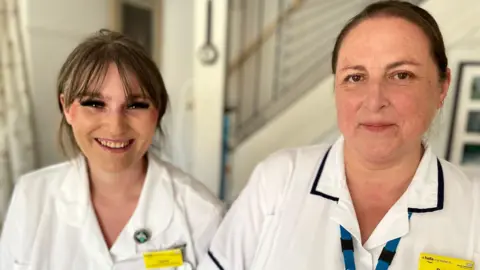
Debbie Smith is one of the CTT members and a clinical lead physiotherapist for the trust.
"In Enid's case, she's got arthritis in her knee and is waiting for surgery," she said.
"So we would do as much as we can to get her strong and maximised before the surgery."
But she said they also saw people coming out of hospital and recovering from surgery, helping with rehabilitation.
The service is delivered by about 130 staff, including physiotherapists, occupational therapists, therapy support workers and practitioners.
Occupational therapy apprentice Laura Mills said the priority was maintaining independence and function for patients.
This included keeping people at home and making sure their work was "really patient-centred".
"That the goals that they want to achieve we're really addressing, and how we can support them to live independently [is the priority]," she added.
Common reasons for delayed discharge include waiting for a care home place, confirmation that their existing care home can still offer appropriate care, a return home but waiting for additional support to be put in place, waiting for a hospice placement or other end of life care outside a hospital.
Follow BBC Sussex on Facebook, on X, and on Instagram. Send your story ideas to southeasttoday@bbc.co.uk or WhatsApp us on 08081 002250.
