The prehistoric species fighting for survival in Lough Neagh

 AFBI
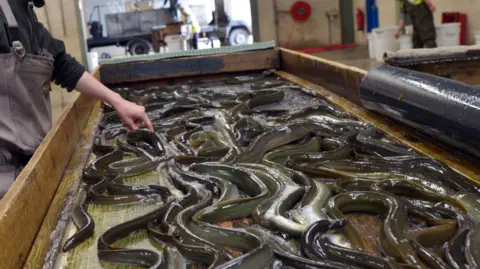
AFBIThe Lough Neagh eel was the first Northern Ireland product to be granted Protected Geographical Indication (PGI) status by the EU.
But no yellow eels will be caught on the Lough this year - or for the next two years - following the closure of the fishery.
Only a minimal amount (25 tonnes) of silver eels (fully mature) may be caught at the Lough Neagh Fishermen's Co-operative.
People who depend on eel fishing for the bulk of their income are now waiting to hear what support they may get from Stormont.
They point the finger firmly at environmental pressures in the Lough.
With eel-fishing bans already in place in some countries, some scientists say the writing has been on the wall for decades.
Daera has said a financial assistance scheme has been developed and the "necessary approvals for the proposal are currently being pursued".
What's so special about the eel?
This prehistoric creature has survived ice ages, the asteroid impact that killed the dinosaurs, and continental drift.
Scientists know the European eel starts its life in the Sargasso Sea, off the east coast of the United States, but they have never witnessed its breeding behaviour in the wild.
They know it crosses the Atlantic as a one-year-old fish, drifting on currents for up to three years to reach the freshwater lakes of Europe.
It transforms into a glass eel as it travels from coastal estuaries to places like Lough Neagh and Lough Erne.
Then it becomes an elver and disappears into the depths.
For up to 20 years, it feeds mostly on invertebrates like the Lough Neagh fly, growing into a yellow eel (sometimes called a brown eel).
More changes happen when it reaches maturity at 16-18% body fat.
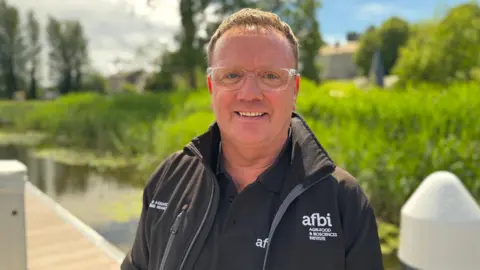
Prof Derek Evans from the Agri-Food and Biosciences Institute has spent years studying this "fascinating" species.
"It is only recently we have come to realise that as part of their process of changing from yellow to silver eels, they go through a range of really incredible metamorphic changes," he explained.
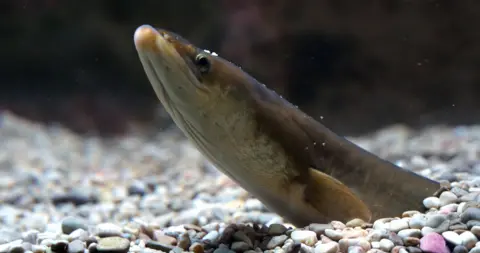
"Their colour changes – they become very dark on top, very white underneath; their eyes get much bigger, their fins become rounded, even their backsides disappear - they become sealed almost like a biological submarine, I guess you could say."
That allows them to undertake the epic journey back across the Atlantic, not eating as they swim but developing their reproductive cells - sperm and eggs - so they can spawn when they reach their destination.
"We now know from work by colleagues in Norway that there seems to be some kind of magnetic superpower, what are called magnetophores in the retinas in the back of their eyes, that can detect the Earth's magnetic field and help them find their way back to the Sargasso."
"And it's a one-time journey," Professor Evans added.
"They go back, they spawn and they die. We never see adults again. The only thing we see are the little, finger-long glass eels coming back sometime within the following year."
Why a restriction on fishing?
 AFBI
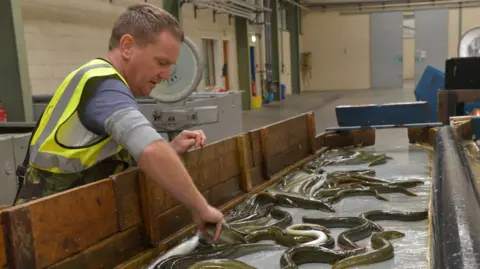
AFBIIn the 1980s there was a collapse in the number of eels arriving - what scientists call recruitment - at freshwater bodies in Europe.
Prof Evans said it fell from 14-16 million juveniles a year, to a little more than 200,000.
"1983 was the pain point whenever we first noticed that drop, but it remained.
"It wasn't just a blip - it was something that continued and has continued right up to the current time."
Marine biologists and fisheries scientists believe human influence is the main cause - impact on climate; hydropower systems that eels have to migrate through; pollution and contamination; introduction of exotic parasites; and overfishing.
There has also been a rise in illegal smuggling of the species outside Europe.
Eel management plans were implemented at fisheries across Europe from 2009, followed by an export ban, to try to support recovery of the species.
Recreational and commercial fishing of eels has now stopped in some countries.
But the eel still returns to places like Lough Neagh, where licensed fishermen like Gary Erlain can earn up to 80% of their income from them.
Fears for the future
Fishing was stopped last year when the quality fell short of the market requirement.
Last month, the Agriculture Minister Andrew Muir announced a series of measures for the Lough Neagh eel fishery, to ensure long-term recovery of stocks.
The Department for Agriculture, Environment and Rural Affairs (Daera) said the new measures, are informed by scientific advice and reflect the department's statutory responsibilities to protect the European eel, which is classified as critically endangered.
Muir said work is being progressed "as a priority" to develop a temporary cessation scheme to support permit holders affected by the closure of the yellow eel fishery.
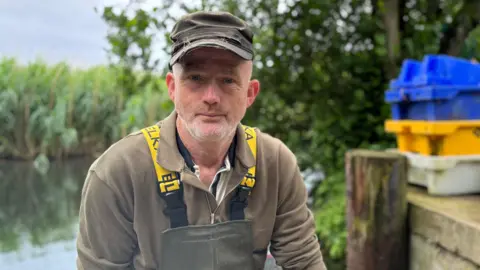
Gary McErlain has his own thoughts about the collapse in the eel population.
"You can point to a whole host of factors such as zebra mussel, climate change, whatever else. We can see very clearly our Lough Neagh fly is down, the pollution is up," the eel fisherman said.
"You had the algae bloom of 2023, '24 and '25, and I would say last year was worse than any."
He suspected "it's going to happen again" following two periods of heatwave conditions in Northern Ireland.
 Getty Images
As the seventh generation of his family to fish for eels on Lough Neagh, he gets emotional when he contemplates the future.
"I'm blessed that I've come from a long line of commercial fishing, and I'm blessed that I had the opportunity to do it," he said.
"So to ask me how I feel in relation to that not continuing into the future - that's devastating."
Increasing the chances of adult fish to breed through management plans, fishing bans and protected routes to sea are seen as key to restoring the species.
As a scientist, Prof Evans is cautiously optimistic.
"The eel is a very resilient species, it's been here millions of years.
"It's seen itself through many ice ages. It's a survivor.
"Given the right chances, it will continue to survive."
What support proposals have been brought forward?
Daera has said a scheme of financial assistance has been developed and the "necessary approvals for the proposal are currently being pursued".
The department said that the approval process "spans more than one department and therefore can take some time to complete".
There is no timescale for it, but the department said that when secured, and approved by the Minister, the details for the scheme will be announced.
