Views sought on moving high-risk births from hospital

 BBC
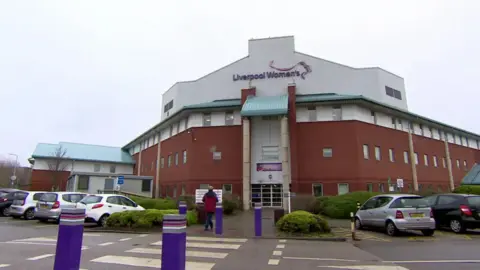
BBCPeople have been invited to have their say about plans to transfer some maternity services from Liverpool Women's Hospital to the Royal Liverpool.
About 130 high-risk births would be affected each year under the proposals.
As a six-week engagement exercise on the plans got under way, the NHS said it would be safer for some women to go to the Royal Liverpool due to the lack of emergency care provision at the Liverpool Women's Hospital.
However, opponents claim it would create more problems than it solves due to fears the Royal Liverpool Hospital is already overstretched, and many women prefer to be seen in a healthcare setting which focuses on their needs.
The two hospitals are 1.3 miles (2km) apart.
One problem is that Liverpool Women's Hospital on Crown Street has limited critical care facilities, so if there is a medical emergency, women have to be "blue lighted" in an ambulance to one of the city's two acute hospitals – Aintree or, more commonly, the Royal Liverpool.
Clinicians said this could be very dangerous and there have been cases where women have nearly died.
Also, because the Royal Liverpool does not have a neonatal unit, it means if a woman is transferred there after labour her newborn baby has to stay at Liverpool Women's.
Dr Fiona Lemmens, executive clinical director for Cheshire and Merseyside, said: "This piece of work is about making care safer for a small group of really high-complex women who have got either complex pregnancies or complex gynaecology problems that need surgery or special additional care wrapped around them that we currently can't provide at the Crown Street site."

Lesley Mahmood is a co-founder of the Save Liverpool Women's Hospital campaign which opposes the move.
She told BBC North West Tonight: "We're worried that, one, it's the thin end of the wedge, but two, where is the room in the Royal?"
She said her group was also concerned about wraparound services at Liverpool Women's Hospital for newborns, breastfeeding and mental health as well as other facilities for women who need gynaecological surgery.
"Where is all that going to go on the Royal," asked Mahmood. "And where's the money and staffing coming from?"
She said she also had concerns about pregnant women classed as "high risk" in the Royal's accident and emergency department.
"If high-risk women become suddenly ill and they feel they should go to the Royal then obviously there's long queues for the A&E [there].
"There's people sitting in chairs who are waiting for a trolley, lying on trolleys waiting for a bed, that's not an appropriate setting for high-risk pregnant women or high-risk gynaecological women."
Dr Lemmens said this would not be the case, since for complex pregnancies a "very clear care plan" will be produced in advance, so that women will know "exactly what to do" in a range of scenarios. This may involve going to the Royal or Liverpool Women's Hospital.
She stressed the woman's care plan "will not include presenting to A&E at either Aintree or the Royal Hospital."
Listen to the best of BBC Radio Merseyside on Sounds and follow BBC Merseyside on Facebook, X, and Instagram. You can also send story ideas via Whatsapp to 0808 100 2230.
