Why is pony and trap racing being banned on roads?

 Getty Images
A ban to address a long-running issue of pony and trap racing on roads in Buckinghamshire is coming into force.
Buckinghamshire Council said the new public spaces protection orders, preventing the races, would take effect from 8 May.
It will apply to the A413, from Chalfont St Peter to Denham, and the A40 between Beaconsfield and Denham.
But some people who use them legitimately as local transport are worried that the ban will affect them.
What is pony & trap racing?
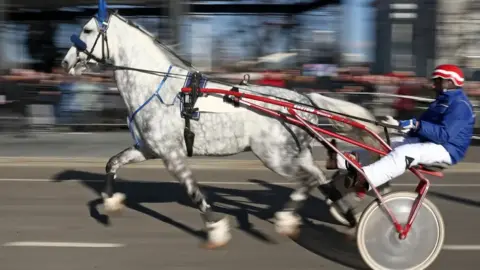
While the council refers to it as pony and trap racing, in the UK it is also known as "sulky racing" or "trotting racing" and involves a one-person cart attached to the back of a horse, which has normally been bred for racing.
But many local travellers who use horses as part of their culture are worried about being unfairly connected to the racing.
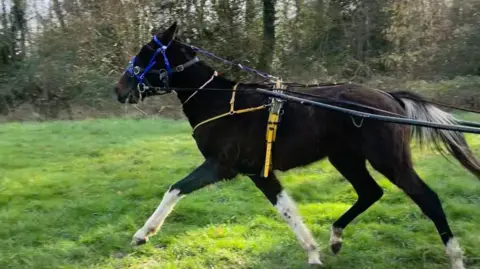
They use a different kind of "exercise cart" which seats two or three people and travels at a much slower and safer pace.
Driving horses is a deeply rooted cultural tradition for Gypsy and traveller communities.
John, a traveller who lives in the Chalfont area, is worried the ban will affect him using his horse and cart.
He has never raced ponies, but he does transport his children around the area with them.
"Me and my lad take ponies along those roads at 10-15mph...our ponies don't go fast, we use them to go to the local village.
We don't go out on them if a race is on. I've been involved with horses my whole life, they've stopped us travelling and now they're trying to stop us using horses."
The racing events are popular social gatherings that bring many families together, but they have faced criticism from animal welfare groups and police due to the risks of racing on public roads, prompting calls for safe, regulated spaces for the activity to continue rather than be banned.
What problems is it causing in Buckinghamshire?
Historically, the A413 between Kingsway Roundabout and the A40 at Tatling End has been the primary location within the Thames Valley area for races.
With no recognised place for racing, unofficial events on public roads often cause disruption to other road users.
The council said Thames Valley Police (TVP) reported 639 pony-and-trap racing incidents between 2020 and 2025.
Sarah Green, the Liberal Democrat MP for Chesham and Amersham, said: "Those taking part gather at a section of the A413 and run a series of races along the straight stretch of dual carriageway.
"The immediate danger is posed to those already using the dual carriageway."
She said support vehicles follow the ponies and traps - usually 4x4s or pick-up trucks - "which block both lanes of the carriageway, creating an illegal rolling roadblock to allow the race to take place."
There have been fatalities in other parts of the country, including when three people died in a crash between a pony and trap and a lorry earlier this month.
 Contributed
What change has the council made?
Buckinghamshire Council's public space protection order (PSPO) states that while pony and traps can still be used for transportation purposes, they cannot be used for racing or timed trials on those roads.
PSPOs are powers which can be used by local authorities to deal with particular nuisances that affect a local community's quality of life.
They can be enforced by council officers and the police, who can issue fines of £60, rising to £100.
Steve Bowles, the Conservative cabinet member for communities, said the protection orders were in place to "tackle the long-running and dangerous issue of unauthorised pony and trap racing, which has led to significant road safety risks, traffic disruption and distress to local communities".
The orders would allow police to "prevent racing before it occurs, helping to keep these busy routes safer", Bowles added.
But some locals are worried.
Anthony is not a traveller but uses a horse and cart. He said many of those who race ponies are not local.
"I'm concerned that a ban, without clear communication, means I'll be assumed to be engaging in illegal racing.
"This blanket ban risks disproportionately impacting those of us who live here and use the roads responsibly, while not addressing the root of the issue."
What is the current law?
Currently it's legal to use a horse and cart on a public highway, and no licence is required.
The Road Traffic Act 1988 prohibits the racing of motor vehicles and regulates cycle races but there is no equivalent regulation for pony and trap racing.
Green, meanwhile, is urging the Government to introduce a licensing scheme.
"If someone wants to organise a cycling competition or road race in the UK using the main roads, there are regulations to follow to ensure that cycling races are routinely organised safely and with minimum disruption to the community."
But that is not the case for pony and trap racing.
"I suggest that the Government need to introduce regulations for pony and trap racing along the same lines, primarily because of road safety, but also because of the significant policing resource that these unofficial races eat up," she added.
What has the local reaction been?
Many local residents have commented that they support the ban, but question how it will be policed when races sometimes only last a few minutes.
While it's part of Gypsy and traveller tradition to parade horses and ponies in what is called a "drive", races on public roads are a separate event that people train for.
Sally said that driving horses is intrinsic to her family's way of life.
"This ban is not representative of those of us who live here. We don't race sulkies, which use a different type of highly prized horse but we do join in charity drives on those roads in the summer."
"Now we feel like we're being judged and that we're being prevented from driving our horses. There's been a lot of negativity towards us online."
And John added: "We use an open road so we can see the traffic ahead. If me and my son take our ponies out the police could say we're racing.
"Everyone pays council tax – why haven't they consulted us?"
"I've lived here most of my life and use those roads to responsibly exercise my horse" said Anthony.
"I'm not involved in racing but jogging my horse is an important part of my life....as it is for many round here."
Sherrie Smith from Gypsy support group TravelStronger belives the ban is disproportionate and discriminatory.
"PSPOs were not designed for road safety. Races are an obstruction and should be stopped by the police, but this is a targeted attack on an ethnic minority and contravenes the Human Rights Act 1998."
Update 7 May: On 3 May we removed a photograph from this article which had been provided by a contributor after learning that it had been digitally altered.
Do you have a story suggestion for Beds, Herts or Bucks? Contact us below.
Follow Beds, Herts and Bucks news on BBC Sounds, Facebook, Instagram and X.
