How air pollution is being monitored

 Getty Images
As part of its Air Day coverage, BBC South visited Southampton and Reading to understand how pollution builds up and is measured.
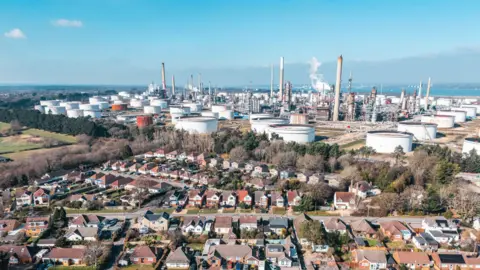
The main source of pollution in the UK is local emissions, such as road traffic, industrial processes, heating and agriculture.
On a windy day, any pollution that builds up could be blown away, but on a calm day, particularly in winter, the pollution can be trapped at the earth's surface.
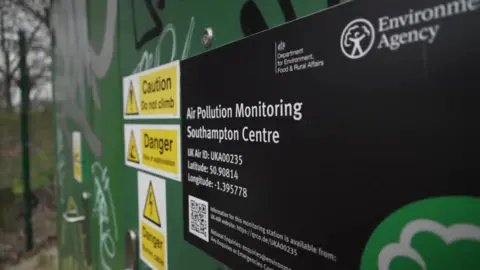
I met Simon Hartill, scientific officer for Southampton City Council's environmental health department, at one of its four ground-based air monitoring stations.
At the station in Brintons Road, near St Mary's Stadium, the council and Environment Agency monitor levels of nitrogen dioxide, sulphur dioxide and other pollutants.
They are often created by burning fossil fuel products like the petrol or diesel that power vehicles.
There are three other automatic monitoring stations across the city at Onslow Road, Victoria Road and Redbridge Road. Other cheaper, smaller fusion tubes are used to monitor conditions elsewhere.
"[The Brintons Road station] is a very important site of the city because it's part of the government's national network," Hartill said.
"The automatic stations are very expensive, the analysers [cost] thousands of pounds. They're quite big so we can't put them everywhere, whereas the fusion tubes – they're quite cheap. We can put them up lampposts, outside people's houses and we've got about 80 in the city."
We breathe in oxygen but we also breathe in small amounts of other gases and particles that can be harmful for our health.
Melanie Ades from the European Centre for Medium-Range Weather Forecasts (ECMWF) is based at its Shinfield Park base in Reading.
"The way I like to think about it is it's like the UK Met Office but rather than forecasting weather across the UK, it forecasts air quality across Europe," she said.
It also has two other bases – in Bologna in Italy and in Bonn, Germany.
"There are two main ways which we measure air quality," she said. "[They are] Satellite observations, which are broad scale, global observations, and then you have local observations. In the UK, we are mainly affected by local emissions but we do have impacts from global situations."
Visible affects are evident from major events, such as last year's forest fires in Canada or storms in the Sahara lifting up dust and scattering it across Europe and the UK.
Despite more knowledge and awareness of the effects of pollution, the presence of nitrogen dioxide and other pollutants has reduced both in the long-term and in recent years.
Government figures show the average concentration of it has been cut by more than half at roadsides and in urban areas since the late 20th Century.
But there is still reason to cut it, with potential impacts of nitrogen dioxide exposure including shortness of breath and a cough, and studies suggesting that the impact is more pronounced with people with conditions like asthma.
