Police to 'reflect' on disabled woman killing

 Durham Police
A police force has said it will "reflect" on its actions in the case of a psychotic woman who killed a disabled victim minutes after speaking to officers.
Patricia Hewitt, 42, slashed and stabbed 56-year-old Angela Lloyd with a knife and scissors dozens of times after forcing her way into the victim's Newton Aycliffe home in August 2025.
She was given an indefinite hospital detention order after admitting manslaughter through diminished responsibility.
Hewitt had been let free by magistrates earlier in the day and Durham Police officers spoke to her shortly before she killled her victim. A force spokeswoman said it would look to see if "any lessons [could] be learned".
Hewitt, from Stanley, killed Angela Lloyd, who had severe mobility and health issues, while demanding money during a psychotic episode on 13 August 2025.
Earlier that day, Hewitt had been given a suspended prison sentence at Newton Aycliffe Magistrates' Court for an "unprovoked" assault on a woman in Chester-le-Street the day before.
Several people contacted police on the afternoon of 13 August to report concerns about Hewitt, whose erratic behaviour included trying to get into a stranger's garden, walking around semi-naked muttering to herself and stealing wine from a shop.
 Family handout
Two police community support officers (PCSOs) spoke to Hewitt at about 18:00 on a grass hill near Bakewell Place, where the victim lived, prosecutor Jolyon Perks KC told her sentencing hearing.
She was wearing one shoe and told the officers she was waiting for a taxi, while also muttering to herself, appearing "intoxicated" and apologising for being an "inconvenience", the court heard.
The officers offered her a lift home which she declined, the court heard.
As they were speaking to her, a worker from a nearby shop approached and told Hewitt she had to "stop stealing wine" from them, adding she had taken two bottles that day, the court heard.
Hewitt gathered her belongings, apologised again to the officers and walked away, leaving the scene at 18:28 BST, Perks said.
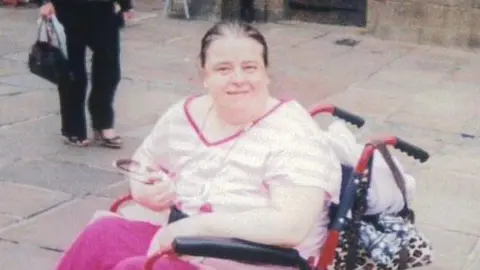
Three minutes later she was fatally attacking defenceless Angela Lloyd, a devout Catholic who supported numerous charities and "lived life to the full", the court heard.
 Family handout
Psychiatrists later agreed Hewitt was having a psychotic episode, probably as a result of schizophrenia, with her voluntary drug use not a major factor.
Speaking after the sentencing, a Durham Police spokeswoman said the force wanted to extend its "deepest sympathies to the family and loved ones of Angela".
"This was a horrific and unprovoked attack on a vulnerable woman within the safety of her own home," the spokeswoman said.
At the time of the killing, the force referred itself to the Independent Office of Police Conduct (IOPC) which assessed the case and returned it to the police force to continue investigating, she said.
The spokeswoman said: "Following any tragedy, the public would rightly expect us to consider whether there was anything which could have been done differently.
"We will reflect on some of the processes and procedures that were highlighted during the case to determine whether any lessons can be learned.
"Our primary thoughts remain with Angela's family at this time."
The IOPC confirmed there had been a referral but the parameters were not met for it to investigate, with a death and serious injury incidents probe only eligible when the victim had prior contact with police rather than the culprit.
The sentencing hearing also heard Hewitt had prior involvement with mental health services and had been admitted to hospitals six times between 2009 and 2024, with her psychosis concluded to be drug-induced.
Her last interactions with health professionals were in June 2025, when Hewitt refused to engage with treatment and said she had "no intention of stopping" her use of "illicit drugs", the court heard.
She had 122 offences on her criminal record including multiple incidents of attacking emergency workers, violence and possessing weapons, as well as supplying Class A drugs.
