Tens of thousands evacuated from French tourist spot and near Madrid as wildfires spread
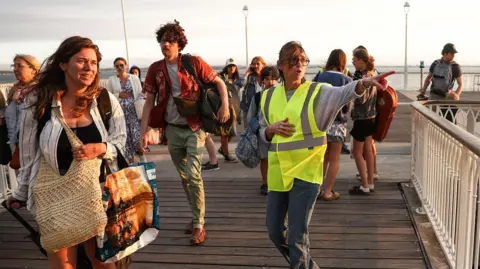
French authorities have ordered the evacuation of the entirety of the Cap Ferret peninsula on the south-west coast, with hundreds of people escaping by boat.
Tens of thousands of people are being evacuated from the tourist spot west of Bordeaux, as firefighters continue to battle what the local prefect described as an "XXL fire" in the Gironde region.
The fires, which began on Tuesday, have burned for days, with officials saying 10,000 hectares (almost 25,000 acres) had been consumed by flames.
Meanwhile, Spain's government has declared a national emergency after wildfires burnt out of control in several areas close to the capital Madrid, prompting the evacuation of more than 19,000 people.

 Getty Images
Responding to the spread of fires, Isabel Díaz Ayuso, Madrid's regional president, said it was: "The worst fire in the history of the region."
Speaking at an emergency command post in the southwestern municipality of Cenicientos, she said the area was facing a "perfect storm" with high temperatures, relentless wind and several fire fronts merging.
"The situation is completely unusual and catastrophic," she said, adding that the priority was saving lives.
Spanish Prime Minister Pedro Sánchez spoke of a "dramatic situation" and urged people to take great care. Three fires were burning west of Madrid, at Villa del Prado and San Martín de Valdeiglesias.
French Interior Minister Laurent Nuñez said 40,000 people had either been or were in the process of being evacuated from the Cap Ferret peninsula, which has the Atlantic on one side and the Bay of Arcachon on the other.
Local prefect Sophie Brocas said 53 homes had been lost as well as a campsite, but that 2,000 houses had been saved.
A local councillor said 2,000 evacuees from the peninsula had already arrived by boat in the port of Arcachon on the south side of the bay.
Fire and rescue chief Marc Vermeulen said the wildfire had spread rapidly at the end of Thursday and into the early hours of Friday. Authorities then took the decision on Friday morning to begin the evacuation of the town of Arès, which lies south-east of Lège-Cap Ferret on the Bay of Arcachon.
Vermeulen compared the fires overnight to those in 2022 - explaining the area is in a more severe state of drought now.
While in 2022, fires were "exploding" at the end of the day and the nights were favourable for firefighting, in the current fires they are exploding during the night at midnight or 01:00.
"When I say explosion, it means that for several hours, we had propagation speeds on the order of 800 to 1,000 hectares burned per hour, in the context of a suburban area."
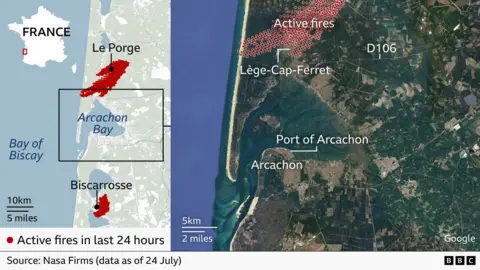
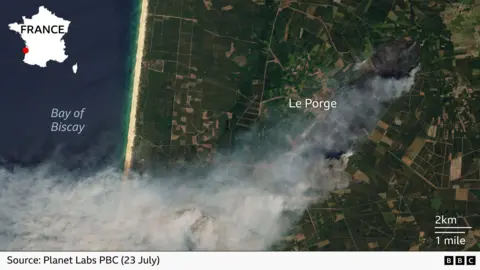
Further down the Atlantic coast, around the town of Biscarrosse in France's Landes region, another major fire that began on Thursday afternoon has prompted the evacuations of more than 23,000 people.
About 18,000 people in Biscarrosse and 5,000 in Parentis-en-Born had to leave their homes, campsites, a nursing home and a summer camp.
Landes prefect Gilles Clavreul said the fire around Biscarrosse was not going to be out by the end of Friday, with winds of up to 50km/h (31mph) and temperatures of 36-37C.
He added that 105 homes and other buildings had so far been identified as either partially or completely destroyed by the flames.
No further casualties have been reported overnight in south-west France, although two firefighters died on Tuesday while tackling a blaze near Bordeaux airport.
French President Emmanuel Macron said on Thursday night the wildfire situation in the country was "very tense" - especially in the Gironde region.
The European Union has sent three planes and two helicopters to help the French fire effort, and another four planes to Spain.
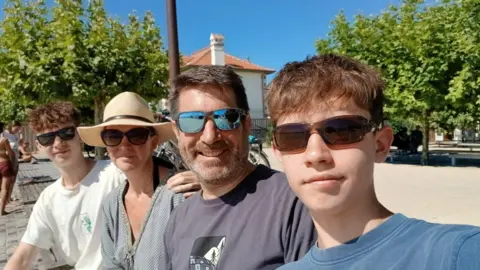 David Morton
Headmaster David Morton, 53, from Gloucester in southwest England had been on holiday with his wife and sons when they received an emergency alert via text overnight on Thursday instructing them to evacuate.
The family were staying in a house in Petit Piquey, along the peninsula, and were woken up at 03:00 local time (01:00 GMT) by an alert on the property's landline.
"Everyone was driving with their lights on, driving very slowly – there was lots of fire service people, ambulances, police on the other side of the road controlling things and we could see several fires in the distance as we drove," he told the BBC.
"It's different from seeing it on the television… seeing it blazing out of control despite hundreds and hundreds of firemen and women helping."
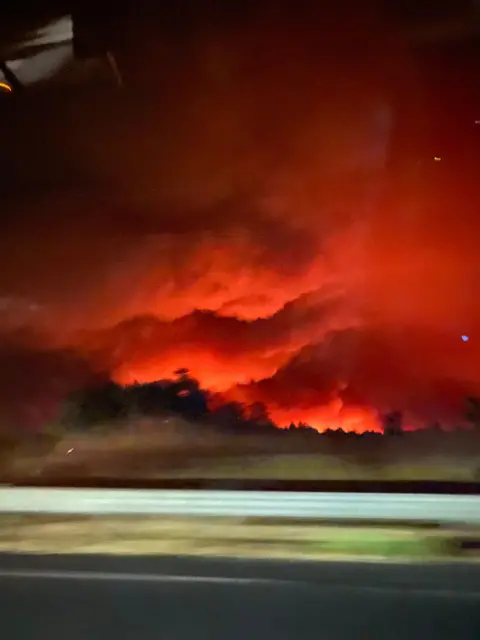
Olivia Jarratt, 44, was evacuated from Truc Vert campsite on the peninsula with her husband and two children in the early hours of Friday morning.
Her daughter was woken with sirens and the family left their tent, camping gear and bikes behind as they made the drive to Bordeaux.
"At first, we dismissed it, and thought she was having a nightmare, but we realised it was all going on, and everyone was packing in a panic. There's only one road off the peninsula, so people were trying to be as quick as possible.
"There was a loudspeaker with the sirens, but obviously that was in French, and with everything, we couldn't understand what was happening."
 Olivia Jarratt
The Cap Ferret peninsula has a year-round population of just under 8,000 but that can swell by 10 times that number in peak season.
Around 20,000 people within the Gironde region had been evacuated on Thursday many of whom were visitors to campsites on the peninsula.
"This is a tourist disaster that we are experiencing once again," Franck Chaumès, president of the Gironde branch of the Union of Hotel Trades and Industries, told FranceInfo.
He added that the union was working to secure financial aid and "potentially offer some rooms to displaced residents".
Spanish forest fires 'ravaging thousands of hectares'
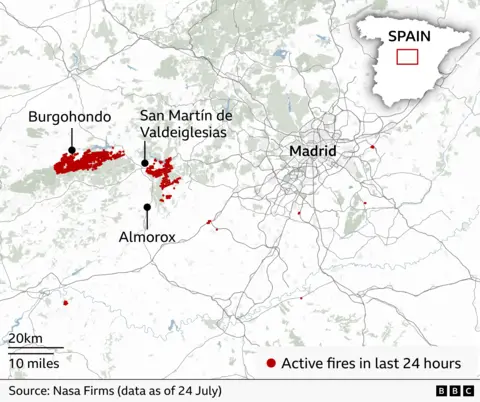
In Spain, Interior Minister Fernando Grande-Marlaska declared a national emergency as fires burned at Villa del Prado and San Martín de Valdeiglesias in the Madrid region and at Burgohondo in Ávila.
Local emergency services said on Friday afternoon that the Madrid fires had merged, while more than 19,000 people had been evacuated from their homes in three towns west of the capital.
The mayor of El Tiemblo, one of the affected areas in Ávila, said the fire had spread from Navaluenga to the Iruelas Valley - a distance of about 20km (12 miles) - in less than half an hour. "It was horrific," Arturo Varas González told laSexta.
"The smoke was incredibly thick. You couldn't breathe," Jose Cobos, who escaped with his wife and three dogs, told Antena 3.
Residents of Chapinería, Navas del Rey, and Colmenar del Arroyo have received Es-Alert messages to leave.
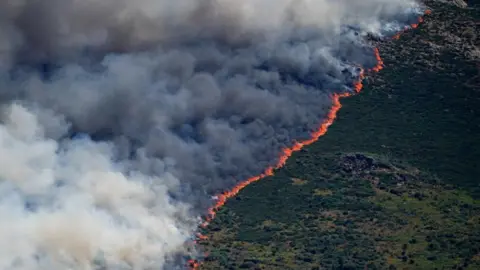
Pedro Sánchez said earlier in the day that forest fires were "ravaging thousands of hectares" and affecting numerous communities.
An update on Friday morning had described the two fires that have now joined as being "out of control".
Grande-Marlaska said 9,000 hectares (around 22,200 acres) had burned in Ávila, and 3,000 in Madrid.
It followed earlier evacuations from Aldea del Fresno and other parts of the region.
 Reuters
Europe is the fastest-warming continent, heating at more than twice the global average since the 1980s, according to the EU's Copernicus Climate Change Service. That rapid rise in temperatures is making its summers hotter and, particularly in the south, drier.
The hotter, drier conditions leave soils, trees and other vegetation with less moisture, creating the fuel in which wildfires can take hold. A spark is still needed - most often from human activity, usually accidental but sometimes deliberate, or from lightning.
Once a fire starts, extreme heat, dry vegetation and strong winds can help it spread faster, burn more intensely and become much harder to control.
How forests and landscapes are managed also matters: accumulated vegetation and abandoned land can provide more fuel for fires. But the European Environment Agency has said "climate change has increased forest fire risk across Europe", with the greatest danger expected in southern Europe.
Additional reporting by BBC climate editor Justin Rowlatt and Alex Akhurst
Are you in an affected region? If it's safe to do so, get in touch by using this link or the form below.

