Paddleboarding gave me my mobility back after rare spinal condition

 Amy Cipriano
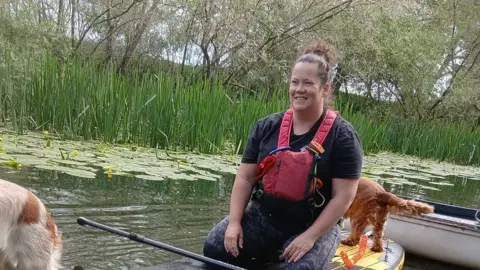
Nurse Amy Cipriano has said the waterways are "absolutely everything to her" after she took up paddleboarding when she was diagnosed with a rare spinal condition.
The hobby gave Amy her mobility back after she found out in 2021 she had cauda equina syndrome, caused by the severe compression of nerves in the lower spine.
Following her diagnosis, she could no longer lift weights and started paddleboarding. But she said within months she realised there were problems in the waterways in Leicestershire.
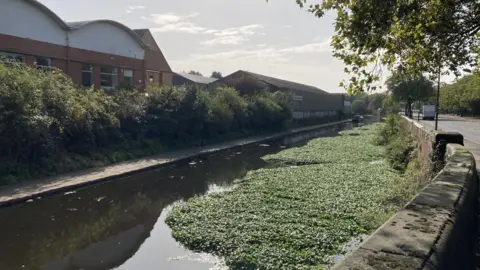
She told the BBC she spends her spare time clearing floating pennywort, which grows into "huge, dense mats and literally fills the waterway" and "something needed to be done about it".
Of paddleboarding, Amy said: "I've got my mobility back, I'm active, I'm exercising, it's massive for your mental health, and I get to instruct beginners to come out on the water and have a go.
"It's so special."
 Amy Cipriano
Her medical conditional was diagnosed after she was injured in an accident. She said it was "traumatising" and her "life changed forever".
"I didn't really know who I was. I didn't know what my identity was," she added.
She told the BBC she went to Leicester Outdoor Pursuit Centre, and gave paddleboarding a go, despite initially doubting whether she could do it.
"I've never looked back," she said.
The 44-year-old added that she was "very fortunate" that her spinal cord decompression surgery was successful.
Amy, from Birstall, said she underwent further surgery in March 2025, and now uses a crutch full-time.
"What it means is when I'm on the water, I'm standing with no mobility aids - I'm moving with no mobility aids," she said.
"I'm safe - I can't crash into people when I walk round corners.
"And it's so freeing, it's just a wonderful feeling."
 The Canal and River Trust
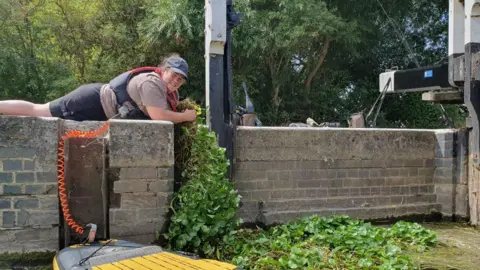
Amy said that, in the last three years, herself and other volunteers have pulled out more than 100 tonnes of floating pennywort from the River Soar in Leicestershire.
She has dedicated all of her spare time to ridding the waterways of invasive species, and educating people about the different plants.
The Canal and River Trust said the weed - which was introduced into the UK in the 1980s as a plant for garden ponds - could grow up to 20cm (8in) a day and was able to double its weight in as little as three days.
Hannah Booth, environment manager for the south at the Canal and River Trust, previously said the invasive weed species was "one of the biggest issues" for waterways across the country.
The trust said floating pennywort's "excessive coverage" across the surface of water could impede flow, causing oxygen depletion for fish and other wildlife.
It added that since 2014, it has been banned for sale in the UK.
 Amy Cipriano
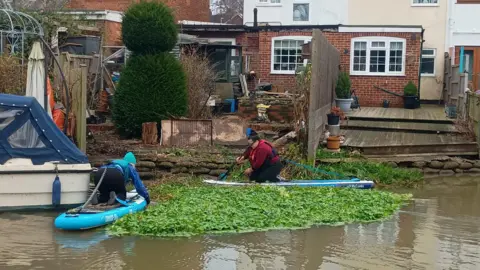
When asked how the floating pennywort was removed, Amy said "hard work", and "lots of hand pulling".
"We start by cutting the mats, because the mats are huge and dense, so we cut the mats, the people on the water float the mats across to those volunteers on land, and we literally drag the pennywort out of the water.
"It's heavy, it's 90% water, and we're moving tonnes and tonnes of the stuff at a time," she said.
She added that some of the floating pennywort was mechanically removed but funds for it were "limited, and it's just not enough", and the small bits left behind were pulled out by hand.
Additional reporting by Jake Garner
Listen to BBC Radio Leicester on Sounds and follow BBC Leicester on Facebook, on X, or on Instagram. Send your story ideas to eastmidsnews@bbc.co.uk or via WhatsApp on 0808 100 2210.
