What do children need to know when calling 999?

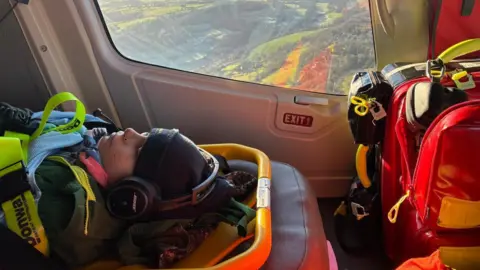 Family picture
As the school summer holidays begin, parents are being urged to make sure their children know what to do in an emergency.
Pilot Simon Gough, from Wiltshire and Bath Air Ambulance, said it is "critical" to know where someone is so that the emergency services can get to them quickly.
He said it was especially important if children were outdoors on their own during the summer holidays, and pointed to the example of one 15-year-old who had managed to get a helicopter to his injured friend by using the what3words app, which allocates every location three unique words to guide people to it.
Research commissioned by the app showed three in 10 children do not know the number for the emergency services and more than a third cannot reliably recite their home address.
What is what3words?
Gough said the emergency services are advising families to talk to their children about what to do in a medical crisis, particularly as more of them take part in outdoor activities over the summer holidays.
He said children should be taught what to say on the phone, what number to dial and to practise in case they have to make the call.
"Understand the what3words," he added. "Make sure you know the three words that signify your house, your front door or the holiday address you're at."
What3words is an app also available on mobile web browsers that has become recommended by emergency services.
It splits the world up into small grids identifiable by three words, which can help locate people more precisely. It can be given to a 999 operator for crews.
Gough explained that having the exact position makes it easier to find someone, especially in rural areas like the one he covers.
"It's critical, especially where time is concerned."
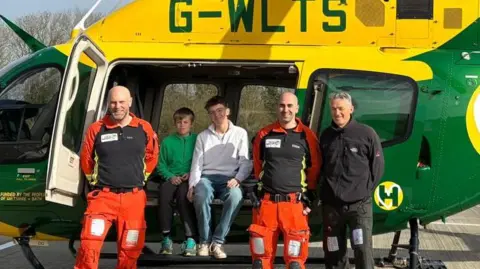 Family photo
'I knew what to do'
Gough said the incident in which a teenager "stayed really calm" during an emergency happened earlier this year.
Henry, 15, from Wiltshire, had learned what to do in emergency situations in the scouts, so when his friend, Dom, 12, was injured in a mountain biking fall, he knew how to react.
"I just thought it was a normal crash. I went to check he was OK, but he was unconscious," Henry said.
Dom explained they were in woodland in January, looking for new jumps to do when he "was going too fast, lost control, flew over my handlebars and hit my head on the ground, the bike landed on top of me".
"All I can remember is I was really cold, it felt like I was dreaming."
Henry went to call 999, but had no signal, so enlisted the help of dog walkers.
They put Dom into the recovery position, gave him extra layers and were able to make the call.
Henry was able to give the emergency services their exact position through what3words.
"It was a bit scary but I knew what to do, I learned it at scouts. On expeditions or anything really, there could be an accident anytime and I had what3words in my phone for that."
The air ambulance helicopter landed four minutes after the call, just two minutes away from the group.
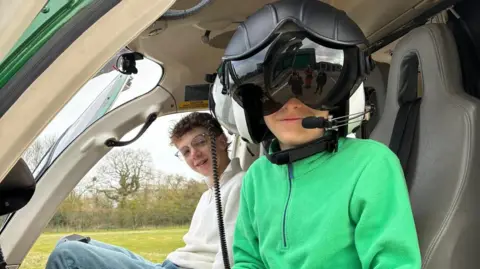 Family photo
What happens when you dial 999?
Call handlers will ask people who call 999 a series of questions when they pick up the phone.
To begin, they will ask which emergency service you require - police, fire or ambulance.
The handler will transfer the call to the most appropriate service and then the caller will be asked a series of questions so they can work out how best to help.
People who make the call are encouraged to be as specific as they can, even if they don't know all the details. What has happened, who is involved and where the injured person is are the most important elements.
Follow BBC Wiltshire on Facebook, X and Instagram. Send your story ideas to us on email or via WhatsApp on 0800 313 4630.
