Ministers approve £100 oil payment for lower income households

 Getty Images
Stormont ministers have approved extra money to widen a support package for households which use home heating oil.
The executive has pledged £19.2m to go along with the £17m already set aside for the scheme from the UK government.
That will see up to 340,000 households receiving a £100 payment to go towards their heating oil bills.
It will apply to households with a combined income of £30,000 or less or those on certain benefits including pension credit.
The payment will come in the form of a pre-paid voucher, with people asked to apply online according to Communities Minister Gordon Lyons, whose department will take the lead in distributing the payments.
Lyons said he could not yet provide a timeframe for the scheme but said legislation would need to be passed, as well as eligibility checks taking place before households can receive the money.
It is unclear where the extra money will be found as all the Stormont departments are struggling under financial pressures.
Lyons said it was "targeted support" that would protect those who need it most, and that he recognised the length of time it had taken to produce the scheme, but that he wanted to get it right.
However, the minister said it was a short-term measure and that "more would need to be done" by the government.
First Minister Michelle O'Neill said the executive had made the decision while talks around agreeing a multi-year budget continued.
She said all ministers had painted a picture at Thursday's meeting of a "budget at breaking point", and that the executive now wanted to meet Prime Minister Sir Keir Starmer to make its case.
Deputy First Minister Emma Little-Pengelly said the executive saw and heard the message about pressures that businesses and households are facing.
She said the UK government had the tools and the financial firepower to help people in Northern Ireland, adding: "This is the moment to use both.
"This cannot wait… people cannot wait, we need a comprehensive package of support and we need it now."
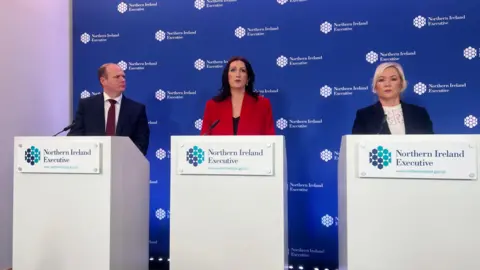
The issue of fuel costs was discussed at the executive in the context of ongoing talks at the executive about a multi-year budget.
Ministers have repeatedly said they need additional resources from Westminster in order to balance their departmental budgets.
The government has provided the executive with additional funding worth £380m for public services over the next three years and has previously said that ministers must make "difficult" choices.
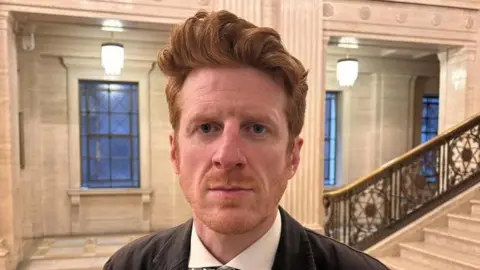
SDLP leader of the Opposition at Stormont Matthew O'Toole said the executive "cannot blame" the government for their "failure to agree a multi-year budget".
"It's crystal clear to everyone that the real reason is infighting between the executive parties.
"They were snubbed by the secretary of state after extending a bizarre invite for him to attend today's meeting in an attempt for political cover," he said.
O'Toole welcomed the £100 support but said it was clear more support was needed and the executive "cannot simply shift all the blame to London".
How close is the executive to agreeing a budget?
Discussions have been taking place since January in a bid to approve a budget for the next three financial years.
A multi-year budget would allow Stormont departments to plan longer-term spending and the executive has not agreed one for more than a decade.
But there are particularly acute pressures in the departments of health, education and justice that have made reaching agreement on it difficult.
A Stormont source said the executive was "stretched to breaking point" and that the current funding allocation was not enough over the next three years.
The executive is also exploring the option of agreeing a budget for 2026-27, but in the event that is the outcome, ministers would face returning to discussions before the end of the year to set a budget for 2027-28.
The timing of the next assembly election in May 2027 could complicate negotiations on a budget for that year.
Asked how close the executive was to agreeing a budget, the first minister said it was "still a work in progress", but that she was not giving up hope on a multi-year plan.
O'Néill added that she disputed the suggestion that the executive was seeking "special treatment", and that it was about ensuring fairness for people in Northern Ireland.
The deputy first minister said she was "not a fan of begging bowl politics", but that in this case, the government was not delivering in the way that it should.
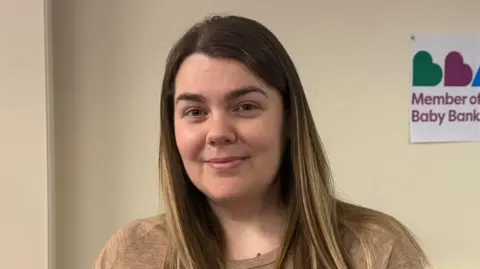
Elise McKenna said the £100 support would "make a huge difference" to some families.
"Sometimes it can be quite difficult because everything's so expensive all the time. But I suppose we all just do our best with what we have."
She said the extra help would allow her to get more of her "everyday essentials", but that "they could do a wee bit more to help with different things to help with fuel, shopping, even school".
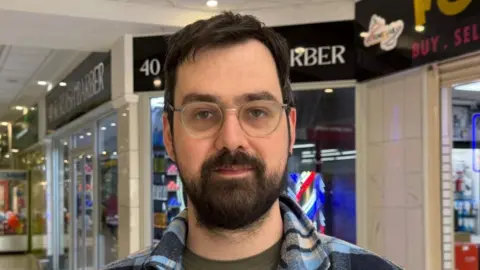
Andy Blair said the cost of living for everyone is "quite high at the minute" and that any help would be useful.
"A hundred pounds would probably go pretty quick, but more than anything you can't address the cost of living with a one-off payment, it's about more long-term support at an institutional level than giving people cash," he said.
What is the government's view?
The UK government has repeatedly said the funding on offer to the executive is a "record settlement" from Westminster.
All the executive parties maintain that the allocation does not go far enough.
Stormont's finance minister has been making the case to the Treasury to restore the "stabilisation fund" - additional one-off funding which accompanied the restoration of devolution in 2024, which has now ended.
Northern Ireland Secretary Hilary Benn also continued to raise the prospect of Stormont carrying out its own methods of revenue raising, in order to help shore up public services.
In a statement issued during the executive press conference he announced the expansion of the British Industrial Competitiveness Scheme to Northern Ireland.
Asked to comment on news of the additional funding from the UK, Finance Minister John O'Dowd said he had been in the executive all morning but would examine the detail.
Asked if it was proof the government had listened to the executive's pleas, he said that it was not clear "how much they had listened or who they had listened to", and that it will take time to work through the information.
