Community figures back ban on face coverings

 Getty Images
Some West Midlands community figures have welcomed a ban on face coverings in Nottingham city centre and say it should also apply in their area.
From Tuesday, police and community protection officers in the city can ask people to remove coverings if they "reasonably believe" they are being used to conceal their identity to commit crime or anti-social behaviour.
Enforcement will not apply to face coverings worn for legitimate reasons, including religious, cultural, health, work or personal safety.
Dan Baker, from Lichfield, founded a group against bike theft and said he hoped the new Nottingham measure, following similar plans in Stafford, "works its way up and down the country".
Baker stated that after his 13-year-old son was a victim of bike theft when he lost his "prize possession... I just thought 'that's it, we need to step up and stand up [to it]'".
The group, Bikers Against Bike Theft and Balaclavas, stands against bike thieves and balaclava gangs and supports victims.
Baker pointed out that after three or four months it had got "over 25,000 followers now across socal media, so you can see how much it's affecting the whole community, not just the bikers".
If people do not co-operate in Nottingham, they could be issued with a £70 on-the-spot fine or face prosecution with a maximum penalty of £1,000.
The city council there said residents had felt intimidated when they saw people wearing balaclavas, skeleton masks or other face coverings without a legitimate reason.
Asked if he would like to see the ban in place in the West Midlands, Baker replied "definitely".
"I'm a biker myself, so there are legitimate reasons to wear a balaclava under a helmet, but there's a huge difference between that and somebody in an illegal stolen bike or causing anti-social behaviour.
"We've just had one of the hottest summers out and the amount of people wearing balaclavas it's ridiculous."
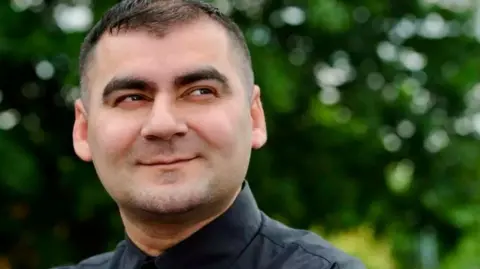 Mohammed Zafran
Mohammed Zafran, CEO of Midlands Community Hub in Bordesley Green, Birmingham, backed the idea, saying if "there is a problem... they should be able to go up to them".
"No-one should be living in fear... you need to make sure everyone's safe," he stated.
The hub, which provides a safe space if people feel threatened, had steered people away from crime and back into education, Zafran said.
At the community interest company's hub, it had had "loads of youngsters come in with balaclavas", he revealed.
'Youth crime ridiculous'
Zafran said activities there included drug awareness and knife crime workshops and youngsters were referred by police and schools who thought they were on "the borderline of getting into crime".
But the hub needed to know their identity, he stressed.
"'If you come in, that's fine, but you can't come in covering your face... We can't have you intimidating other people'.
"Youth crime is ridiculous... Youngsters [have been] stabbing each other and you see the footage and they've got balaclavas on."
Zafran, who is also chair of the West Midlands Crimestoppers volunteer committee, said the measure should be introduced in Birmingham.
He added: "If anyone [is suspected to be] up to no good, by all means. You should be able to question [them]."
Zafran welcomed the approach in Nottingham in which the enforcement will not apply to face coverings worn for legitimate reasons, including religious and cultural.
"You don't want to rattle communities," he said.
More than 90% supported the measure in a consultation, according to the Nottingham council.
Political economist from Birmingham, Prof Steve McCabe said "city centres, town centres, they're becoming, it appears, increasingly hostile places [in] a number of ways".
Shopkeepers had a number of problems, he added, so if you "do something that makes high streets places where people want to go and congregate and to shop, then of course that's good economically".
Follow BBC Birmingham on BBC Sounds, Facebook, X and Instagram.
