Britons on hantavirus cruise ship face 45 days of self-isolation

 Facebook
British passengers on a cruise ship with a confirmed outbreak of hantavirus will likely be asked to self-isolate for 45 days on returning to the country, a UK health official said.
TwoBritons are self-isolating at home in the UK after potential exposure, and a 56-year-old British man is in a stable condition in the Netherlands after being evacuated from the ship on Wednesday.
Another British passenger, 69, was medically evacuated to South Africa where he remains in intensive care, and was said by officials to be "doing better".
Prof Robin May, UKHSA chief scientific officer, told the BBC that UK passengers would probably be asked to self-isolate at home, but that "depends on individual circumstances".
The MV Hondius is expected to dock in the Canary Islands at the weekend. Spain says officials are in advanced talks with the UK to send a repatriation flight for British nationals.
They include 19 current passengers and four crew members listed as British, according to Virginia Barcones, Head of Spain's Civil Protection and Emergencies.
Three people have died either on board or after travelling on the ship, which set sail from Argentina a month ago.
Officials have said that one of the three deceased is confirmed to have had the virus, while the other two deaths are under investigation.
Five cases were confirmed by the World Health Organization (WHO) on Thursday, and it said more may follow due to the virus's six-week incubation period. All five cases were people who were on the ship.
The WHO called it a "serious incident" but said the risk to the public was low, stressing the outbreak was not similar to the Covid-19 pandemic.
Contact tracing is under way in multiple countries for passengers who left the cruise ship before the outbreak was detected - including in the UK, Switzerland and the Netherlands.
Operator Oceanwide Expeditions said30 people from a dozen nations - including seven Britons - disembarked from the ship at St Helena in the south Atlantic on 24 April.
It said the first confirmed case of hantavirus was not reported until 4 May and that all guests who disembarked the ship have been contacted.
Four of the British passengers remained in St Helena, two were self-isolating in the UK after flying back via Johannesburg, and the seventh passenger had not yet been traced, the UKHSA said.
The two Britons self-isolating in the UK are doing so voluntarily and do not have symptoms. They contacted health officials when they heard of the ship's cases.
The UKHSA said contact tracing was ongoing for anyone who may have sat next to them on the flight home.
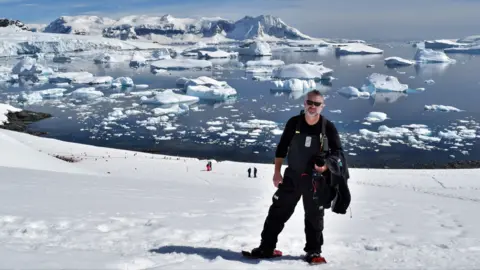
Meanwhile, 56-year-old Briton Martin Anstee, a retired police officer and an expedition guide on board the MV Hondius, is in a stable condition in a hospital in the Netherlands.
He is one of three people evacuated from the ship on Wednesday for treatment, Oceanwide Expeditions said.
He told the BBC he was "fine".His wife, Nicola, told the Daily Telegraph it had been "a very dramatic few days".
"He's relieved to be off the ship. He had it quite mild then it got a bit more serious and now he's stable again.
"The fear with this virus is it can deteriorate very quickly so it's been a bit up and down for him. I don't believe he's in imminent danger now but it was horrible."
The other two evacuees include a 41-year-old Dutch crew member and a 65-year-old German.
Oceanwide Expeditions said the German evacuee was "closely associated" with a German woman who died on board the ship on 2 May.
In addition to Anstee, another patient is also receiving hospital treatment in the Netherlands, while a 69-year-old British man is in a private health facility in Sandton, Johannesburg.
Dr Maria Van Kerkhove, from WHO, said: "I am very happy to say the patient in South Africa is doing better, and the two patients in the Netherlands we hear are stable. So that is actually very good news."
The origin of the outbreak is still unknown and it is not known if people other than cruise ship passengers have been infected with the disease.
WHO director-general Tedros Ghebreyesus told a news conference that the first two cases had "travelled through Argentina, Chile and Uruguay on a bird-watching trip which included visits to sites where the species of rat known to carry the virus was present."
One of the three deaths was a Dutch woman, 69, who left the MV Hondius when it stopped at St Helena on 24 April, and travelled to South Africa where she died two days later.
Her husband had previously died on board on 11 April, while a German woman also died on board. Neither are confirmed to have had the hantavirus.
Dutch authorities say they will contact passengers on a KLM flight from South Africa to the Netherlands which was briefly boarded by the Dutch woman who later died.
A woman with possible symptoms of the virus has been taken into hospital in Amsterdam - it is reported she was a KLM stewardess and said to have been in contact with the woman who died.
The WHO has also confirmed a man who had travelled back to Switzerland after disembarking the ship tested positive and is receiving care at a hospital in Zurich.
Singapore authorities are isolating and testing two people who were on the cruise ship, and who also were on board the same 25 April flight from St Helena to Johannesburg as someone who later died.
Meanwhile, two US states - Georgia and Arizona - have confirmed to the BBC that they are monitoring three passengers who had returned to the US after disembarking. All are currently not displaying symptoms.
The US Department of State said it is in "direct contact" with affected passengers.
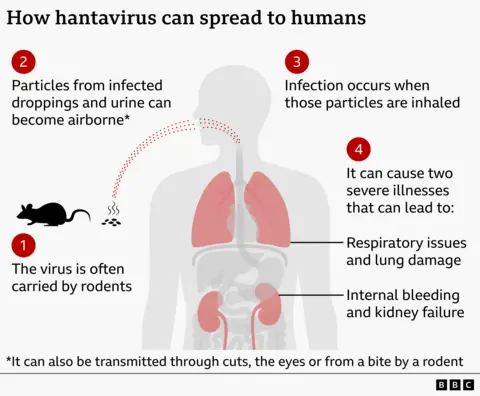
Hantavirus typically spreads from rodents, but health experts believe that in this case, it may have passed between humans that were in close contact.
The Andes strain of the virus has been confirmed in two of the ship's passengers, according to South Africa's health minister, and experts have observed the strain spreading between human patients in previous outbreaks, although very rarely.
About 150 people from 23 different countries are still on board the cruise ship under "strict precautionary measures", Oceanwide Expeditions has said.
In an update on Thursday, it said "no symptomatic individuals are present on board."
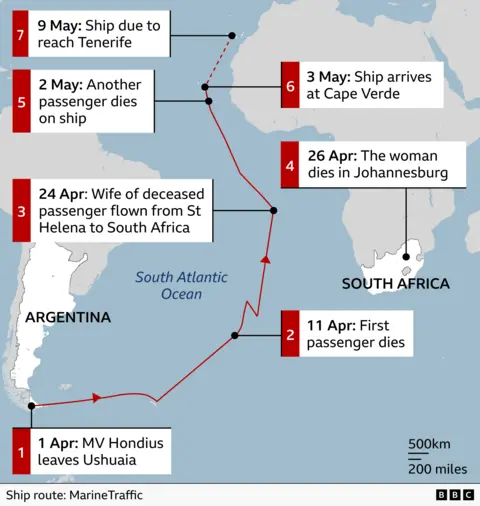
Spanish authorities have given permission for the ship to dock in the Canary Islands, despite concerns from local officials.
All passengers will be evacuated at Granadilla port in Tenerife, Spain's health minister Monica Garcia said on Wednesday.
Everyone on board will undergo a medical assessment when they arrive and, if fit to travel, those from abroad will be repatriated to their home countries, she said. None are currently showing symptoms.
Foreign Secretary Yvette Cooper said the situation was "very serious and deeply stressful for those affected and their families". Consular staff were in contact with British nationals onboard the ship, she added.
The Foreign Office said it was "working urgently" to get British nationals stuck on board the MV Hondius home safely.
Additional reporting by Alex Kleiderman and Ella Kipling.
Are you on the ship or do you know someone who is? If you feel able to do so, please get in touch by using this link or the form below.

