More advice needed for working in heat, workers say

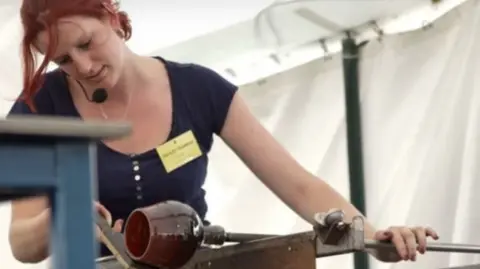 Darren Weed and Hayley Gammon
More advice should be given to those working in hot conditions during the heatwave, according to workers across the Midlands.
With a red weather warning for extreme heat in place until 23:59 GMT on Thursday, the Met Office has advised that substantial changes in working practices and daily routines will be required.
Bradley Smith, who lays concrete driveways in Wolverhampton and Shropshire, says the government should do more to tell workers about the dangers.
Advice would be even more welcome for Hayley Gammon and Darren Weed, both glassblowers who already face 1000C temperatures from their furnace. The government though says no UK law covers maximum and minimum working temperatures.
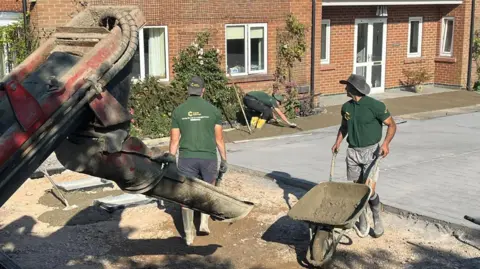 Bradley Smith
"I just wish there was a bit more guidance from the government to give us a bit more support and guidance on what we should and shouldn't do," Smith told BBC Radio WM.
"It's been hard work. We made the call not to go in on Thursday or Friday. It's far too hot and we don't think it's safe really.
"Most of our jobs involve working concrete, so lots of issues can stem from pouring concrete in this weather.
"It can cause plastic shrinking, thermal cracking and reducing long term strength. There are a lot of issues with the heat that some people don't realise."
Gammon and Weed are glass blowers working in the West Midlands and Kidderminster and are used to working in hot conditions, but not in a heatwave.
Weed said: "Furnaces that are set to 1000 degrees all day, so it can be quite an intimating space to be working in."
Gammon added: "You need to stand by the furnace every couple of minutes, [because] you're collecting glass, you're re-heating it, so you're surrounded by that heat constantly.
"On the hottest days, it's just not feasible, it's just not safe."
'Heat events more often'
We are going to have to get used to coping with higher temperatures as a result of climate change, according to BBC West Midlands environment correspondent David Gregory-Kumar.
He said when he started in his role, heatwaves were the sort of thing we could expect with climate change, though we could not be sure it was the definite cause.
"Twenty-five years later, the science is very different," he explained. "Not only can we say climate change is making this heatwave worse, scientists can say by how much."
He said studies from scientists at Climameter, a consortium of researchers that puts weather events in a climate change context, found it was making current weather patterns 2C to 4C warmer than what was typical in the 20th Century.
Gregory-Kumar said they found this out by searching records for previous similar weather events and comparing them to what was happening now.
"One worry is heat events like this week seem to be happening more often than models predicted," he added.
"It raises the prospect of the impact of climate change on us when it comes to intense heat being worse than we thought."
Government advice
Government advice on hot weather working includes:
- A minimum of 16ºC, or 13ºC if employees are doing physical work
- There's no guidance for a maximum temperature limit
It adds employers must stick to health and safety at work law, including:
- Keeping the temperature at a comfortable level
- Providing clean and fresh air
Employees should talk to their employer if the workplace temperature is not comfortable.
Follow BBC Wolverhampton & Black Country on BBC Sounds, Facebook, X and Instagram.
