Luton women share impact of 'bussing out' policy

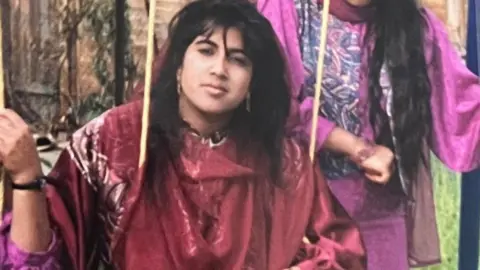 Rahena Begum
Between 1965 and 1970, children from immigrant families were moved around to neighbouring schools, often miles from home.
"Bussing out", a government policy known formally as the Education of Immigrant Circular 7/65, impacted children across 11 local area authorities - including Luton.
Schools were banned from containing more than 30% of children from minority backgrounds. Once that quota was reached, children were taken elsewhere.
Fifty-two year old Rahena Begum, who is from Luton, remembers being "bussed out" at the age of six.
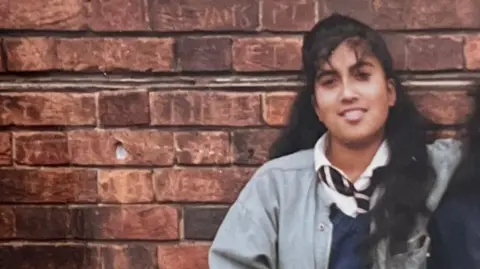 Rahena Begum
Rahina was regularly taken from Hillborough Junior School in Luton to a school in a neighbouring town with her nine-year-old brother.
"They used to put all the children from a different country in one classroom," she said.
"We didn't know English and I was very quiet then. I was scared and anxious. I didn't know what was happening."
Rahina's family immigrated from Bangladesh to the UK in 1978 when she was five years old.
As a child she lived in the Bury Park area of Luton, which has a notable South Asian demographic.
At the time, she recalls her parents not understanding why she had to be taken to a different school when there were schools local to them.
She said there was "no mixing" with white children at her school.
"The teachers did not make an effort for the white children to come and play with us.," she remembers.
"I did not understand why they wouldn't. We were all children."
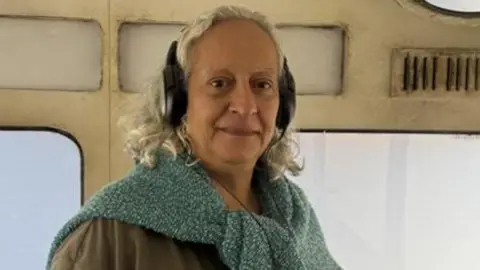 Khadijah Hasan
The "bussing out" policy was scrapped in the late 1970s, after it was found to be racially discriminatory.
The impact of the policy was explored in an audiovisual exhibition by creative director Dr Shabina Aslam, who was inspired by her own experiences of the policy in Bradford.
"I'd arrived in this country from Kenya," she says.
"It was bizarre - we had to get up early in the dark and wait with other brown children for a bus to come.
"We were always late and had to leave early. No one would speak to us."
The exhibition in Luton featured the interior of a bus - to replicate the journey of the schoolchildren.
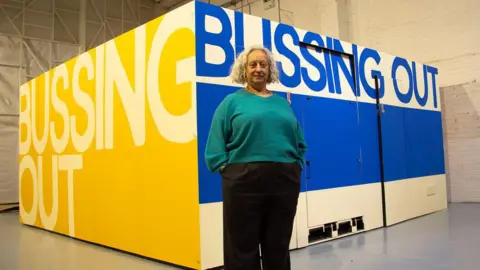 Dr Shabina Aslam
Luton-based creative group Revoluton Arts facilitated the exhibition. Maya Pinder, 31, their senior producer, said it had "connected communities".
"People passing by have come up to us and shared their own experiences, when they didn't have a space to do so before," she added.
Councillor Maria Lovell MBE, portfolio holder for women, equalities, and community safety said: "We acknowledge the direct role Luton Council played in implementing the bussing out policy during the 1960s and 1970s.
"This discriminatory practice separated Black and South Asian children from their local schools, their communities and their sense of belonging, causing harm that has been felt across generations.
"We welcome the Bussing Out exhibition to Luton and recommit ourselves to confronting the legacy of historic and systemic racism in our town."
The "bussing out" policy was adopted by Blackburn, Bristol, Halifax, Hounslow, Huddersfield, Leicester, Luton, Walsall and West Bromwich.
Do you have a story suggestion for Beds, Herts or Bucks? Contact us below.
Follow Beds, Herts and Bucks news on BBC Sounds, Facebook, Instagram and X.
