The people driven into debt - and court - over council home care

 BBC
BBCMore than 2,000 people across England have faced legal action from their local council after the cost of care visits drove them into debt, a BBC North West investigation has found.
Some councils have seen the cost of providing home care - such as helping people get up, bathe and eat - rise by about 50% in the last three years, and the costs to some disabled people have increased dramatically.
Ahsan Razzaq, from Oldham, saw his home care fees go up from about £42 a month to more than £500 and, unable to pay, was issued a court judgment ordering him to hand over more than £15,000.
Oldham Council said it only took legal action where other efforts to recoup arrears had failed.
The latest available figures for the number of people falling into debt for home care fees showed about 60,000 had fallen behind with their payments in 2022.
And the number of legal actions – or threats of action – per year could now have doubled, current figures obtained by the BBC suggest.
People who have fallen behind with their payments can face court action, liability for paying the council's costs, and visits from bailiffs looking to seize goods to pay.
Disability campaigners said there was a crisis in home care funding.
The Local Government Association (LGA), the body representing local councils across England, said: "The adult social care system remains in desperate need of sustainable funding and reform."
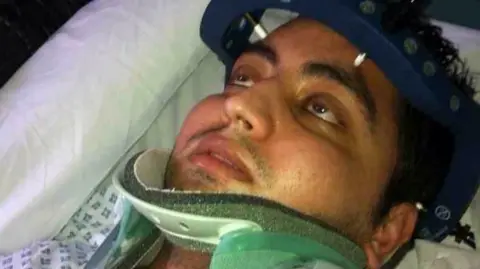
Ahsan, 36, said the debt was affecting his health and that it sometimes made him not want to live anymore.

Ahsan was severely injured in a car crash in 2013. He was left with little use of his body and uses a wheelchair. He requires multiple care visits a week.
His care fees increased from £42.92 to £542.52 a month in 2023.
But he said he did not know why. His solicitor is now trying to get the judgment set aside, and said he had not been provided with any justification for the increase either.
Ahsan said living with the debt made him fear he would have to give up the few things that helped him connect with the outside world – including his specially adapted mobility vehicle.
He said: "My mobile phone, car, these are things that I can feel joy with, can feel part of the family with, part of the world. Otherwise, there is nothing.
"I'm just like a dead body in this world."
The BBC has previously reported other cases of people who have seen their care fees rise roughly in line with the increase Ahsan has experienced.
In those cases, local authorities have said the increased charges reflected changes in the financial circumstances of the people receiving the care.
But Ahsan's family said they were at a loss as to why his care costs had risen, saying neither his financial situation nor his health had improved.
His sister Sadaf said: "We don't know why it is this amount now. They said it was because of a change in his circumstances, but he has not got better and will never get better. If anything, he is getting worse. He is in and out of hospital.
"If he had to pay that much, he would not have enough left to live on, to pay his food bills or cover his other needs."
Under the Care Act 2014, local authorities can increase the basic cost of their care fees to reflect increased costs and pressures.
They are required to conduct a financial assessment that makes sure the person receiving the care is not left without a minimum income of about £183 a week for a single person up to pension age.
Oldham Council has not said whether the increase in Ahsan's case was in line with its general increase in fees or due to a change in his circumstances.
But the BBC has found Oldham Council is one of the local authorities that has seen the highest cost pressures on its home care spending – going up by about 51% in the last three years.
It expects to spend about £51m on the service this year, against an income from clients of just over £8m.
It has not confirmed how many people it has taken to court over unpaid fees.

The BBC found that 45 of 58 councils who responded to a Freedom of Information request have taken legal action against people who have run up debt for home care visits since 2023 – a total of 2,163 cases.
The number of cases range from one to up to 345 per local authority.
There have been about 400 cases of legal action against home care customers in the North West since 2022.
Campaigners said Ahsan's plight showed the "noble aspirations" of the Care Act to help people with disabilities live a full life were at odds with the reality of how little money local authorities had to pay for it.
Rick Burgess, from the Greater Manchester Coalition of Disabled People, said research suggested thousands of people were in arrears to their councils.
But the BBC has learned there have been at least 500 cases over the last three years where councils have started legal action over the debts.
He said: "The levels of debt that exist around the country… people are living with it every day. It's very stressful for people.
"Overall, the system is not resourced to be doing the job it should be doing and also legally has to be doing."
The LGA said: "Care providers are under increasing pressure from rising costs, inflation and changes to employer national insurance contributions.
"Councils, as commissioners of social care, work closely with providers to ensure the best possible provision of services for local people, but until the sector is adequately funded, the consequences of a lack of resources and a system that is under strain will remain."
In the North West, 19 councils responded to the BBC's enquiries.
The council that had taken the greatest number of court proceedings out was Cheshire West and Chester, with 110 cases.
It said legal action was a "last resort", where "debt remains unpaid and attempts to reach an agreement have been unsuccessful", adding: "Cases where legal action is required represent a very small proportion of the total number of people receiving adult social care services."
Blackpool Council had the next highest number of cases, with 83.
It said: "We take every reasonable step to help individuals and families understand their charges and to agree manageable arrangements.
"Legal action is only considered when all other avenues of engagement and support have been exhausted and is taken to ensure the proper protection of public funds."
The highest number of commenced legal actions, and actions pending, was at Somerset Council.
It also said legal action was a "last resort" where "there is no reasonable alternative".
'Worthless judgments'
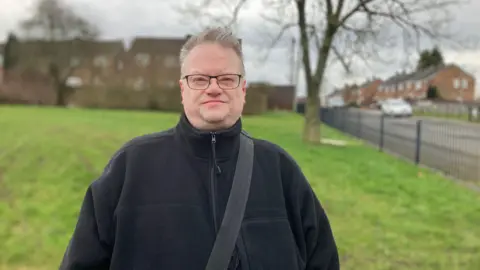
Ahsan's solicitor Ali Alshafei said it was of concern how many councils had secured default judgments against the people they cared for.
A default judgment is one in which a judge makes a ruling without a trial, for example in cases where the defendant has not provided any response.
The highest number of default judgments was secured by Cheshire West and Chester, with 58. Blackpool Council secured 39.
Oldham Council secured a default judgment against Ahsan, onto whose debt legal fees have now been added.
Alshafei said: "If people can just about afford to live then they do not have the money to pay legal expenses.
"These orders are councils seeking to be allowed to send to bailiffs to go round to the properties of vulnerable people and seize assets. It's atrocious.
"If people have no assets then these judgments are worthless because they have nothing to enforce them against. You are just taking them through an exercise of further suffering."
Of the North West councils that responded to the BBC, default judgments were made in 184 cases.
'Downward spiral'
The Care Act of 2014 was intended to revolutionise the way social care was provided.
The government described it as a way of "improving people's independence and wellbeing".
Disability campaigner Burgess said: "Local authority funding has been massively cut. There have been some slight increases but they've not replaced what was cut. So it's just been a downward spiral of underfunding.
"They're not able, anymore, to meet what the Care Act wanted to be."
Ahsan said it had been suggested to him that if he were to give up his specially-adapted mobility vehicle, he could use the estimated £200 a month fuel costs towards paying off his debts.
But his family said his particular needs meant he could not travel on a bus or by taxi.
His brother said Ahsan's quality of life would be hugely diminished.
"He will be stuck at home most of the time. He will definitely miss out on family events if we go out somewhere."
Ahsan said he feared that "if needed, they would take all the money away", adding: "I said, 'Just kill me. I don't want to live this life. Just kill me, take all the money from me. I don't want to live this life'."

The BBC asked Oldham Council about Ahsan's case, and put to it his family's claims, including that they did not know why his care funding had changed.
The council said: "We understand that issues around care charges can be worrying and stressful for people and their families, and we approach these situations with care and sensitivity.
"Councils are required by law to assess whether someone should contribute towards the cost of their care. Any charges are based on national rules and are only applied following a financial assessment to make sure they are fair and affordable.
"Where contributions are not paid and arrears begin to build up, the council's approach is always to try to resolve the situation through discussion and by agreeing a repayment plan that reflects a person's circumstances. Escalation would only ever be considered if those efforts are unsuccessful.
"We would always encourage anyone in this situation to engage with us so we can work together to find a solution that takes their circumstances into account."
A spokesman for the Department of Health and Social Care said: "Our thoughts go out to people impacted by the cost of care. Local authorities have a duty to support people with their care needs, should only charge people as much as they can afford - and must leave people with enough money pay for daily essentials and any disability-related costs.
"This government has made available a funding boost of £4.6bn for local authorities to pay for social care before the end of this Parliament and has recently announced a record 7% uplift to the Minimum Income Guarantee, so around 150,000 working age adults requiring care keep £400 more each year after charging."
Listen to the best of BBC Radio Manchester on Sounds and follow BBC Manchester on Facebook, X, and Instagram. You can also send story ideas via Whatsapp to 0808 100 2230.
