Exhibition revisits Bradford's 1904 Somali Village

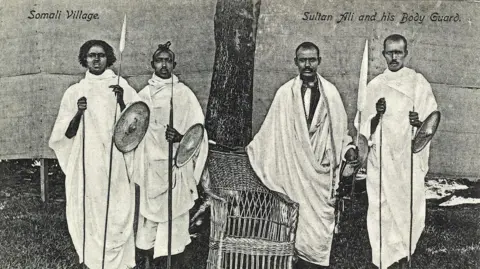 Somali Village/Yahya Birt
The story of how a Somali village became the centre of a major exhibition in Bradford in 1904 is being told just feet away from where it was originally located.
The village saw 57 Muslim men, women and children transplanted from Somaliland to Lister Park for six months in 1904 and attracted tens of thousands of visitors.
Part of the 1904 Bradford Exhibition, most of the profits from the Somali Village were used to develop the art collection at Cartwright Hall in Lister Park.
The Weaving Together Industry, Culture and Empire exhibit, which runs at Cartwright Hall from 9 May, features archaeological finds as well as contemporary postcards, photographs and film from the village and exhibition.
Curators Yahya Birt and Abira Hussein said these types of touring groups were popular across Europe and America in the Victorian and Edwardian periods.
Birt said: "Something like 39,000 racialised and colonised people were put on display from Asia and Africa, even some from Europe."
The 1904 Bradford Exhibition, which attracted 2.4 million paying visitors, was "huge", according to Birt.
"There were two tickets. You bought a ticket to go into the exhibition, but then you bought a separate ticket to go into the Somali Village, which was also in a walled compound.
"More people than lived in Bradford paid a ticket to go into the Somali Village, so there must have been either repeat visits or people who came from outside as well."
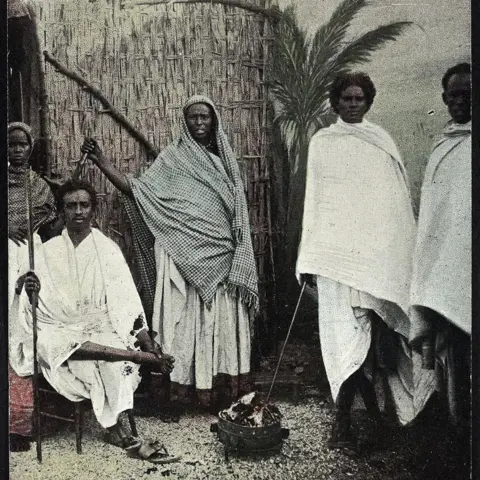 Somali Village/Yahya Birt
Alongside seeing village life, visitors to the exhibit could also see performances and battle recreations.
"It was very high profile. It wasn't something that was obscure and this wasn't the only kind of show," Birt explained.
"There was a show three years early in 1901, which re-enacted the Boer War at Manningham Fields, which became Bradford City FC Stadium later on.
"It was a full-on war re-enactment between the Zulus, the Boers and the British."
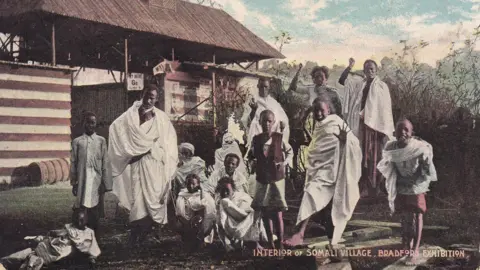 Somali Village/Yahya Birt
Hussein said the current exhibition, which runs until 1 November, features some objects which have "never been on display before in Europe".
"It's kind of groundbreaking, in a sense, in the space and the opportunity that we had to tell this story, but also in terms of the narratives and the materials we're able to show and bring together," she added.
Hussein said the current exhibition was the first time a display of this size and duration had ever been held in the UK.
"It is a combination of Bradford history and colonial history, but also Somali history and diasporic history now," she said.
