A son overlooked and a jailed tycoon: Inside Samsung's succession drama

 Bloomberg via Getty Images
When power shifts at the top of some of the world's biggest companies, most people don't notice.
If products perform, services work and store shelves are full, then who sits in the boardroom doesn't make headlines. But when it comes to Samsung, the family dynasty behind it is so complicated – and the company so crucial to the South Korean economy – that it's front-page news.
And so it was in 2017 when the Samsung heir-in-waiting, Lee Jae-yong - who is also known as JY Lee - was jailed for his part in a corruption scandal that also brought down the country's president.
The 57-year-old is the grandson of Samsung's founder. Geoffrey Cain, author of the book Samsung Rising, described him as "one of the most powerful people in the history of technology".
But in 2015, with his father – Samsung's chairman – in hospital following a heart attack, Lee's succession was not secure.
He'd been accused of giving money to foundations run by Choi Soon-sil – a close friend and confidant of South Korea's former President Park Geun-hye – in return for political support for a merger that would strengthen his grip on the conglomerate.
 Bloomberg via Getty Images
He was also accused of using stock and accounting fraud in that merger – between one Samsung subsidiary, Samsung C&T, and another part of the business empire, Cheil Industries.
Prosecutors said he did that so he could take control of the biggest possible chunk of the newly merged entity and, by extension, assume control of Samsung Electronics: the jewel in the empire's crown, and a key source of power and control.
Lee Jae-yong has always denied the fraud charges, but was found guilty of bribery in 2017.
When the huge corruption scandal broke in 2016 it sparked weeks of protests by millions of people on the streets of Seoul, and eventually led to the country's president being impeached.
Why was this deal so crucial?
Since Samsung was founded as a grocery store in the late 1930s it's been in the hands of the Lee family. According to Geoffrey Cain, the family is the "equivalent of royalty" in South Korea. They grew the business into a true global power, taking in insurance, memory chips and construction, along with the consumer tech that's so familiar.
But to stay in family hands, the conglomerate has had to go through a series of complex mergers, acquisitions and power transfers. It's this manoeuvring that put Lee Jae-yong in jail.
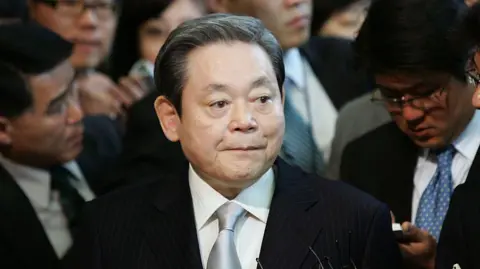
He'd been in de-facto charge since 2014 when his father, and then Samsung chairman, had a heart attack. His father had grown the company from a successful South Korean business to a global conglomerate. In preparation for taking over, Lee Jae-yong had been through a series of top roles.
 Getty Images
But when he became acting chairman, he faced a difficult situation: the tricky processes to ensure total family control over Samsung weren't quite finished.
By this point the business empire had become incredibly complicated: it comprised dozens of companies, from Samsung Electronics to retail; construction to chemicals. They were all linked together in an intricate spider's web of cross-shareholdings.
The other problem was that the family faced an enormous inheritance tax bill of more than $10bn (£7.4bn). But if they started selling off their shares in the companies to pay it off, the Lee family might risk losing control.
The risk of succession
As the only son, Lee Jae-yong was chosen to lead Samsung when his father died. But despite being groomed for three decades to take over, for some, he just wasn't a convincing choice to steward South Korea's biggest company, and the economic hopes of a nation.
According to Jaeyeon Lee, a reporter at South Korean newspaper Hankyoreh, "he was just really different... While his father was seen as very aggressive and just very goal-oriented. [Lee Jae-yong] was seen as more shy and quiet and cautious."
Some say his sister was more capable, and he was criticised for not being ruthless enough. Questions were also raised about his abilities when his pet project e-Samsung collapsed in the dotcom bust.
The family had already been scarred by one succession that didn't go smoothly a generation before, when Lee Jae-yong's dad - the youngest son - was picked to lead the company ahead of his two older brothers.
There's a dispute over what happened with the eldest son, Lee Jae-yong's uncle, Lee Maeng-hee, who traditionally should have inherited. According to one version of events, when he was given a chance to run the company, he was found wanting. He says he ran the company for seven years. But whatever the truth, it was the youngest son - Lee Kun-hee - who was named as the heir in 1976. It would be a decision that would ripple down the decades.
The empty chair
After an uncertain start, Lee Kun-hee oversaw a period of success for the Samsung group during the 80s and 90s. But there were more challenges to come. In 2008, both Lee Jae-yong and his father resigned after a former Samsung lawyer turned whistle-blower claimed knowledge of a slush fund that was being used for bribes and political payoffs.
As Jaeyeon Lee from the Hankyoreh newspaper describes, "[the lawyer] said he just couldn't stomach the corruption anymore. According to him, Samsung was like so rotten that it made his job unbearable."
 AFP via Getty Images
It led to questions about what would happen to the company – and to South Korea's economy. Especially since Lee Jae-yong was the person tipped to become the next chairman.
Suddenly the company looked leaderless. His father was later cleared of the bribery allegations but was found guilty of tax evasion and given a suspended sentence and a fine. He was technically a free man, but there was still a vacancy at the top of the Samsung tree. How would the Lee family regain control?
The 40-year feud
Lee Kun-hee was eventually given a presidential pardon and returned as Samsung chairman. But his problems weren't over. In 2012 his elder brother – Lee Jae-yong's uncle - launched a bid to reclaim what he saw as his rightful inheritance. It was a move that could derail the plan for the next generation.
The Samsung founder's eldest son always thought he would lead the business one day but he was overlooked in the first succession in favour of the youngest brother.
The developing feud was further fuelled when Lee Jae-yong's father became chairman and divided up the empire in 1976: his uncle's side of the family was given what could be a considered a less powerful part of the business. And so, 40 years later, Lee Jae-yong and his father were facing a legal claim which might have forced them to return shares worth hundreds of millions of dollars to his uncle. A successful lawsuit would force the unwinding of the empire, and threaten the plan for Lee Jae-yong to take over.
Steadying the ship
Ultimately, the sibling dispute and the subsequent lawsuit may have brought home the benefits of having a clear line of succession. The courts found that although some of the uncle's claims had merit, time had run out to take legal action. As reporter Jaeyeon Lee puts it: "the siblings were all angry at each other, and I think that's partly why [Lee Kun-hee] just made the succession line very clear for his children".
And so when Lee Jae-yong's father became bed-ridden after a heart attack, it's very clear who would take charge. His son: the man who would later become tangled up in a huge corruption and bribery scandal that would last the next 10 years.
Acquittal
It wasn't until July 2025 that Lee Jae-yong was finally cleared, when the Seoul High Court upheld his acquittal over alleged fraud related to the merger deal widely thought to have secured his succession. It brought to an end a decade of criminal charges, court hearings, and stints in prison for the Samsung chairman.
It also marked a departure from the traditions of South Korean chaebols, or family businesses. During legal proceedings, Lee Jae-yong indicated a change in direction for the Samsung dynasty.
"I want to make a promise right now – that there will not be any more controversies related to the succession. I will not hand over managerial rights to my children."
So, it begs the question, if the eldest son won't automatically get the keys to the empire: who will?
Hear more on this story in the 10-part BBC World Service podcast Inheritance: Samsung. In the UK or around the world.
