Gas prices drive down US inflation - but will it last?

 Getty Images
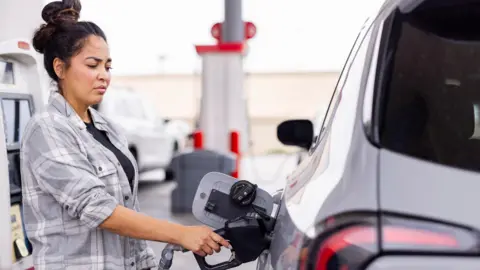
Inflation in the US eased last month as the cost of energy and filling up at the pump fell, but questions remain over whether it will prove short-lived due to the renewed conflict in the Middle East.
Prices rose 3.5% in the year to June, according to the Bureau of Labor Statistics (BLS), down from 4.2% recorded in May, which was a bigger drop than experts expected.
However, fresh military strikes by the US on Iran this week caused oil prices to surge again, with the cost of a barrel of Brent crude, the global benchmark, rising $10 in the space of 24 hours to hit $87.
Kevin Warsh, chairman of the Federal Reserve, said the central bank had "no tolerance to persistently elevated inflation".
He told Congress in his first appearance before the House Financial Services Committee on Tuesday that he was committed to "restoring price stability" in the wake of the Middle East conflict impacting prices.
"Inflation's a choice," he claimed. "We monetary policymakers need to choose lower prices and that's the commitment my colleagues have made."
Analysts have suggested inflation could rise in the coming months, which could mean that the Fed decides to hold interest rates at the current level, or raise them.
"Energy prices plunged on the Iran ceasefire and memorandum of understanding (MOU)," said Scott Anderson, chief US economist at BMO Capital Markets.
"But with fighting back on in the Gulf, the MOU in tatters, and energy prices heading higher again in July, the balance of risks remains more heavily weighted toward a rate hike at some point this year."
The BLS said gasoline prices decreased 9.7% last month but remain much more expensive than a year go. On Tuesday, the national average had risen to $3.86 a gallon from $3.79 a week ago, according to motorist advocacy group AAA.
"Gasoline prices are already back above June levels, meaning the next inflation report will heat up again," said Ipek Ozkardeskaya, senior analyst at Swissquote Bank.
'My goal is for no politics'
President Trump pushed Warsh's predecessor, Jerome Powell, to cut interest rates, and has made it clear he expects Warsh to fulfil his demand for reductions in borrowing costs for Americans.
The Fed held US interest rates between 3.5% and 3.75% at Warsh's first meeting in June.
And, speaking to Congress, Warsh was keen to stress the independence of the Fed, stating that he had demonstrated during his time in charge to date his "commitment to independence".
"My goal is for there to be no politics," he added.
Lindsay James, investment strategist at wealth management firm Quilter, said despite Warsh having got his "feet under the table" it did not "mean rate cuts are looming in order to appease President Trump".
"Instead, we are likely to see a conservative outlook from the Federal Reserve when it meets in a fortnight," she added.
While energy prices fell 5.7% last month, food price inflation increased further, with the cost of meat, poultry, fish and eggs going up, along with dairy products and cereals.
However, eating out remains more expensive, with meals on average costing 3.7% more than they did last year.
While the overall inflation rate fell in June, lower inflation does not mean that prices are getting cheaper, it is just that they are rising at a slower pace.
So-called core inflation, which strips out food and energy prices that are seen as volatile, remained unchanged in June at 2.6%.
That figure is what will be closely monitored by the Fed when it comes to deciding whether to cut, hold or raise interest rates.
Federal Reserve governor Christopher Waller warned on Monday that policymakers would have to consider raising rates.
"If we get another hot reading on core inflation this week, then the FOMC (Federal Open Market Committee) will need to consider tightening monetary policy in the near term," Waller told the New York Association for Business Economics.
The theory behind increasing interest rates to tackle inflation is that by making borrowing more expensive, more people will cut back on spending and that leads to demand for goods falling and price rises easing.
But it is a balancing act, as high interest rates can harm the economy as businesses may hold off from investing in production and jobs. Interest rate cuts, which Trump has called for, can boost the economy by lowering borrowing costs and encouraging spending and investment.
On Tuesday, more than a fifth of small business owners in the US reported that inflation was their "single most important" problem, the highest amount for almost two years, according to the National Federation of Independent Business.
