Midnight social media curfew proposed for UK teens aged 16 and 17

 Getty Images
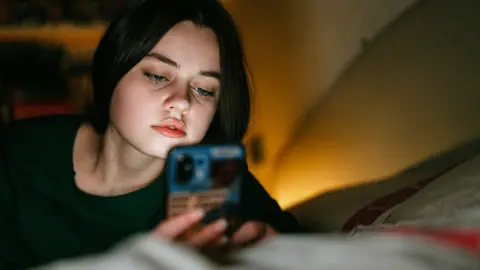
Older teenagers in the UK will face an overnight social media curfew, the government has announced - though they will be able to opt out of it by changing their account settings.
It would mean apps such as Instagram, TikTok and YouTube being set to be unavailable by default to 16 and 17-year-olds between midnight and 06:00.
The government also wants "addictive" features such as auto-play and infinite scroll to be set to be disabled, saying - combined with the curfew - the measures will improve teenagers' focus, sleep quality and family life.
However, campaigners such as Ellen Roome, who believes her 14-year-old son Jools Sweeney died in an online challenge gone wrong in 2022, does not think the plan goes far enough as teenagers can switch the setting off.
"I just think it's not good enough really just to have a product you can switch off, it's a bit like offering a 17-year-old a bottle of alcohol and then moving it slightly out of arms reach, they can just drag it back in, I really wish they could go stronger and harder on these things," she told BBC Radio 4's Today programme.
The new plans follow the announcement in June that under-16s in the UK would be banned entirely from a range of platforms.
It adds to a complex - and potentially confusing - mix of policies and measures from the government and tech firms intended to keep young people safe online.
They include optional parental controls over children's devices and child-only versions of popular sites such as YouTube.
Lorna Woods, professor of internet law at Essex University, told the BBC she felt the measure was designed to target apprehensions from parents and child safety groups.
"There have been concerns about the way services keep children and young people engaged on their phones for long periods, and that this can impact their sleep, amongst other effects," she said.
Meta, which owns Facebook, Instagram and WhatsApp, has previously said it wants age verification to be handled by manufacturers of devices themselves, rather than the onus being entirely on platforms.
Apple recently introduced such "device level" age checks, meaning anyone using iPhone and iPads with the latest version of their operating software will be asked to verify their ages.
Baroness Kidron, who has strongly campaigned for safety and age assurance measures to be at a device rather than app level, was critical of the government's approach.
Speaking to BBC Breakfast she said it should not be about "banning children from tech" but "banning tech from putting toxic products in the hands of children".
'Dog's dinner'
Online safety minister Kanishka Narayan defended the action the government had taken, saying on BBC One's Breakfast programme the combination of the curfew and limiting auto-play features meant that "Britain is already going to be the most robust place in the world when it comes to regulating" tech companies.
In an earlier statement, Technology Secretary Liz Kendall said the measures would be "crucial in helping young people get the sleep they need, focus on school and college, and spend more quality time with family and friends, all of which are fundamental to building a happy, healthy and fulfilling adult life".
Laura Trott, the Conservative shadow education secretary, described the plans as a "dog's dinner".
"Either they think 16 and 17-year-olds should be on social media or they don't, but curfews they can simply switch off won't achieve anything," she said.
The government said further measures would be aimed at helping children use AI chatbots safely - including by making providers introduce regular breaks for under-18s.
It says it will aim to lay its new proposed measures in front of Parliament by the end of 2026, with the aim that they take effect alongside its social media ban for under-16s next spring.
But some child safety charities and experts have cast doubt on the effectiveness or promise of a midnight curfew for older UK teens.
"While we welcome these measures for older teens, this latest move is yet another piecemeal set of announcements, not the comprehensive plan for children's safety that's required," said Andy Burrows, chief executive of the Molly Rose Foundation.
He added that Prime Minister Sir Keir Starmer "leaves office having announced a social media ban without a plan" - with his likely successor Andy Burnham to "inherit a series of missed opportunities".
Prof Sonia Livingstone, an expert in children's digital rights at the London School of Economics, said a curfew could harm vulnerable children by limiting their access to social media when they might need it most.
"If it's a curfew on companies using push notifications to wake someone up in the night, absolutely have a curfew," Prof Livingstone told the BBC.
"But if it's a curfew that prevents a child in need of support or help or comfort reaching out to trusted sources in the middle of the night, I think that's quite harmful potentially."
Dame Rachel de Souza, children's commissioner for England, said: "We have to listen to young people. They don't want a ban, but they do want to be protected from addictive, infinite scrolling."
She added: "I want to know more about how the policies, such as a curfew, will be delivered and will be watching closely to make sure they are effective – alongside pushing Ofcom to make full use of its powers to make the online world safer for children."
Meanwhile, social media analyst Matt Navarra said the measure was "not a curfew" but a "mildly annoying settings prompt with a government press release attached".
"The UK Government is calling this 'world-leading' online safety, but with no VPN restrictions, it's leaving the side door open and putting up a sign asking teens not to use it," he said.
No action on VPNs
Previous attempts to restrict what young people can see online - for example Australia's social media ban - have been hampered by VPNs, which can hide the true location of an internet user.
But the government said it would not be taking any action to restrict them in the UK for now, saying they were useful for whistle-blowers, minority groups and family privacy.
It cued findings from research it commissioned which indicated there was little to show VPNs were being used by many children to get around age checks.
"We have decided not to limit VPNs today and that's the primary conclusion for now but it is something we will continue to review," Kanishka Narayan told BBC Breakfast.
In a report published on Tuesday, the government said it had trialled a selection of different options with 300 teens, and found an overnight curfew showed sleep benefits.
But Pete Etchells, professor of science communication at Bath Spa University, cautioned against the results - saying it was merely "one part of the puzzle" in restricting tech use.
Additional reporting by Chris Vallance

Sign up for our Tech Decoded newsletter to follow the world's top tech stories and trends. Outside the UK? Sign up here.

