Women accused of witchcraft highlighted in talk

 Getty Images
Witchcraft and its links to a county were being explored in talks by a library service.
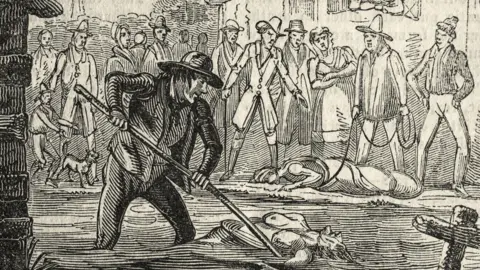
Hertfordshire Archives and Local Studies will look at the stories of women like Ruth Osborne, who, in 1751, was drowned by a mob of around 5,000 people.
Mrs Osborne, from Tring, was a beggar and was accused of bewitching a local farmer after he refused to give her some buttermilk.
The farmer and his cattle became ill, and a public advert was posted in the community to announce that Mrs Osbourne and her husband John would be "ducked by the neighbour's consent."
 Lily-May Symonds/BBC
Ducking was a practice used to detect witches by dunking the accused into a body of water to determine whether they sank or floated. Sinking to the bottom indicated innocence, while floating indicated they were a witch.
A mob of around 5,000 stormed the village that day in April 1751 to find Mr and Mrs Osborne hiding in a local church.
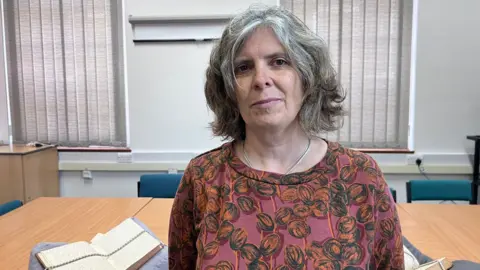
Llinos Thomas, senior librarian at Hertfordshire Archives and Local Studies, said: "Ruth was dead at the end of the ducking.
"A local chimney sweep named Thomas Colley was witnessed holding Ruth down in the water with a pole."
Colley was the only person who was accused of Mrs Osborne's murder, and he was sentenced to death by hanging.
Mr Osborne is thought to have survived the ducking.
Ruth's death occurred sixteen years after the Witchcraft Act of 1735 ruled that witchcraft was no longer a crime, although people were still suspicious of the occult at the time.
Ms Thomas, 57, added: "At this time, people absolutely believed in witchcraft.
"In Hertfordshire over the time of persecution, there were 79 people who were accused, only 14 of which were men."
 Holly Nichols/BBC
One of the last women in England to be condemned to death for witchcraft was from Hertfordshire, according to Hertfordshire Archives and Local Studies.
In 1710, Jane Wenham, from a village near Stevenage, was accused by a local farmer of using witchcraft to kill cattle and horses.
Ms Wenham was found guilty and sentenced to death in 1712; however, the judge ordered a stay on her execution, and she was able to seek a royal pardon.
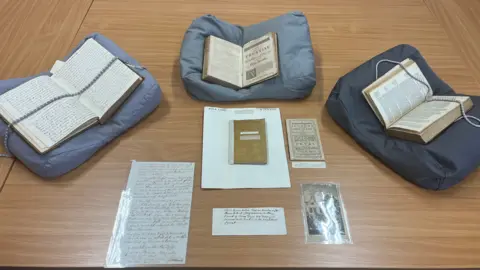
Hertfordshire Archives and Local Studies offer talks on 'Hertfordshire's Notorious Witches', which can be booked on their website.
Follow Beds, Herts and Bucks news on BBC Sounds, Facebook, Instagram and X.
