Academic finds diverse algae on Antarctic mission

 Jerry Gillham, British Antarctic Survey
An academic has discovered "surprisingly rich" communities of microscopic algae in one of the most remote locations on Earth.
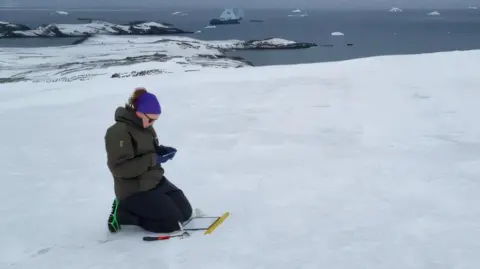
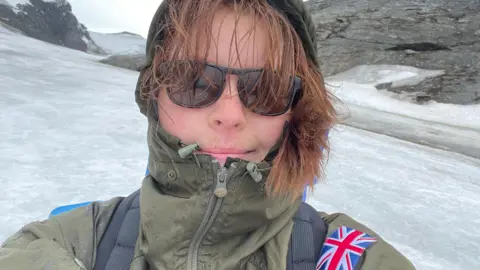
Dr Emily Broadwell embarked on a three-month expedition to Signy Island in Antarctica to study the growth of rare snow and glacier algae for her PhD at the University of Bristol.
The samples revealed "unique algal communities" on different ice and snow surfaces – challenging the assumption that Antarctic glacier ecosystems will respond uniformly to global warming.
The glacial microbiologist said the findings, published in the journal ISME Communications, "highlight how much there is still to learn about life in these cold, remote environments".
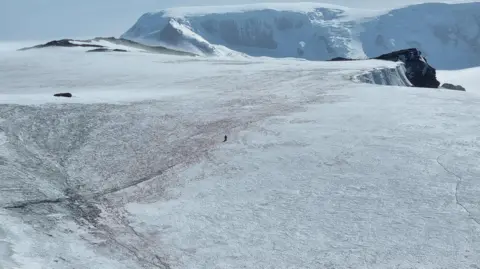
Signy Island is located 370 miles (595km) from the rest of the Antarctic peninsula, and 800 miles from the Falkland Islands.
 Jerry Gillham, British Antarctic Survey
The journey there alone took two weeks and saw Broadwell's team navigate the "daunting" Drake's Passage, where ocean waves can reach up to 18m (60ft).
She and five others were based in an ex-whaling station, used for research by the British Antarctic Survey since 1947, where temperatures averaged 0C.
On her return, while on board the research vessel RRS Sir David Attenborough, Broadwell passed iceberg A23a – which was until recently the world's largest and oldest iceberg.
 Emily Broadwell
Broadwell brought back algae samples to a lab at the University of Bristol's Cabot Institute for the Environment, for detailed analysis of its DNA alongside other samples from the Arctic and the Alps.
"These landscapes are changing fast, and arctic and alpine glaciers might be some of the first habitats lost completely to climate change," she said.
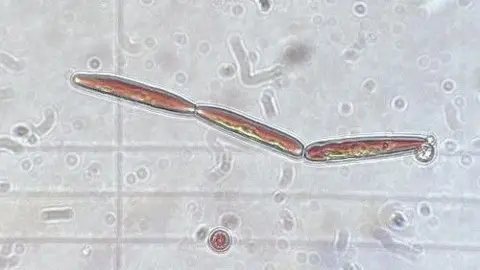
"The research uncovered a surprisingly rich and habitat-specific diversity of both snow and glacier algal species.
"Notably, we found red snow algae dominating the ice cap, where Ancylonema glacier algae would normally be expected to prevail."
While these algal blooms absorb carbon dioxide from the atmosphere through photosynthesis, they also pose a major threat to the region's delicate balance.
The expansion of plant life darkens the snow and ice, reducing its reflectivity and causing the surrounding area to warm up, triggering ice and snow melt.
 Emily Broadwell
Results indicate that, as temperatures rise, future algal blooms in this region may not follow the same trajectory as those at the more widely studied Greenland Ice Sheet, which regularly experiences large-scale glacier algal blooms.
"Different types of snow and ice supported distinct algal communities, with [Signy] Island hosting rarely observed ecological niches," said Broadwell, who is now a postdoctoral researcher at Aarhus University in Denmark.
Study co-author Dr Chris Williamson, associate professor in polar microbiology, emphasised that this "hidden diversity" highlights that further samples are needed.
"These findings are exciting and there is much more potential to expand our knowledge on the diversity and distribution of these unique microbes," he added.
Follow BBC Bristol on Facebook, X and Instagram. Send your story ideas to us on email or via WhatsApp on 0800 313 4630.
