'New bus stops are an accident waiting to happen'
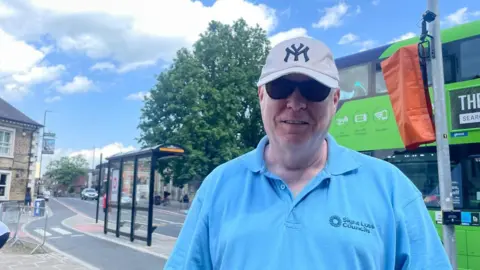
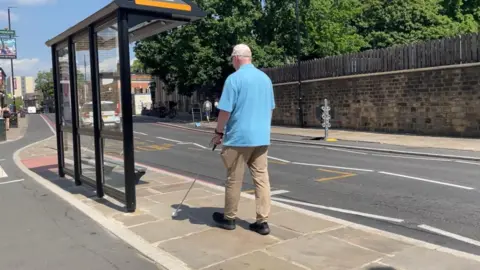
Getting a bus is something many of us do without a second thought, but for some people it is a lifeline. Iain Mitchell, 62, has been registered as severely sight impaired since birth and relies heavily on public transport to get around - but he says new bus stop designs in Leeds have added extra hazards to his journeys.
"I am really at risk because I am reliant on cyclists seeing me," explained Mitchell, who runs sight loss councils across Yorkshire for the Thomas Pocklington Trust.
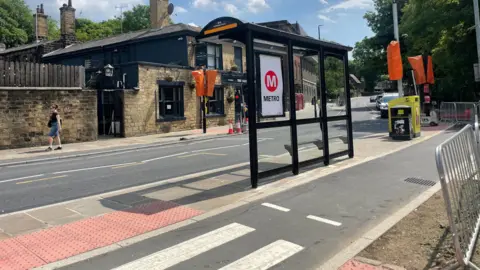
On Otley Road in Headingley, a number of new-style "floating" bus stops have recently been installed as part of an upgraded cycle route.
Unlike at traditional stops, passengers now have to cross a bike lane either to get to the stop itself or board the bus.
According to Leeds City Council, there are now 131 floating stops across the council area.
And sight-loss groups like Mitchell's are concerned.
"I am not in control of my environment as much as I would like to be to make it safe for myself.
"The only way I can describe it is it's like playing a game of Frogger, but with real people," said Mitchell, who sometimes uses a mobility cane to get around safely.

 Sofía Luis-Hobbs/BBC
"Floating bus stop" is an umbrella term for different types of road layouts where spaces are shared between bus passengers, pedestrians and cyclists.
According to the Department for Transport:
- They are made up of a bus stop, cycle path and pedestrian footway
- There are many different configurations, and some see the bus stop effectively on an "island" as a cycle lane separates it from the pavement
- The current definition includes bus stop bypasses, shared use bus borders and cycle tracks with a bus boarding island
In November 2025, the minister for roads and buses, Wakefield and Rothwell MP Simon Lightwood, wrote to all local authorities in England asking them to pause the installation of floating bus stop designs which require passengers to board directly from or into a cycle track.
This pause is still in place.
The Department for Transport said where these designs are already installed, new guidance should be used to make adjustments to them.
 Sofía Luis-Hobbs/BBC
'Making alterations'
Mitchell wants councils and other authorities to work with visually impaired communities to understand the problems posed by this new type of bus stop - and ideally does not want any more to be created.
Leeds City Council is currently making alterations to three of the recently installed stops on the A660 in Headingley, after getting feedback from road users.
 Sofía Luis-Hobbs/BBC
Changes will include narrowing the cycle path through to the bus stop, and giving pedestrians priority to cross the path.
A council spokesperson told us: "The cycle tracks/bus stop arrangements originally constructed along the A660 (Headingley) were compliant with the government guidance of the time that governed the design of these areas.
"This guidance was revised in January 2026, and whilst no requirement was placed to retrospectively upgrade these facilities, having considered the feedback received from all road users, the council are currently in the process of making alterations."
But Mitchell said this does not go far enough.
"We would always want traffic signals to indicate when it's safe for us to cross."
For cyclists, the stops can also pose challenges.
Martin Bennett Stanley is a member of the Leeds Cycling Campaign, a group that aims to make the city a "much better place for cycling".
He said the stops could be an "effective tool" - but only if they were used safely by everyone.
"I use floating bus stops as a pedestrian, bus passenger and a cyclist. It is very important that they are correctly designed and implemented according to established design guidance.
"Personally, as long as they are approached at a sensible speed, with an expectation that I may need to stop, I have no trouble using them.
"If they are poorly designed with inadequate widths and poor visibility, yes I think they could be considered dangerous."
'Unsafe and unsettling'
In Cleckheaton, two floating bus stops are due to be installed on Bradford Road as part of improvements to the A638.
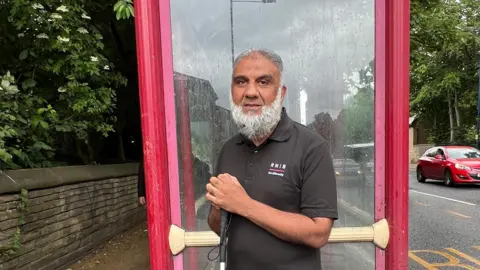
Maqsood Sheikh, 56, has sight loss and said it would be "very difficult to find the bus stop in the first place" as they are often not on the main pavement.
"It makes me feel frustrated at times, and leaves me feeling a little bit anxious when I'm travelling," he added.
Sheikh lives in Bradford, but often travels on the bus to Leeds and Sowerby Bridge to visit friends.
He said stepping out into a live cycle lane means he is completely relying on cyclists and "hoping" they will stop.
"It can be a very unsafe, unsettling, dangerous feeling," he explained.
A spokesperson for Kirklees Council said: "We know floating bus stops may be new to many people and that some residents, especially those with additional accessibility needs, may have concerns.
"As always, road safety remains our priority."
The council said a safety audit had been carried out and designs will include tactile paving, controlled pedestrian crossing points, and pedestrian priority measures to assist visually impaired users.
 Sofía Luis-Hobbs/BBC
Sheikh is a campaign lead for the Royal National Institute of Blind People (RNIB) and stressed the psychological impact floating bus stops have.
A survey from the RNIB found that 49% of blind and partially sighted people make fewer journeys to avoid floating bus stops.
"Normally a blind or partially sighted person would be walking along pavements and they would use their white cane to actually detect where the bus stop is.
"But because the bus stop isn't located on the actual pavement and it's on a floating island, they could just walk past it if they did not know it was there," said Sheikh.
Mitchell added there was a particular fear among those with guide dogs.
"They walk half a metre in front of the person that they are guiding and no person would want to put their guide dog at risk.
"There will be an accident sooner or later."
Listen to highlights from West Yorkshire on BBC Sounds, catch up with the latest episode of Look North.
