Child abuse survivor calls on Law Society chief to quit over reference

 BBC
BBCA survivor of child abuse has called on the chief executive of the Law Society of Northern Ireland to resign after he provided a character reference for her abuser.
Nicola Bannon was one of four women who were indecently assaulted by their former schoolteacher William Lloyd-Lavery at a Belfast school in the 1970s.
Lloyd-Lavery's cousin, David Lavery, provided a character reference to a court after the former schoolteacher was convicted earlier this year.
On Tuesday, Lavery was sacked from his role as a human rights commissioner but he remains in post as chief executive of the Law Society of Northern Ireland.
"I do appreciate that he [David Lavery] has apologised for his severe lack of judgement," Nicola said.
"But honestly that questions whether or not he is the right person to be leading an institution of such importance as the Law Society of Northern Ireland."
She told the BBC's Good Morning Ulster programme: "If I was in a similar situation, I would resign."
Apology for 'hurt and distress'
In a statement, Lavery apologised for a "serious error in judgement on my part in providing a character reference for my cousin and particularly for any hurt and distress that I caused the victims in this case".
"I profoundly regret that and I am committed to doing all I can to address it in the time ahead," he said.
 Pacemaker
The Law Society said it had "undertaken an internal process" but would be making no further comment due to the "confidential nature of that process".
It added that it acknowledged "the concern that this has caused".
"We are committed to facilitating appropriate consideration of the use of character references following conviction, acknowledging that there will be a broad range of views. "
Nicola said she was surprised and disappointed by this response and called for greater "transparency" from the Law Society and "more reassurance" for victims.
She contrasted it with the "very firm and decisive action" that was taken by Lavery's other employers at the Northern Ireland Human Rights Commission (NIHRC).
On Wednesday afternoon, Law Society President Mark Borland said he had listened to Nicola's powerful testimony.
He added that he profoundly regretted "the distress and trauma that this has caused for her and for the other victims of William Lloyd Lavery".
"I am deeply sorry if the society has in any way compounded their pain," Borland said.
He said the Law Society "has conducted an internal process and for reasons of confidentiality, we are limited in what we can say publicly".
"I know that will be disappointing but I want to assure Nicola and other victims that we hear them, we are listening to their concerns and experiences and we are committed to ensuring that their voice is heard in the public debate about the use of character references following conviction," he said.
He added that the Law Society will "take steps immediately to convene that discussion with our members and we will seek to include the voices of victims and survivors including, if they felt appropriate, the victims in this case".
On Tuesday, Northern Ireland Secretary of State Sir Chris Bryant removed Lavery from his post as a human rights commissioner.
The Northern Ireland Office spokesperson said the NIHRC found that Lavery had breached the NIHRC code of governance, and was "capable of bringing the commission into disrepute".
Elaine Crory from the Women's Resource and Development Agency said the Law Society needed to be "more transparent" with what is going on in its internal investigation.
"I do think that they owe the public, and especially the survivors in this case a proper explanation of what that entails."
Reacting to Borland's statement, she told Radio Ulster's Evening Extra programme there was "not much meat to it".
"You can respect somebody's confidentiality and you can also tell us the public what did that internal review entail," she said.
The Law Society's decision not to reveal the outcome of its own internal process was criticised by the chair of Stormont's Justice Committee Paul Frew.
"To stay silent on this I think is wrong," the Democratic Unionist Party (DUP) assembly member told BBC News NI.
"I think they have to, at the very least, tell us what their conclusions were and how they got to those conclusions."
Frew said openness and transparency was required so the public could have confidence in the decision-making process.
What happened in the trial?
Earlier this year, Lloyd-Lavery, of Richmond Avenue in Lisburn, was found guilty of six counts of indecent assault against four of his former pupils.
The pensioner previously taught history at Richmond Lodge School in Belfast and was later a press officer for the Ulster Unionist Party (UUP).
The woman, who were aged between 13 and 14 at the time of the assaults, were praised by the trial judge "for coming forward to expose a paedophile".
Lloyd-Lavery was sentenced to two years in prison in April.
Following that hearing, two of the victims waived their right to anonymity to speak publicly about their experiences.
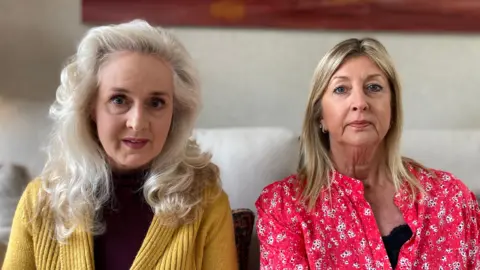
During that interview, Nicola Bannon and Lynne Darcy said they found it difficult to deal with the character references that had been given to the court before their attacker was sentenced.
The following month the Northern Ireland Human Rights Commission (NIHRC) launched a formal process into the actions of Lavery, who was then its commissioner.
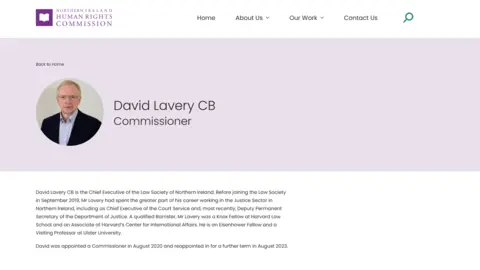
In Lavery's character reference, Lloyd-Lavery was described as someone who had a Christian faith, a family man, and someone who wanted to contribute to society.
"I know that he was well respected in these circles and was viewed as a person of sound judgement and good character," it said.
David Campbell, chair of the Loyalist Communities Council former UUP chair, also provided Lloyd-Lavery a reference.
In May, Campbell told BBC News NI: "It was never my intention to add to their [the victims] hurt."
Why do courts use character references?
Character references, which are introduced following a conviction, are a legitimate part of the justice system, according to Belfast solicitor Paul Dougan.
"It's part and parcel of information that assists the judge in reaching a fair and balanced decision in terms of sentencing," he told Good Morning Ulster.
It is important for the judge to have a "complete picture about the person to be sentenced," he added, and to take into account factors such as previous convictions or a clear record.
Nicola said that while she recognises there is a place for character references in some court cases, she objects to them being used in child sex abuse cases.
"Often the very things used to mitigate a sentence - such as somebody's position in society or their role as a teacher or educator - that's often the mask behind which they offend.
"They use that position in order to groom children, in order to abuse them because they know those children have to obey what they say."
On Wednesday a senior member of the Council for the Law Society resigned over the handling of the matter.
Philip Armstrong announced his resignation in a post on LinkedIn citing decisions from the law society "which he cannot in all conscience agree", and wrote an open letter providing the reasons for his resignation.
In the letter, which has been seen by BBC News NI, he calls the decisions made by the council "throughout the current situation with the Chief Executive, to be questionable".
He added: "I have also come to question whether the Law Society can be seen to act in the best interests of its members across Northern Ireland."
BBC News NI has approached the Law Society NI for response.
