How one woman's solar vision is now powering 6,000 homes

 BBC
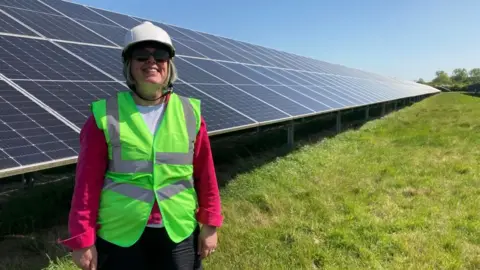
BBCBuilding a 94-acre community solar farm fulfils a lifelong dream for Barbara Hammond.
Ray Valley Solar, a community energy project based in Arncott near Bicester, Oxfordshire, has the potential to power more than 6,000 homes for a year. Its business model means any profits go back into the community.
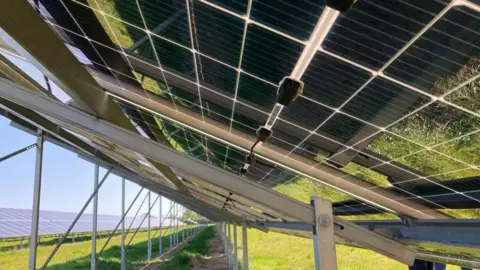
The latest technology is being used, including double sided "bi-facial" panels to catch rays bouncing back from the ground, making the solar farm 20% more efficient than older schemes.
Could this be the future of renewable energy in Oxfordshire?
For Barbara, the business model is key.
The Arncott development is part of the Low Carbon Hub. As a community benefit society, it operates as a business, trading in electricity, with all the profits going back into Oxfordshire's communities.
This in turn goes into projects that help people to understand more about environmental challenges and continue to develop low carbon solutions.
"I like to think of it as a fractal model. It just keeps growing in impact," Barbara said.
The community solar farm has the capacity to power a village the size of Eynsham, distributing power to local homes and businesses. But it does not have the ability to go much further afield.
That is where more large scale solar farms can become more effective.
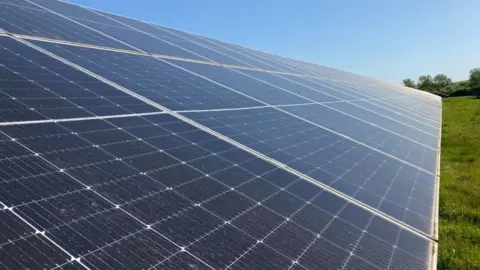
Compared to the solar farm in Arncott, the proposed development at Botley West is 40 times bigger.
It would cover more than 2,000 acres, generating 840 megawatts of clean electricity each year, with the potential to power 330,000 homes.
It is now in its final stages of planning, with the government asking for more time and information to consider whether to approve the development. A decision is due in September.
Opponents of the proposals have raised concerns about its potential impact on the countryside and argued that the technology could become obsolete in the coming decades.
Mark Owen Lloyd, from developers Photovolt Development Partners, previously said he welcomed "the opportunity to continue engaging constructively with the government and other stakeholders".
"We remain confident in the strength of our application, which has been developed following extensive consultation and detailed environmental and technical assessment," he said.
