Brazil's President Lula to discuss economy and security with Trump at White House

 Reuters
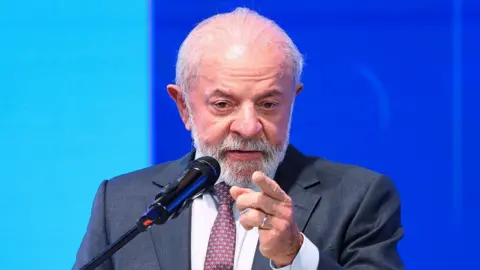
US President Donald Trump will host Brazilian President Luiz Inácio Lula da Silva at the White House on Thursday for talks on tariffs, other economic issues and combating organised crime.
The two leaders have had a turbulent relationship since Trump returned to office, and the visit will be closely watched for signs of a breakthrough in their disputes.
The impasse over trade - following Trump's imposition of tariffs that target Brazilian goods - particularly damaged relations between Washington and South America's largest economy.
The US president also intervened in Brazilian politics last July when he wrote a letter to Lula asking that criminal charges be dropped against Lula's political opponent, former Brazilian President Jair Bolsonaro.
A close Trump ally, the far-right Bolsonaro was convicted last November of leading an attempted coup, and sentenced to 27 years in prison. Lawyers for Bolsonaro appealed the conviction.
Trump cited the Bolsonaro case as one factor in his decision to increase tariffs on Brazil.
Lula established himself as a popular left-wing figure while presiding over a period of economic growth in Brazil during his first two terms as president from 2003 to 2011. He returned to office after defeating Bolsonaro in the 2022 presidential election, and is running for another term later this year.
The leaders held their first meeting of Trump's second term in Malaysia last year.
Ahead of the United Nations General Assembly later that year, Lula told the BBC he had "no relationship" with the other leader.
But a brief meeting on the sidelines of the event in New York seemed to signal that the pair were seeking to iron out their differences.
Trump praised Lula during his UN speech, and said afterwards that "he seemed like a very nice man," and that "we had excellent chemistry."
The duo are scheduled to hold a working meeting late Thursday morning at the White House.
Beforehand, Brazilian Vice-President Geraldo Alckmin said they would discuss a pact to combat organised crime, among other issues.
Meanwhile, a White House official told BBC the leaders would discuss "economic and security matters of shared importance".
It is not known whether all the issues on Brazil's economic team's radar will actually be addressed during the meeting. That will depend on the "temperature" the White House sets for the meeting, according to a source who spoke to BBC Brasil.
Critical minerals
One of the topics on the agenda of Brazilian negotiators is critical minerals - considered strategic for both countries.
"There is room for it in the areas of big tech, rare earths, and strategic minerals," said Alckmin when commenting on Lula's trip, according to the Brazilian newspaper Valor Econômico.
On one hand, Americans want easier access to mining projects in critical mineral deposits, especially rare earth minerals. On the other, the Brazilian government has been advocating for greater state control over these projects and that investments in the area include the processing of minerals - not just the export of raw materials.
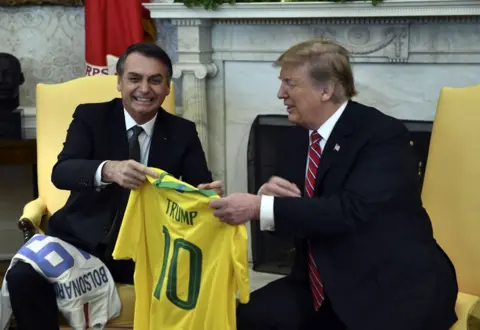
Critical minerals, including rare earth elements, are necessary both in equipment used to generate and store clean energy, and in the electronics and military industries. Among them are lithium, cobalt, and niobium, which can be used to manufacture electric batteries, magnets for wind turbines, electronic chips, aeroplanes, missiles, and satellites.
 Getty Images
In the second Trump administration, the US has aimed to reduce its dependence on China for critical minerals and rare earth elements. It is estimated that China holds around 60% of the known reserves of this material and is responsible for 90% of its refining.
But Brazil has emerged as a potential partner since the country has the second largest - only to China - known reserve of rare earth elements.
In recent months, the US has launched a series of initiatives to expand its access to critical mineral reserves, including established partnerships with other nations. Brazil, however, has been resisting such an agreement with the US, especially if it would require Brazil to give preference to exports to the US.
Tariffs
Despite Trump's easing of tariffs on a range of Brazilian products in recent months, Brazilian economic experts want to try to reduce or eliminate remaining tariffs on some of the country's US exports.
An estimate from Brazil's Ministry of Development, Industry, Trade and Services (MDIC) indicates that at least 29% of exports are subject to additional tariffs by the US government.
In April 2025, the US imposed a flat 10% tariff on every country in the world. In July, the Trump administration imposed an additional 40% tariff on various Brazilian products - seen at the time as a US response to the treatment of Bolsonaro. The episode was considered the peak of tensions, but the relationship between the two countries has since improved.
In November, the Trump administration removed some of the tariffs on Brazilian products and in February, the US Supreme Court ruled some of Trump's tariffs illegal, benefiting countries like Brazil. Subsequently, the US implemented a flat 15% tariff on global imports to the country.
But Brazil still wants the US to reduce tariffs affecting key areas of its economy. Some data shows that Brazilian exports to the US in the first quarter of this year reached their lowest historical level since 1997. Exports totalled $7.8bn (£5.7bn) in the period, indicating an 18.7% decrease compared to the same quarter of 2025.
