Smartphones could become illegal in NI schools

 Getty Images
Northern Ireland could ban smartphones in schools by law, following a move made earlier this year in England.
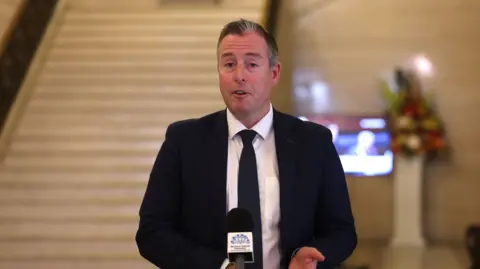
Education Minister Paul Givan is consulting on whether to introduce the legislation.
Givan said the move was not "anti-technology" but about making schools "safe and supportive."
He said he wanted children and young people to be able to "focus on learning" and plans to issue revised guidance to schools on preventing pupils using their phones ahead of the new academic year.
Some schools in Northern Ireland have already taken part in a pilot scheme which involved pupils putting phones in magnetic pouches when they came to school.
At £250,000 for nine schools, the cost of the scheme has been criticised.
However, a study into the pilot scheme carried out by experts from Kings College London (KCL) suggested that the restrictions had improved behaviour in class.
Teachers in the schools said the restrictions reduced disruption in the classroom, and improved interaction between pupils.
Pupils had more mixed views, and younger students were more likely not to use their phones than older students.
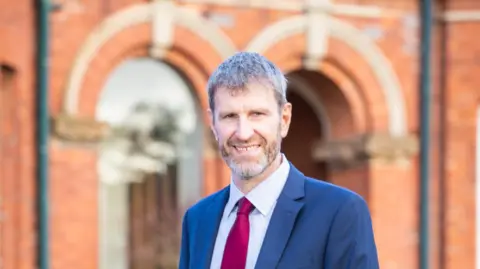 Friends' School Lisburn
There were also "negligible changes" in the well-being of pupils who took part in the mobile phone pouch pilot, though there was "some decrease in self-reported anxiety and depression symptoms," according to the study.
The research team from KCL called on teachers and school staff to restrict their own smartphone use in school in order to be role models for pupils.
They also said that schools should consider letting older pupils use their phones more for study.
Stephen Moore, the principal of one of the schools in the study, said their school-wide ban had encouraged "young people to interact with each other".
"I think there are very few schools that implement a ban on phones and then go back to having phones," he said.
"I think the benefits far outweigh any disadvantages there might be."
Moore added: "I think pupils have been quite receptive to the new rule and we've certainly encouraged them to interact with adults and sort problems out for themselves."
Smartphone use in schools has been described by some principals as the "most serious issue facing schools in a generation".
One head teacher said smartphone use was "affecting the development of children's brains as well as their well-being".
And over recent years, individual schools have introduced policies on the matter; many ban phones during class time and require parents to call reception if they need to contact their children.
Some have expressly banned smartwatches and smart glasses too.
 PA Media
In a statement Givan said that, while many schools had robust phone policies: "I believe we now need a stronger and more consistent approach across our education system."
He said that the consultation on whether to bring forward a law banning mobile phones from schools would last for 12 weeks.
"Before any final decisions are taken, it is important that parents, pupils, teachers and school leaders have an opportunity to have their say and I would therefore encourage anyone with an interest to respond to the consultation," he said.
"My aim is simple. I want schools to be places where children and young people can focus on learning, enjoy healthy friendships and thrive in a safe and supportive environment."
'Clear positives'
Speaking to BBC Radio Ulster's Talkback programme, Givan said that mobile phones have "had an impact within our education system".
"The evidence showed - in terms of those negative impacts... in terms of behaviour, wellbeing, mental health, safeguarding issues.
"Even for the teaching profession, that concern that they're being photographed or videoed, and then that can spill out into social media and wider society.
"So those were the negatives of having the mobiles. The pilot scheme has shown that now with fewer disruptions in the classroom there's better quality teaching," he said.
"There are clear positives that have emerged in this.
"There was there was a bit of kickback, you know, we don't want this, we don't need it, but having brought it in, it has proven to be successful and beneficial and that's why now we'll move forward with greater guidance."
The education minister added that "if technology is going to be utilised" then "it shouldn't be through smartphone technology".
What do parents think about a possible ban on smartphones?
Janet Ward was also on the programme speaking on her daughter's experiences in school.
She said that despite the benefits a ban would bring, a lack of access would also cause issues for students, as absent teachers sometimes upload work to google classroom for them to complete.
"But if they don't have access to their phones or Google Classroom, it's going to make things difficult for them."
She added: "It's a tech world no matter what we do, these kids are going to go on to university, it's all about technology and you're going to be submitting essays and typing.
"You go to get a job, anywhere you go everything is computer based."
However, Dr. Clare Sinton from Smartphone Free Childhood NI welcomes the guidance: "There is no place for smartphones in schools."
She believes legislation "can take the weight off" head teachers being made responsible in deciding whether or not students should have access.
"It gives a standard rule across the country, it totally takes the responsibility off the school from having to make the decision," she added.
It is not yet clear how any law would work, but more information on the proposal is due to be published on the Department of Education's website on Thursday.
The consultation will run until 19 November.
A similar legal ban on smartphones in schools has recently come into force in England, while Scotland and Wales do not have legal bans but do allow head teachers to implement phone bans.
In the Republic of Ireland, state-recognised schools are required to ban pupils' use of and access to personal mobile phones throughout the school day.
