I was a soldier in Ukraine - now I teach to shape our future

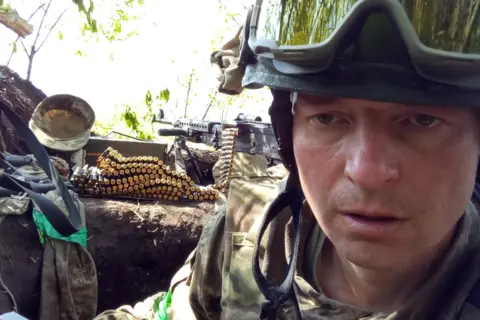 Sergiy Sylantyev
An Aberdeen-based scientist has swapped the front line in Ukraine for teaching - as he believes his country's future will be shaped not just by war but through education.
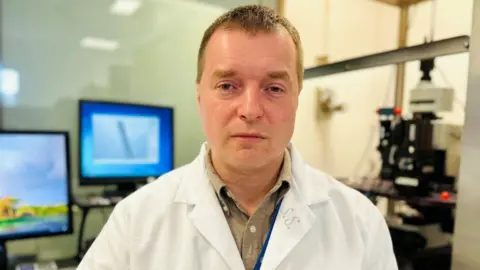
Neuroscientist Sergiy Sylantyev was working at the Rowett Institute at the University of Aberdeen when Russia invaded his home country in February 2022.
He travelled back to Ukraine to serve as a soldier in the army.
Sylantyev, 50, later resumed his research in the Granite City but is now returning to Ukraine as part of a scheme to strengthen academic links.
Sylantyev was born in the Odesa region of Ukraine, and his working life later brought him to Aberdeen.
He was working on a research programme when Russia invaded.
With no prior military experience, he headed back to his homeland where he was given combat training and deployed.
He continued in his research while under mortar fire in the trenches as he feared he would be killed and his work go unpublished.
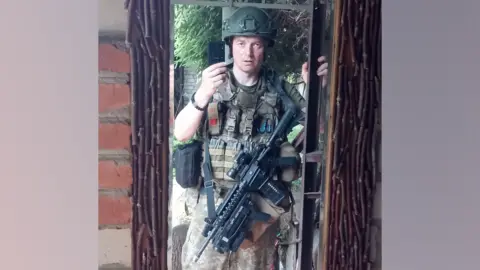 Sergiy Sylantyev
He has now been selected by The Fund of the President of Ukraine for Education, Science and Sports to teach university students back in Odesa.
He was one of 10 people picked for the programme.
Sylantyev said the conflict was an experience which "profoundly changed my understanding of resilience and responsibility" and he is glad to have the opportunity to contribute in a different way.
"Ukraine requires not only military support and humanitarian assistance, but also a long-term strategy for sustainability," he said.
Despite the ongoing military conflict, Sylantyev said he was encouraged by the high number of applications to join the scheme.
"One particularly striking aspect of this programme is that it requires the physical presence of participating scientists in Ukraine," he explained.
"In the context of ongoing missile attacks and security risks, this might have discouraged applicants. Instead, the programme received approximately three times more applications than anticipated, requiring an additional selection stage.
"This demonstrates that many British academics are willing to support Ukraine not only symbolically, but through direct engagement."
Sylantyev said only through "deep and durable integration with Europe" could such sustainability be achieved - and must extend beyond economics and security policy.
He said universities were key in shaping innovation and international partnerships.
"Collaborative teaching, joint research projects, student exchanges, and institutional partnerships are therefore not peripheral activities: they are strategic investments in Ukraine's future," he said.
"Science remains one of the most powerful instruments of resilience, and collaboration remains one of Europe's strongest commitments to Ukraine's future."
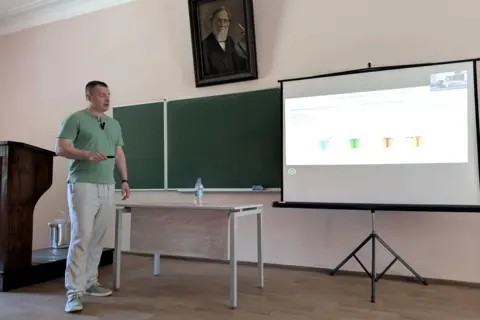 Sergiy Sylantyev
Rowett Institute deputy director Prof Lora Heisler described Sylantyev as an "outstanding scientist" whose dedication extended far beyond the laboratory.
"His courage, integrity, and commitment to knowledge have been evident both in his research and in his service during the conflict," Heisler said.
"It is a privilege to see him now contributing his expertise to support Ukraine's academic community and future resilience."
Sylantyev said: "Ukraine's path will be shaped not only on battlefields or in diplomatic negotiations, but also in lecture halls, laboratories, and universities."
