'A rare condition means I think I know every person I see'

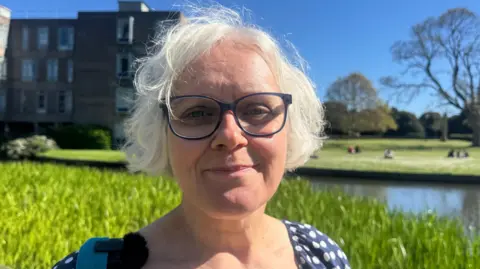 BBC/ Emily Johnson
When Jenny Parry walks down the street, she passes a sea of strangers. Except, to her, they seem all too familiar. Shehas a rare neurological condition which means that everyone she sees resembles a friend she has known for years, with accompanying cloudy memories of parties or workplace laughs.
"About seven years ago, I had a migraine and after that, I suddenly realised that I thought I knew every single person that I saw and knew them really well," Jenny explains.
"At first, it was really quite stressful and difficult because everyone I looked at, I could remember doing things with them but logically I knew that I didn't know them.
"Every face gives me a memory of something we've done together, but it's like I'm looking at it through a pane of glass that's a bit obscure.
"There've been many embarrassing occasions in the first couple of years where I thought I knew somebody and went up to them and they didn't know who I was and after that happened a few times, I just ended up not approaching anybody," she says.

The 54-year-old, from Scarborough, says her condition, known as hyperfamiliarity for faces - or HFF for short, began to present challenges for her, especially while working at a local zoo.
"They put me on the reception and told me that, because it's so expensive, people could go in and out for the day as many times as they wanted," she says.
"I asked if they're going to stamp their hand and was told, 'no, you'll know if they've been in before'.
"But I just ended up letting everybody in and was slowly realising that I was probably losing them quite a lot of money."
Jenny's condition is rare, with research into it still taking place.
However, people with the opposite condition, called prosopagnosia or face blindness, are believed to make up 2% of the population.
It, too, causes social anxiety and other associated problems.
Keen to find out what was happening in her case, Jenny went online to research facial recognition problems and ended up emailing a PhD student in the USA.
It then led to her having MRI scans at the University of York to examine her brain activity.
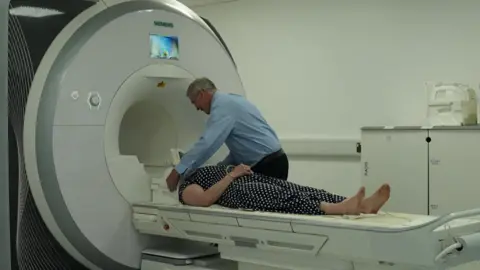
Prof Tim Andrews, who is a senior researcher at the university, found that HFF was caused by an altered connection in Jenny's brain.
While her visual systems and memory perform normally, the communication between the two has become hyperactive, generating a constant false alarm of familiarity.
After initial scans all looked normal, the researcher conducted an experiment using the TV show Game of Thrones.
They scanned the brains of those who had never seen the series and avid fans who were familiar with the characters.
"We found that there were differences in the brain between these two groups and we wanted see if there were regions of the brain where Jenny was more similar to the familiar participants than the unfamiliar participants, because, as luck has it, Jenny had never seen Game of Thrones before," Prof Andrews says.
"We got Jenny to look at a video while she was in the brain scanner and we found a region of the brain that was more similar to the familiar participants in a place called the hippocampus."
This could be visually seen on a scan, validating everything Jenny had been experiencing.
"For people who have to deal with this on a daily basis, it's really reassuring to know that there is a reason behind this condition," the professor adds.
'Coping mechanism'
Life for Jenny now looks a little different.
She has taught herself not to engage with faces immediately, instead focusing on hairstyles and clothes until a person introduces themselves to her.
"If I want to engage with someone's face, then I will," Jenny says.
"If I was at a job interview and I wanted to feel relaxed, I'd engage with the interviewer's face and I feel like I've known them for years.
"I've come to this coping mechanism now that works really well for me."
Jenny also sees the humour in her condition, finding ways to giggle at herself in her job as a keeper at Filey Zoo.
"I'm really honest and open with everybody about it now, so now I see it as a positive in my life," she adds.
"If I want to feel instantly relaxed around with people, I engage with their faces. People with anxiety would love to be able to do that, wouldn't they?"
Jenny hopes her experience will inspire others, who tend to find HFF isolating.
"It'd be really nice if people with similar conditions could think, actually, let's try life a little bit more and see what works for me," Jenny says.
"I guess there'll be different techniques for everyone that work."
Listen to highlights from North Yorkshire on BBC Sounds, catch up with the latest episode of Look North.
