Museum's giant tiger given careful clean

 Leeds Museums and Galleries
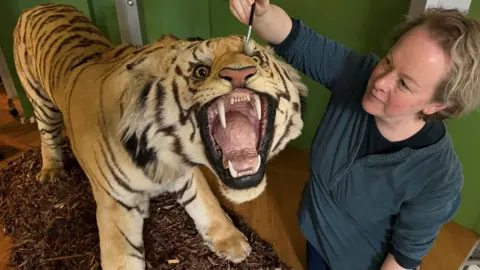
One of the world's biggest taxidermy tiger mounts has undergone some delicate pampering as part of a conservation project at Leeds City Museum.
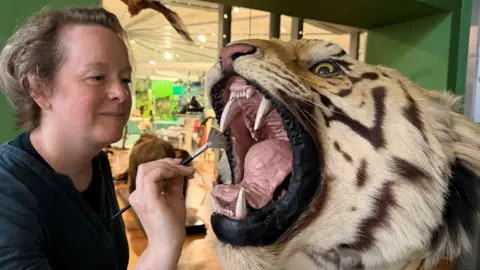
Curators carried out a careful clean-up of a 12ft (3.6m) long Bengal tiger which has been a resident of the city for more than 160 years.
Armed with specialist tools, they checked the creature for dust and tiny pests which can damage vintage taxidermy.
Also getting a spruce up, were some of the museum's other fragile residents including the delicate tail feathers of its incredibly rare pair of Huia, an extinct species of bird that once lived in New Zealand.
The tiger was originally shot in the foothills of the Himalayas in 1860 by Maj Gen Sir Charles Reid, who later boasted it was the largest he had ever seen.
Its pelt was shipped to Britain as a trophy and displayed at the London International Exhibition before being bought by Leeds industrialist William Gott in 1862.
He then commissioned noted taxidermist Edwin Henry Ward to mount the tiger's skin and presented the finished article for display by Leeds Philosophical and Literary Society, where it was hailed as "unequalled in Europe".
 Leeds Museums and Galleries
Curators Clare Brown and Sarah Burhouse spent several days in the museum's Life on Earth gallery, working to preserve some of their most historic natural science specimens.
Burhouse, Leeds Museums and Galleries' curator of natural sciences, said such exhibits were prone to damage from clothes moth and the buried carpet beetle.
"People often panic if they collect taxidermy and they see pests such as these and think there's an infestation.
"But actually, these are just creatures that live in our environment so it's nothing to worry about.
"But we do need to keep on top of these things, particularly because our collection is susceptible to damage from them."
The curator said their inspections of specimens had uncovered some damage to the tail of the male Huia which had "been nibbled a bit, probably by clothes moths",
She added: "We think this is historical damage though rather than something new."
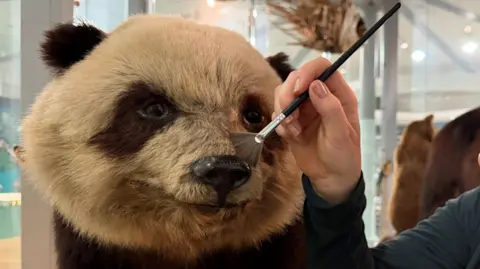
Another taxidermy mount to receive attention was Grandma the panda - part of the first group of live giant pandas to arrive in the UK in 1938,
Captured near Weizhou village in central China, she reached Britain in 1938 but died two weeks later from double pneumonia.
After her death, her remains were distributed to museums around the country for research, with Leeds receiving the skin of Grandma - named such because she was the oldest panda in the group.
 Leeds Museums and Galleries
The Life on Earth Gallery is home to a vast collection of taxidermy which also includes a polar bear, turtle, sea lion, a Tibetan yak and the skeleton of a huge bluefin tuna.
Burhouse said the collection gave people access to the natural world and preserving them was important for future generations.
"Some of these animals have been in the collection for 200 or more years and because of environmental conditions and things like that, we need to continue to monitor to make sure that they have the best longevity possible so people are able to admire them.
"In some situations, those animals have become endangered and are becoming more rare so if we don't look after the examples we have in our collections, those species could be lost and forgotten altogether."
Listen to highlights from West Yorkshire on BBC Sounds, catch up with the latest episode of Look North.
