School trust installs knife arches in 'UK first'

 BBC
BBCA Black Country academy trust says it has become the first in the UK to install metal detector "knife arches" at all of its secondary schools.
Dudley Academies Trust has introduced the scanners at four sites, where hundreds of pupils now pass through them each morning as part of daily entry routines.
The BBC was shown detectors in use at two schools — Beacon Hill Academy in Sedgley and The Link Academy in Netherton — where lines of pupils passed through, placing mobiles, keys and other items in trays, before walking through the arches in a process designed to take only a few seconds.
Leaders say the move is a proportionate safeguarding step, reflecting concerns about knife crime across the West Midlands, although they stress there has been no history of knife incidents in their schools.
The trust has spent about £50,000 installing nine arches across its sites.
'Reassurance' for pupils and parents
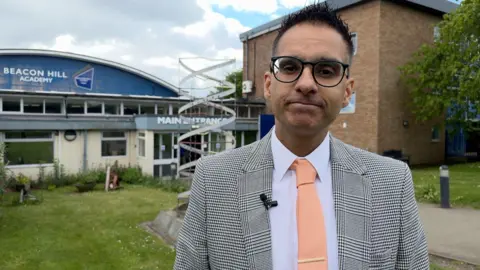
At Beacon Hill Academy in Sedgley, more than 1,100 pupils arrive each day and are asked to remove items before walking through the detectors.
Principal Sukhjot Dhami said the aim was to provide reassurance rather than respond to any specific threat.
"We've never had an incident involving a knife," he said. "But we want to absolutely reassure our learners and parents that they are coming into an incredibly safe environment.
"Our learners have responded really well. They tell us they feel incredibly safe coming to school."
Dhami said the most commonly confiscated items so far had been aerosols and fizzy drinks, rather than weapons.
The trust said parents had been consulted before the rollout, with what it described as the "largest consultation" it had conducted, and that there had been overwhelming support.
"Ultimately our job is to keep young people safe," the principal added. "This is just one part of a wider safeguarding approach, alongside education."
He rejected suggestions the measures were excessive, saying there had been "no negativity or criticism" from the school community.
Knife arches have been used in some individual schools in recent years, but there is no national policy on their use.
The Department for Education has said decisions should be taken locally, and that screening may not be appropriate for every setting.
Speaking to the BBC, school leaders in Dudley reject suggestions the measures go too far, saying ensuring pupil safety must come first and that the arches form part of a broader approach focused on prevention and education.
The issue has been sharpened by a number of high-profile incidents in recent years, including the fatal stabbing of a pupil at a school in Sheffield, cases which many school leaders say have prompted renewed debate about security measures.
Some education figures and school leadership groups say there is limited evidence on their effectiveness, arguing that while they may provide reassurance, they do not address the underlying causes of knife crime.
'A long way to go'
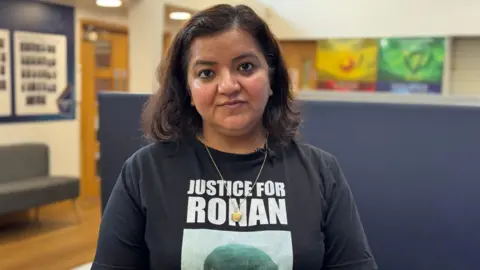
Pooja Khanda, whose son Ronan was murdered in Wolverhampton in 2022, with a ninja sword bought online, visited Beacon Hill Academy to speak with the pupils.
She has led a high-profile campaign for tighter controls on knife sales, helping to secure changes to Ronan's Law.
The legislation, introduced last year, closed loopholes around online knife purchases and banned weapons such as ninja swords.
The campaigner said it was too early to judge the impact of the arches, but welcomed action being taken.
"I always welcome every measure that's being taken, but there's a long way to go", she said.
She added that her campaign was focused not only on restrictions, but on changing attitudes among young people too.
"We need to keep going, keep pushing for the betterment of society for our young people. If we stop, things can go backwards – education and awareness are just as important as any law."
For some pupils, the issue is personal.
Jaiden, a student at the Link Academy, lost his uncle Ryan Passey, who was fatally stabbed in a Stourbridge nightclub in 2017.
After a jury acquitted Kobe Murray of murder and manslaughter in 2018, Ryan Passey's family brought a civil claim against him.
In 2021, a judge found Murray liable for "wrongfully and unlawfully causing Ryan's death" and awarded damages.
Jaiden, who was 4 when Ryan was killed, said the scanners could help prevent further tragedies.
"It's always good to prevent it before it even happens," he said. "We don't want it to happen to other people.
"It's the effect it has on families – it's just terrible."
"A lot of people say they carry a knife for protection, but you shouldn't have them at all," he added.
'Knife crime falling'
Knife crime offences in the West Midlands have been among the highest in England in recent years, although police say overall levels have begun to fall.
Nationally too, Ministry of Justice figures show just over 1,100 children were convicted for knife possession in England and Wales in the year to September 2025, a slight decrease on the previous year.
NHS data shows the number of children admitted to hospital in England after assaults involving sharp objects has remained relatively high in recent years, fluctuating between about 400 and 500 cases annually.
Dudley Academies Trust says its approach is intended to balance those wider concerns with the need to maintain a normal school environment.
While there has been interest from other schools, there are currently no plans for a nationwide rollout of knife arches, with government guidance leaving the decision to individual institutions.
Follow BBC Birmingham on BBC Sounds, Facebook, X and Instagram.
