What is the Garvaghy Road dispute all about?

 Pacemaker Press
For a number of years in the 1990s, the Drumcree parade dispute was one of the biggest stories in Northern Ireland - and then, for 28 years, it fell out of the public eye.
Now, almost three decades on, the parading row, which sparked some of the most serious public disorder in Northern Ireland's history and was linked to several murders, is back in the headlines.
It reemerged after a court case in which a ruling by the Parades Commission - the organisation formed during the Drumcree dispute to decide on contentious marches during Northern Ireland's parading season - was overturned.
In a change to its July ruling, the commission gave the parade the go ahead.
A series of legal challenges followed that decision, with the Court of Appeal finally ruling that the Parades Commission's decision to allow the march had to be respected - but protesters blocked the road, preventing the march from taking place.
But how did we get here?
Drumcree parade before 1998
 Pacemaker Press
There are thousands of parades every year and the vast majority pass off without incident.
The Orange Order, the most prominent of the loyal orders associated with Protestants in Northern Ireland, take part in parades, particularly during the peak marching season between April and August.
The biggest day of the season is 12 July, when Orangemen and women march to commemorate William of Orange's victory over the Catholic King James II at the Battle of the Boyne in 1690.
However, many Catholics see the marches as sectarian and, in the 1990s, there were disputes over those that passed through, or close to, Catholic or nationalist areas.
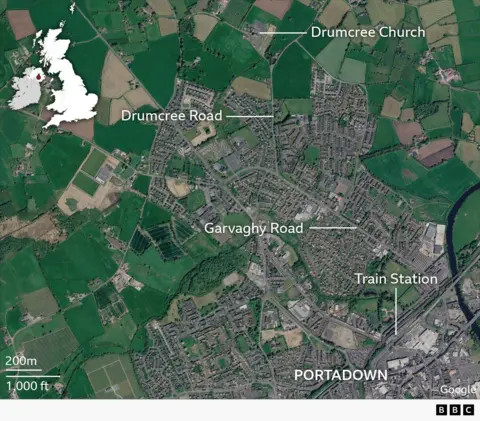
Perhaps the most hotly contested dispute was over the Garvaghy Road in Portadown.
It has been used as part of the Orange Order's march from Drumcree Church since 1807 on the last Sunday before the Twelfth.
In the late 1800s intermittent violence broke out at the parade in the Catholic "Tunnel" area of Obins Street, which was then part of the outwards route.
In the 1960s, an article from the Portadown Times again shows the outwards march to Drumcree Church went via Obins Street through the Tunnel and Corcrain, returning via Garvaghy Road and Castle Street.
However, after two years of violence in 1986 that outward route was rerouted away from Obins Street.
The police rerouted that outward leg through the Garvaghy Road, with the Portadown Times reporting in July 1986 that the RUC's reasoning for doing so was that "unlike the Tunnel area the Garvaghy Road is a main thoroughfare in which Catholics and Protestants reside, "when responding to criticism at the time.
Orange Order leaders at the time told the paper the new route was "permanent".
But that route also became contentious, with protests from residents living along the road.
In the 1990s, the parade again became problematic.
At that timemarches were seen as a public order problem, with the main responsibility lying with the police.
However, in 1995 the march became a serious political issue when Northern Ireland's police force at the time, the Royal Ulster Constabulary (RUC), decided to re-route the parade to prevent it from passing down Garvaghy Road.
There were intermittent clashes, with protesters throwing bottles and bricks and stones, and officers firing plastic bullets. Trouble occurred in several loyalist areas.
Eventually a few hundred Orangemen were allowed to walk the route, despite protests from local nationalists.
In 1996, the RUC again decided to stop the march from going down the Garvaghy Road.
This sparked loyalist violence across Northern Ireland, during which Michael McGoldrick, a Catholic taxi driver, was murdered.
The serious violence that erupted was referenced in confidential state papers from that year.
The UK government and RUC then staged a dramatic U-turn, allowing a symbolic 1,000 marchers to complete their route.
This in turn sparked a week of rioting from nationalists. Amid this unrest, republican dissidents were blamed for a bomb attack at the Killyhevlin Hotel at Enniskillen, County Fermanagh, which injured 40 people.
In 1997, the march was allowed down the Garvaghy Road by then Northern Ireland Secretary Mo Mowlam, despite residents' protests.
This sparked nationalist rioting across Northern Ireland, with cars set alight and police firing hundreds of rounds of plastic bullets.
What happened in 1998?
 Pacemaker Press
In 1998, the newly established Parades Commission, ruled the Orange Order should not march down Portadown's Garvaghy Road on the end leg of its annual march after the Church of Ireland service at Drumcree Church.
About 1,000 police and 1,000 soldiers were deployed to enforce the decision.
The Army and RUC built a barricade on the road which links Drumcree Church with the Garvaghy Road and dug a trench, which was then lined with barbed-wire, through adjoining fields.
Despite the commission's ruling, the Orange Order maintained it would march down what it said was its traditional route.
On Sunday, 5 July, those taking part in the parade left the service at Drumcree Church and marched up to the barricade, where the stand-off began.
Over the following days, thousands of Orange Order members joined the marchers in Portadown to demand access to the road.
Widespread disorder broke out in Portadown and across Northern Ireland.
Between Saturday 4 July and Tuesday 14 July, there were more than 2,500 public order incidents recorded, according to RUC statistics in an Ulster University archive.
Of these, 615 attacks were on members of the security forces, including 24 shooting incidents and 45 blast bombs.
More than 140 houses were damaged in attacks during the violence across Northern Ireland.
But things were to get worse, with one of the most infamous incidents in the history of sectarian conflict in Northern Ireland.
 Handout
Three children - Richard Quinn, 11, and his brothers Mark, nine, and Jason, eight - were killed in an arson attack on their home, in Ballymoney, County Antrim.
The boys were part of a Catholic family living in a predominantly Protestant estate.
One man, Garfield Gilmour, who drove the car for three unidentified UVF men to attack the house, was convicted of murder but had that changed to manslaughter on appeal.
The incident created widespread revulsion, extending even as far as then US President Bill Clinton.
The Orange Order's County Armagh chaplain at the time, the Reverend William Bingham, called for the protest at Drumcree to come to an end, saying: "No road is worth a life, let alone the lives of three little boys."
Stand-offs continued in subsequent years as members of the Order walked to police barricades in protest at the restrictions. Protests were also held by residents living along the Garvaghy Road.
What has happened at Drumcree since 1998?
The Grand Orange Lodge of Ireland has applied to complete the full march for the past 28 years, with exceptions such as during the Covid pandemic - but every year has been denied permission by the Parades Commission.
A small number continued to protest at not being permitted to parade along the route by making their way from Drumcree Church on Sundays for a short walk before turning back.
Community relations within Portadown had improved since the peak of the Drumcree dispute.
Why is Drumcree back in the news again?
 PA Media
For decades, the situation at Drumcree has settled into a relatively minor stand-off that no longer made headlines.
However, that changed in August 2026 after a decision by the Parades Commission to impose restrictions on the parade was quashed in the High Court.
It follows a legal challenge brought by a member of the Order, which saw the commission concede it had made a procedural error in how it dealt with the application.
Not all six members of the commission had signed off on the final determination before it was issued.
The Order said it made "the position of the current commissioners untenable".
One member of the Parades Commission, Billy Gamble, resigned but the five other members remain in place.
An independent review of the commission was announced by Northern Ireland Secretary Chris Bryant, which is being led by Sir John O'Hara KC.
That review is due to begin shortly and be completed before the end of November.
Drumcree parade can go ahead, commission rules

For the first time in almost three decades, the Parades Commission decided that a parade down the Garvaghy Road would be allowed, two days before it was due to take place.
The commission said the parade on 27 September should start earlier than the Orange Order wanted and with fewer people.
That decision faced an immediate legal challenge from the Garvaghy Road Residents' Coalition who oppose the march.
The initial legal challenge saw a judge issue an injunction banning the parade, but that was successfully challenged by an Orange Order member at the Court of Appeal.
At 08:00 BST that Sunday, the Orange Order were set to parade down Garvaghy Road but the route was blocked by protesters.
Some nationalist politicians joined the crowd blocking the road, with Sinn Féin President Mary Lou McDonald and First Minister Michelle O'Neill among them, saying they stand with the residents.
Some unionist politicians like the DUP leader Gavin Robinson accused O'Neill and her party of breaking the law.
Further attempts by a small numbers of Orangemen to walk down the road were prevented by police.
The dispute was discussed in the assembly, and the secretary of state held separate talks with politicians, some residents, and members of the Portadown Orange Order.
Protesters remained on the Garvaghy Road and Orangemen maintained a presence at Drumcree church in a two-week stand off, until Sir Chris banned the parade under advice from the chief constable.
Now the dispute is back in the court.
