HS2 celebrates Brunel family's engineering legacy

 PA Media
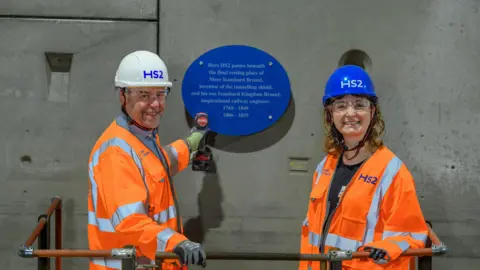
A blue plaque celebrating "one of the world's greatest engineering dynasties" has been installed by HS2 at the exact spot where the tunnel passes underneath the Brunel family tomb.
The plaque was fitted on the wall of Euston Tunnel 40 metres (131ft) beneath the graves of Sir Marc Isambard Brunel and his son Isambard Kingdom Brunel at Kensal Green Cemetery, west London.
HS2 Ltd chief executive Mark Wild, said the significance of Sir Marc and his son's engineering achievements "cannot be underplayed".
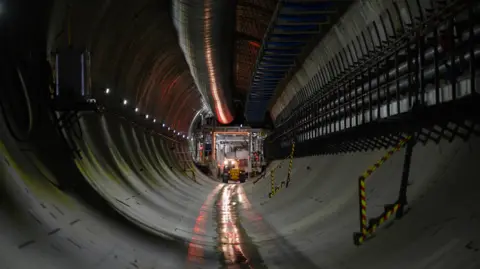
The tunnel is being dug by two machines travelling from Old Oak Common in west London to Euston in the centre of the capital.
Wild added: "How we build our tunnels today is because of Sir Marc's work, and how we build our railways is because of how Isambard Brunel built the Great Western Main Line.
"He built railways flat and straight, and future-proofed them for improvements in speed and capacity which is why we still use them today.
"Installing this plaque gives me the opportunity to reflect on the scale of what the 30,000-strong workforce on HS2 are building – a new railway for future generations that will stand the test of time, despite all the challenges we face."
Sir Marc designed the Thames Tunnel beneath the River Thames in London, which opened in 1843. It was the world's first tunnel beneath a river used by boats.
He also invented the tunnel shield method, which was later used to dig the Euston Tunnel for HS2.
Isambard Kingdom Brunel was a renowned engineer who built the Great Western Railway's Box Tunnel in Wiltshire, which was the world's longest railway tunnel when it opened.
His other major achievements included Bristol's Clifton Suspension Bridge and three ships that each became the world's largest when completed.
 PA Media
Katherine McAlpine, director of London's Brunel Museum, said modern tunnelling of the scale of HS2 "would not have been possible" without Sir Marc.
"Two hundred years ago, the father and son team embarked on an audacious project to dig the world's first tunnel under a navigable river, laying the foundations for huge projects like this.
"I am delighted we are able to mark this milestone of HS2 travelling underneath the final resting place of Marc Brunel and Isambard Kingdom Brunel, as a testament to their ingenuity and perseverance," she added.
Listen to the best of BBC Radio London on Sounds and follow BBC London on Facebook, X and Instagram. Send your story ideas to hello.bbclondon@bbc.co.uk
