O'Dowd hits back at Treasury budget report

 PA Media
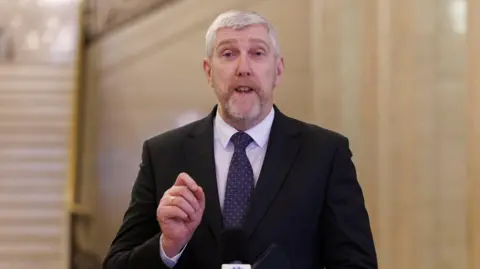
Stormont's finance minister has hit back at a Treasury report which suggested the executive is failing to take steps which would largely solve its budget problems.
The "open book" review of Stormont's finances was conducted after the executive overspent by £400m last year.
It found that ministers would have up to £3bn a year extra to spend on public services if they took measures like bringing the size of the civil service into line with the rest of the UK.
John O'Dowd suggested the Treasury had made unfair and misleading comparisons.
He described the characterisation of health spending in Northern Ireland as "simply not true".
The report said that comparable spending on health (excluding social care) in Northern Ireland is 152% of spend per head in England.
O'Dowd said: "The British government's own figures show that the spend per head on health here is around 6% higher."
He said the report had failed to acknowledge that some functions carried out by the Stormont civil service in Northern Ireland are the responsibility of councils in GB.
He added that the report had also not considered Northern Ireland's "rurality" which makes the delivery of public services relatively more expensive.
He also said that calls for more local revenue raising were simplistic.
"It's easy for a headline maker to say the executive could raise £3.3bn if they were to do A, B and C," he told the assembly's finance committee.
"But you have to look at the impact A, B and C would have on the wider economy."
'Crunch point'
As an example he said the executive had decided not to introduce water charges because of the impact it would have on household finances.
Northern Ireland is the only part of the UK where consumers are not directly charged for water.
O'Dowd repeated the executive's position that Northern Ireland is underfunded in comparison to Wales and Scotland and that a budget cannot be agreed until more money is provided.
In the absence of a budget executive departments have been operating under emergency financial procedures since the start of the financial year in April.
O'Dowd said a budget would have to be agreed at some point to avoid serious damage to public services.
He would not be drawn on when the "crunch point" would be reached.
He said a "lack of urgency" from the Treasury was the major sticking point at the moment.
