'Death Railway' memorial unveiled to mark VJ Day

 BBC/Jim Scott
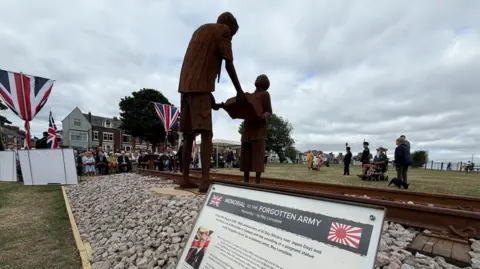
A section of railway track has been unveiled at the site of a World War Two memorial commemorating prisoners who built what became known as the Death Railway between Thailand and Myanmar, formerly Burma.
The reconstruction was installed in South Shields' North Marine Park beneath a sculpture of Sunderland veteran Len Gibson.
He was among 60,000 Allied prisoners forced by the Japanese to build the railway in 1942 and 1943.
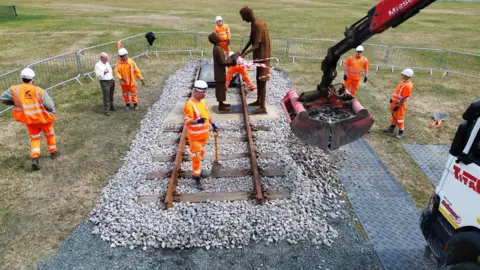
Ten metres (33ft) of old sleepers and track from the Tyne and Wear Metro were laid by volunteers alongside the sculpture and officially unveiled during VJ Day celebrations on Saturday.
The original statue, named The Forgotten Army, was created by artist Ray Lonsdale and commissioned by philanthropist Brian Burnie in 2025 in tribute to Gibson, who died aged 101 in 2021.
 BBC/Jim Scott
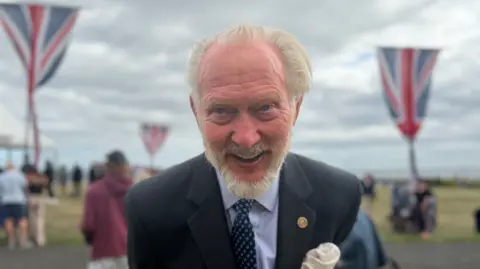
"Laying the track in the sun, it was blistering and we were out in it for hours, but they were there for three and a half years, day after day," Burnie said.
"They buried people every day of their life."
He said the track was 10m in length to signify that, on average, two men died for every 10m of railway built.
"Over the last 80 year, I've been to war memorials all over the world, but this we've created today is real.
"You can see and touch it."
 Daft As A Brush/Brian Burnie
A team of volunteers from Nexus, who operate and maintain the Tyne and Wear Metro, laid the tracks at the memorial site in July.
Infrastructure Director at Nexus Stuart Clarke said the donation of the used Metro tracks was "particularly poignant".
"Our infrastructure team have really enjoyed supporting such a worthy project, creating a lasting memorial for Len Gibson and the many thousands of British soldiers who served in the Far East."
 BBC/Jim Scott
A service marking 81 years since Victory over Japan was declared was held at the now complete statue, with veterans invited from across the country.
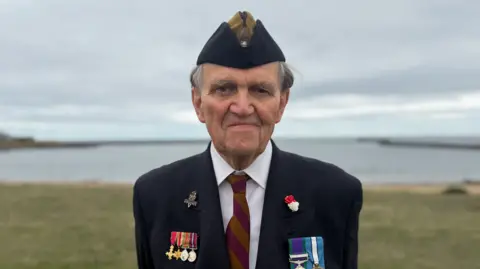
Former Royal Northumberland Fusiliers officer Rodney Buckton travelled from Monmouthshire in Wales to pay his respects to those who "fought like tigers".
"[There were] dreadful conditions; beatings, torture and being used as a slave labour.
"Men suffered from malaria, dysentery and yellow fever, they were virtually murdered by the work they were put through.
"That huge sacrifice, which a generation made all those years ago, is not forgotten."
