Young white-tailed eagles released on Exmoor
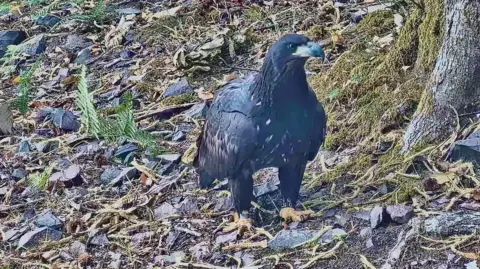
Six young white-tailed eagles have been released at a national park, the first to be introduced there after they disappeared 200 years ago.
The birds were released on Exmoor by Forestry England and the Roy Dennis Wildlife Foundation, as part of a project to restore the area's biodiversity.
Up to 20 additional young birds will be introduced in the area over the next three years.
Angela Eagle, environment secretary for the Department for Environment Food and Rural Affairs, said the return of the "majestic" species showed the government's "commitment to reversing the decline of nature and protecting it for generations to come".

 Forestry England
The project started in 2019 on the Isle of Wight and since then, 45 white-tailed eagles have been released from the population.
In 2023, the project celebrated the first white-tailed eagle chick to be born in the wild in southern England since 1780.
Now it is being extended to include Exmoor, which was chosen after tracking data from released eagles showed the area had often been visited by several of the birds.
Experts say the national park's coastline offers the birds ideal foraging opportunities, including an abundance of fish.
Zoe Smith, from the Roy Dennis Wildlife Foundation, said: "We're restoring a native species that should be here and has been removed from the landscape.
"We have a lengthy consultation process before we're granted a licence."
She added that the scheme only removes one chick at a time from nests, and the birds are checked for bird flu before they are released.
 Getty
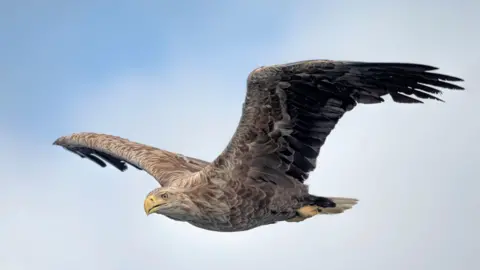
GettyBefore being released, the birds were fitted with satellite trackers so their progress can be monitored by the project team.
It is expected that the young eagles will travel widely across the UK and potentially into Europe before returning to the area to breed when they are four or five years old.
Ali Hawkins, senior ecologist with Exmoor National Park Authority, said: "This is such an exciting moment for Exmoor and a real boost to biodiversity in the National Park, as white-tailed eagles play a crucial role in both marine and land-based ecosystems."
Threat to livestock
The first successful reintroduction of the birds began in 1975 on the Isle of Rum, in Scotland's Inner Hebrides. As more schemes have been launched over the years, however, their return has not always been welcomed.
Some Scottish farmers say they are losing tens of thousands of pounds of livestock each year as the eagles take vulnerable lambs.
But Exmoor livestock farmer Robin Milton said he feels quite ambivalent about the scheme.
"There's no direct impacts on me on the moment. But there's been problems reported," he said.
He added that he thinks there has to be a "proper balance".
"I don't want to see an impact on farming or hares that are around here at the moment," Milton said.
"I'd like to see a much more comprehensive plan there."
Smith responded that her foundation is working with farmers to ensure the reintroduction has been carefully planned.
"Some farmers have raised concerns about this project. We've given them the opportunity to ask questions and we give ongoing support to these farmers," she said.
She added that in Europe, there have been no reports of the same eagle attacking livestock.
Follow BBC Somerset on Facebook and X. Send your story ideas to us on email or via WhatsApp on 0800 313 4630.
