Glazing on king's grave damaged by visitor's bottle

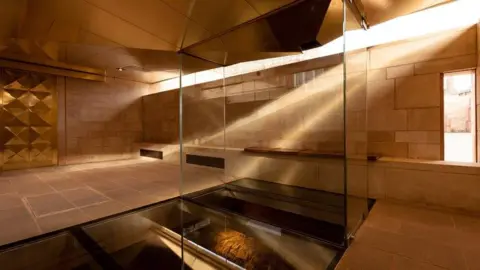 Leicester City Council
Glazing over the original grave of King Richard III was damaged when a glass water bottle fell from a visitor's trouser pocket and caused the glass to crack, a council has revealed.
The last Plantagenet king of England's remains were discovered under a council car park in 2012, and are now part of a visitor centre run by Leicester City Council.
Thick glass allows visitors to walk above the area and view it, but the authority said on Tuesday it was accidentally damaged by the visitor in 2024, when the bottle fell from the thigh pocket of his cargo trousers and shattered on the glazed floor.
Officials said repairs, costing nearly £30,000, would begin on Wednesday and take three days to complete.
'Distinct crack'
Specialists are due to remove the damaged glass and replace it with a new triple-glazed panel.
The council said it would work carefully to protect the archaeology underneath and preserve the scheduled ancient monument.
Repairs will cost nearly £29,830, most of which has been covered by an insurance claim.
Visitors will not be able to access the burial site during the work, but the rest of the visitor centre will be open as normal, the council said.
Of the accidental damage, a council spokesperson said: "A visitor sitting next to the grave site stood up, and the glass bottle of Perrier he had in the thigh pocket of his cargo trousers fell out and shattered on the glazed floor.
"The impact caused a small chip in the top layer of the triple glazed glass panel, which radiated out as a distinct crack across the panel."
Assistant city mayor Vi Dempster apologised for the inconvenience, but said: "These essential works will ensure that the historic grave site of King Richard III continues to be protected to the very highest standards, while allowing visitors to experience this globally important heritage site."
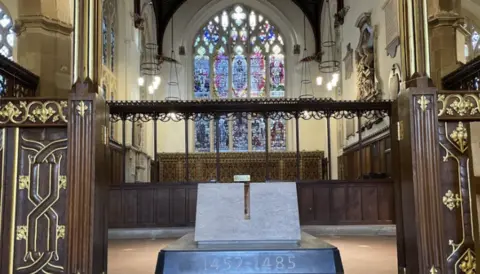
The medieval monarch was killed at the Battle of Bosworth in 1485 when Henry Tudor took the English crown.
For centuries it was believed his body had been thrown into the River Soar in Leicester.
However, the Richard III Society and University of Leicester archaeologists decided to investigate suggestions the king had actually been buried in the former Greyfriars friary in the city.
They uncovered his skeleton in 2012 and the remains, with Richard III's famous curved spine, were later interred at Leicester Cathedral.
Listen to BBC Radio Leicester on Sounds and follow BBC Leicester on Facebook, on X, or on Instagram. Send your story ideas to eastmidsnews@bbc.co.uk or via WhatsApp on 0808 100 2210.
