'When I started it was like Call the Midwife'

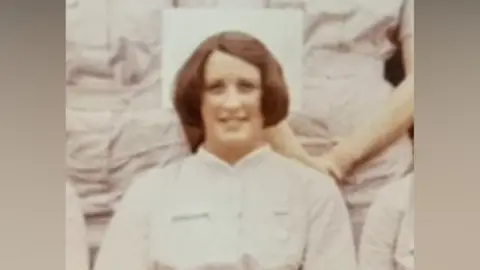 Viv Dolby
After more than 50 years in midwifery, Viv Dolby has reached the "pinnacle" of her career – a silver award from NHS England's chief midwifery officer, Kate Brintworth.
"It's such a prestigious award. It wasn't even on my radar, to be perfectly honest. It was wonderful once I got over the shock," she says.
When Viv started training in Leeds in 1975 "it was like Call the Midwife", she says.
There were no epidurals or gas and air, no CAT scans.
"You would find a second baby there, twin pregnancy, literally when the first baby had come out," she says
But you were taught all the basics and "taught them really, really well".
Now, almost 51 years later, Viv has worked on everything from Leeds General Infirmary's delivery suite to researching pregnant women in Uzbekistan, and she has "reached the top", she says.
"It's a pinnacle of one's career. My goodness. I don't know of any of my other colleagues that have got the awards," she says.
Viv was nominated for "helping to develop the next generation of midwifery leaders". But says the award recognises the work of her whole team.
"We are nothing without each other within the NHS."
Alongside Viv, Emma Fleary another midwife at Bradford Teaching Hospitals NHS Foundation Trust also received a silver award.
They were both nominated by their senior leaders and received their prizes at a surprise ceremony at the hospital.
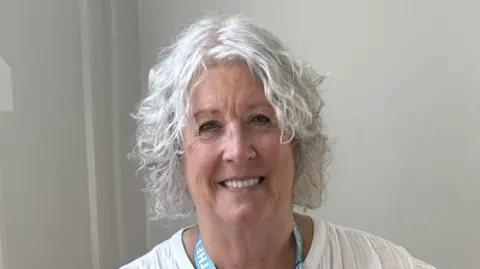 Bradford Teaching Hospitals NHS Trust
After her initial nurse training at Leeds General Infirmary, Viv trained in midwifery in Preston and then returned to Leeds where she worked as a community midwife.
"It was wonderful to be able to be part of that journey to be able to provide total midwifery care to families, to see them grow, to support them, to become known within a location," she says.
After training in the 1970s, during the 1980s she saw technology develop with the introduction of MRI scans and ultrasound.
"I learnt to use Sonic Aid to be able to hear babies' heartbeats at 10, 12 weeks.
"And then we came through HIV in the 1980s, and there was this development of services, there was health centres that opened up and there was this beginning to look at women from a multidisciplinary view."
She left front-line midwifery to focus on research in the early 2000s, which she continues to do at Bradford Institute for Health Research (BIHR), working to improve the care of seriously ill pregnant women.
During the Covid pandemic, she helped develop the research to show the vaccines were safe for pregnant women.
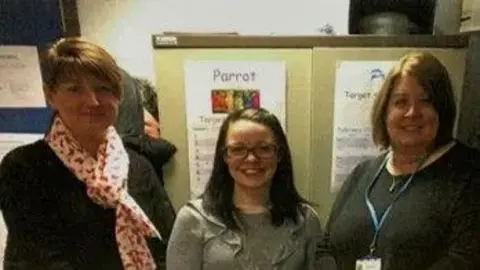 Viv Dolby
Now Viv is working on research to ensure fewer women die in pregnancy and childbirth across Yorkshire and the Humber.
"Unfortunately, we have increasing numbers of women that are dying in pregnancy. Thankfully, it remains very low, but you don't want that ever to happen," she says.
The work follows a number of reports on poor maternity care - including in Leeds.
She says key to that work is ensuring pregnant women and their partners are listened to when they raise concerns.
"It's giving everybody a voice. If that woman is absolutely fine, brilliant, absolutely cracking. But actually sometimes then she will begin to deteriorate.
"Because the thing about pregnancy is that generally the women are well and they compensate like fit young people do. And then all of a sudden, they deteriorate like that, well, we don't want that," she says.
The training facilities for new midwives have also improved dramatically she says.
Recently Bradford Teaching Hospitals NHS Trust introduced a dark-skin manikin to train staff on supporting women who are more at risk in childbirth. But in the 1970s they "learnt as they went along", she says.
She adds "we're coming back to the era now that questions will be welcomed", which is good for staff and patients.
She says midwives must "always develop, always question, always learn, and always be ready to change".
"Even old dogs like me learn new tricks all the time," she says.
Listen to highlights from West Yorkshire on BBC Sounds, catch up with the latest episode of Look North.
