What can be done about the A120's dead deer problem?

 The Royal Parks
The number of deer lying dead along the A120 has been a hot topic in a corner of Essex recently.
People living near Great Dunmow believe the problem is getting worse, and figures from Uttlesford District Council back them up.
So what can be done to improve the situation?
What's the scale of the issue?
 Sam Mannock
On a two-mile (about 3km) stretch of the A120 near Great Dunmow, Sam Mannock counts 15 dead deer lying by the road.
"It's not only deer," she explains. "There was even a large white owl lying at the side of the road."
Mannock is not wrong in thinking the number of carcasses is higher than usual.
Figures from the district council show 43 reports of dead deer and muntjac have been made so far in 2026.
That is more than the 39 reports in the whole of 2025 and 42 the year before.
"Seeing all these animals just littered at the side of the road is so upsetting, it's so awful to see," she says.
"There are children going backwards and forwards and they're going to start to think that is normal and that is the way things should be."
The issue has become a hot topic on local Facebook groups. Some point the finger at developers for building over green spaces.
A council spokeswoman suggests the autumn rutting season could also be to blame, as deer movement increases.
What can drivers do?
 Getty Images
Although the exact numbers are unknown, it is estimated the number of deer killed or injured on UK roads every year exceeds 40,000.
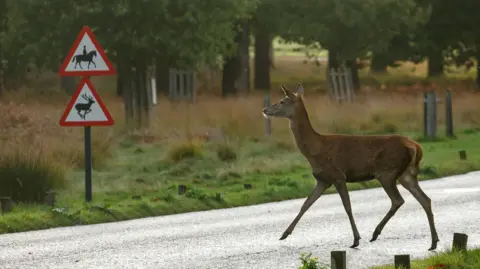
The British Deer Society's Charles Smith-Jones says driver vigilance can help get these numbers down.
"We've all seen the wildlife signs on the roads with the running deer image on it, but we just get used to them – we blank them as we travel along our regular routes," he says.
Smith-Jones advises:
- Be particularly wary at sunrise and sunset
- Deer tend to travel in groups, so if you see one then more could be about
- Full beam headlights dazzle deer and cause them to freeze, so avoid using them if you spot one
- Do not veer out of their way, as it could cause another accident
Who is responsible for clearing up?

It all depends on what road an animal is killed on and which part of it the body lies.
On major routes such as the M25, the A12 and the A120, National Highways is responsible for removing dead animals which are on the carriageway or central reservation.
If the animal is on a smaller route or the verge on an A-road, the local council is responsible
"While reports are spread across the district rather than concentrated in the Great Dunmow area, the figures suggest there may be a slight increase this year," a spokesman for Uttlesford District Council says.
"The figures should be treated as indicative, as some carcasses are removed by council crews during routine work without a formal report being recorded."
A National Highways spokesman says dead animals are removed if they pose a safety risk to motorists.
What else can be done?
 Getty Images
Deer populations can rise quickly as they do not have any natural predators, but this can lead to woodlands being damaged and accidents on the road.
Culls take place annually in the UK, usually running through the winter.
Mannock believes a more humane approach of using appropriate fencing could also mitigate the issue.
"Fences maybe aren't being looked after and maintained [which allows] these beautiful animals to just keep running on to roads," she says.
"The landscapes they once had and lived on are now disappearing."
Another suggestion is for people to eat more venison, creating a supply chain for it.
People for the Ethical Treatment of Animals has also proposed habitat modification and limiting access to artificial food sources as potential solutions.
The exact number of wild deer in the UK is not known, but the government estimates there are about two million.
Do you have a story suggestion for Essex? Contact us below.
Follow Essex news on BBC Sounds, Facebook, Instagram and X.
