Texas know-how part of UK efforts to tame wildfires

 BBC
This week a record 350 delegates attended the UK Wildfire Conference in Leeds. It was the first time since 2011 that the event had been in the north of England and came against a backdrop of a record number of wildfires across the UK.
Texas may seem a long way from Yorkshire, but Leeds is where Johnny Davidson shared his wisdom when it comes to tackling wildfires that have spread to people's homes and businesses.
A captain of the Round Rock Fire Department back home, he is also an instructor with the International Association of Fire Fighters (IAFF), specialising in what he calls "the wildfire/urban interface".
What was once a problem elsewhere in the world has now become a stark reality in the United Kingdom.
In one of the most severe examples 19 homes were destroyed in Stourbridge, in the West Midlands, on the hottest day of the year.
"From what I understand wildfires are kind of a new thing over the last 20 years here in the UK," Davidson said.
"However, it's the same, fire is the same around the world. We've just had an opportunity back in the States to see this more often.
"And now we just want to share what we're learning to make the job safer for the firefighters here in the UK just as well as we do in the US and Canada."

In May, Davidson and his colleagues hosted a visit from two firefighters from the UK who in turn invited them back to the conference at Headingley Stadium.
"They loved it [the training] and saw the importance and recognised the need for it immediately.
"Just a basic understanding of operational readiness and being prepared for these events, which can quickly get out of control, and how as firefighters we quickly run out of resources."
Fire Minister Baroness Blake, a former leader of Leeds City Council, was the first keynote speaker.
"What unites us all is a commitment to tackling the growing challenge of wildfires using our combined expertise and knowledge," she told delegates.
Referencing Stourbridge, she said wildfires in the UK were now "destroying property" and "turning communities upside down".
She also highlighted what she called the four pillars - "preparedness, prevention, response and recovery" - as part of overall efforts to deal with the growing problem.

The conference, founded in 2003, rotates around England, Scotland, Northern Ireland and Wales, and organisers, the England and Wales Wildfire Forum, said it was the busiest ever.
Gareth Clay, chairs the steering group behind the event and is also Professor of Geography at the University of Manchester, said Leeds was a "fantastic venue".
"Close on the doorstep of the Yorkshire Dales, the North York Moors, and has experienced wildfires quite a lot in recent years.
"So we thought we'd bring it to Leeds, showcase the region to our national and international delegates and really set the conference within the heart of Yorkshire."
Wildfires had been evolving and changing "over the last 20 years," he said.
He said they were normally seen as something which only happened in rural areas such as on moorland.
"But over the last couple of seasons (years) in particular we've had major impacts of wildfires in towns and cities across the UK.
"We still have those wildfires in the more rural, remote locations.
"But increasingly we're seeing the most disruption coming from those fires right on the edge of towns, villages and cities."
Clay said these had an impact on air quality, travel, tourism and people's access to recreation with areas out-of-bounds for days or weeks.
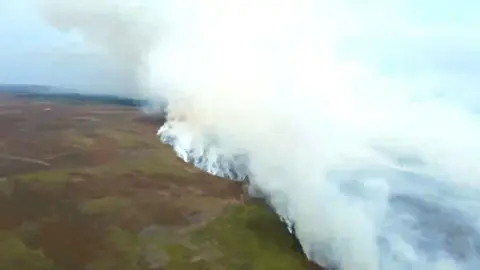 North Yorkshire Fire Service/PA Wire
According to the National Fire Chief Council there were a record number of wildfires in 2026 (1,350) in England and Wales, beating the previous year's total (1,017) which was then the highest.
Land management techniques, emergency service response, and the public's help in preventing wildfires were all on the conference agenda.
But it was the role of the weather, and the influence of climate change, which was at the forefront.
Clay said: "Many parts of the country are still in drought and parts of Yorkshire were in drought earlier in the year.
"So, it's whether or not the weather and the storms, the normal conditions, recharge some of those reservoirs for our drinking water.
"But as importantly recharge the moisture in our vegetation and in our soils.
"So, it's going to be a kind of wait to see how that pans out.
"Because if we don't have that moisture return and we have another hot, dry Spring or another hot, dry summer.
"Potentially, we are in another similar position to where we were last year."
Listen to highlights from West Yorkshire on BBC Sounds, catch up with the latest episode of Look North.
