Ruth Slenczynska, last surviving pupil of Rachmaninoff, dies aged 101

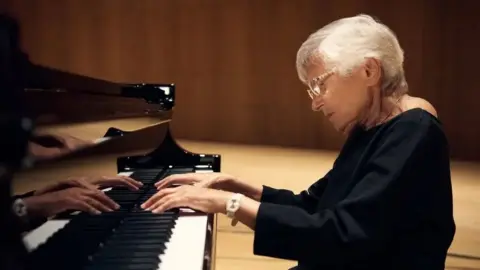 Meredith Truax
Virtuoso pianist Ruth Slenczynska, who was the last surviving pupil of Sergei Rachmaninoff, has died at the age of 101, following an astonishing nine-decade career.
Born in California to Polish parents, the musician gave her first recital at the age of four, and debuted with a full orchestra in Paris aged seven.
Noted for her impeccable technique and musical insight, she played for five US Presidents - even performing a four-hand Mozart duet with Harry Truman at the White House.
Slenczynska performed into her 90s, releasing her final album in 2022. She died peacefully at an assisted living facility in California, said her former pupil Shelly Moorman-Stahlman in a statement to the BBC.
"Tonight, heaven gained a very special angel," said the musician and teacher, adding that Slenczynska's health had faltered after a series of falls.
During recent visits, "she was particularly energetic and mentally clear" and even "played the piano one day", Moorman-Stahlman recalled.
"Always a teacher, during a conversation about a recent performance with orchestra, she 'assigned' me the Mozart Concerto in A M[inor] to learn and bring to her the next time we visited."
After another fall, however, she "passed away peacefully" surrounded by friends, including Moorman-Stahlman's husband, Randy.
 Getty Images
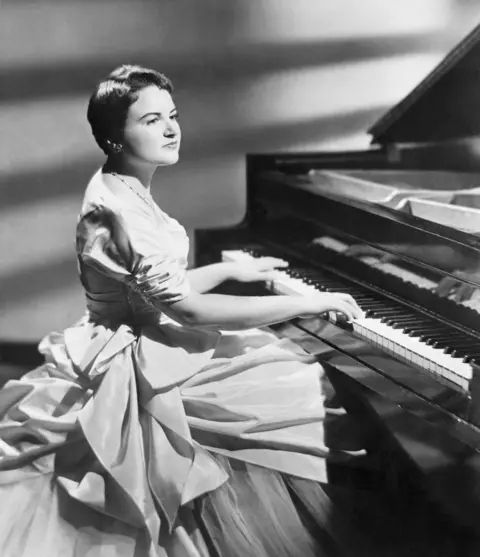
Born in 1925, Slenczynska was heralded one of the greatest child prodigies since Mozart.
A Pathé newsreel, filmed when she was five years old, noted that the toddler had "surprised musical critics by her playing of Beethoven".
Her concerts were "an electrifying experience," wrote the New York Times in 1933, "something nature has produced in one of her most bounteous moods".
The musician's father, Josef Slenczynski, was a well-known violinist and head of the Warsaw Conservatory before being wounded during World War One.
After moving to America, he resolved to raise a successful musician, and deemed his daughter a potential pianist or violinist within hours of her birth.
By the age of three, she was versed in basic musical theory and harmony - and the family moved to Europe so she could access the best teachers and rub shoulders with the most influential musicians of the day.
Tyrannical rule
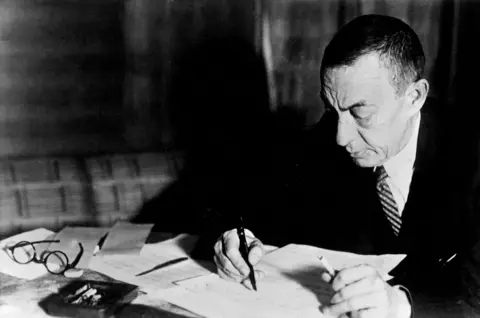
She met Rachmaninoff in 1934, after substituting for him in a concert.
"Mr Rachmaninov had to cancel due to a problem with his elbow," she later recalled. "The manager did not want to lose money from the ticket sales so he contacted my father to see if I could play the concert."
She was summoned to meet the maestro soon afterwards.
"I was a frightened little girl at the door of his apartment at the Villa Majestic in Paris," Slenczynska told NPR in 2022, "and he pointed this long index finger down at me and he said, 'You mean that plays the piano?'"
The nine-year-old shook in fear, until Rachmaninov sat her down and showed her a picture of his speed boat, making buzzing noises to imitate the motor.
Once calm, she played a showpiece for him, then transposed the key instantly when he requested. They became lifelong friends - and she often wore a Fabergé egg necklace that he had given her.
 Getty Images
In those early years, she was mentored by Josef Hoffman, Alfred Cortot, Egon Petri and Artur Schnabel.
She also studied alongside Samuel Barber, hearing his world-famous Adagio for Strings in the classroom, before it even had its title.
However, the tyrannical rule of her father proved to be too much.
"The reason that people were startled at what I could do at the piano was quite simple: Father was making me practice nine hours a day, every single day of the week," she wrote in her 1957 autobiography, Forbidden Childhood.
"If I showed signs of wanting to be just an ordinary little girl, like wanting to cuddle my sisters' dolls or make a little noise or jump up and down and run with the neighbourhood kids, father would come down on me with his pail of ice-cold water: 'That's all baby stuff! You're not a baby. You're a musician. Stay away from those kids and their stupid games. It's all a waste of time! You've got to act like a grown-up young lady.'"
At the age of 15, she rejected her concert career, cut off her father completely, enrolled for a psychology degree at the University of California and eloped with a fellow student, named George Born.
The couple divorced in 1953 and, needing to make ends meet, Slenczynska began teaching piano. Before long, she returned to the stage, ending an absence of more than a decade.
Thereafter, she toured with the Boston Pops orchestra for four years, enjoying an on-stage rivalry with conductor Arthur Fiedler.
"At first, Mr Fiedler got standing ovations, and I didn't," she told the St. Louis Post-Dispatch in 1999. "By the third year, I started getting them, too. I learned how to manage an audience, how to let them know you're glad to be there."
Finally, there was a concert in Chicago where a critic praised Slenczynska at Fiedler's expense, writing: "You don't serve champagne and beer together."
"After that, I was not renewed," she later remarked. "There was room for only one star on that tour."
 Southern Illinois University
Undeterred, she went on to record 10 sparkling LPs for Decca, showcasing her sense of drama and rhythmic control, especially when playing her speciality - the works of Chopin.
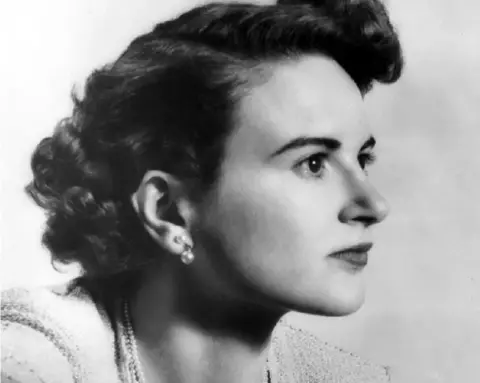
In 1961, she wrote a textbook - Music at Your Fingertips: Aspects of Pianoforte Technique - which remains in print, and later joined the Southern Illinois University at Edwardsville, first as an artist-in-residence, then as a faculty member.
A couple of years later, she married for the second time, to Dr James Kerr, a political science professor. They remained together until his death in 2000, and she described him as the "love of my life".
"I'd marry him again if I could, he's still my sweetheart," she told The Guardian in 2022.
She remained active throughout her life - and, during the first Covid-19 lockdown in 2020, uploaded home recordings of Beethoven's Sonatas to YouTube, to celebrate his 250th anniversary.
She celebrated her 97th birthday with a recital at Lebanon Valley College, Pennsylvania; and returned to Decca in 2022 to record what would become her final album.
Titled My Life In Music, it included touching performances of pieces by Rachmaninoff, Bach and Debussy - approached with a sense of tender nostalgia, as she reflected on her career.
Among the recordings was a version of Chopin's Prelude in F Major, a tribute to her Polish roots, which became one of her personal favourites.
"I had the honour of being with her during her recording session," said Moorman-Stahlman.
"After recording several takes of this work... she quietly turned to me and said, 'This one is good. I would like to have this one played when I ascend into heaven'."
Formal plans for a memorial service and concert will be announced in the coming days.
