Trump says Israel-Lebanon ceasefire to be extended by three weeks

 Reuters
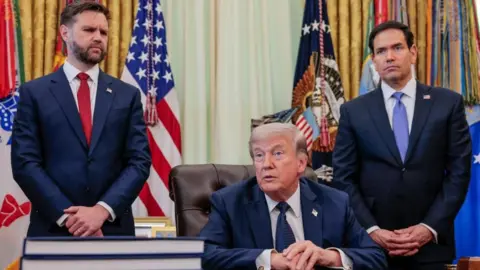
US President Donald Trump said a ceasefire between Israel and Lebanon would be extended by three weeks after fresh talks between the countries' envoys in Washington.
Announcing the extension on Truth Social, the US president said the meeting "went very well", adding the US would be working with Lebanon "to help it protect itself from Hezbollah".
The ceasefire, announced after a meeting in Washington last week, was set to expire on Sunday. The aim is to end more than seven weeks of fighting between Israel and Iran-backed Hezbollah.
In the Oval Office, Trump said both Lebanese President Joseph Aoun and Israeli Prime Minister Benjamin Netanyahu would visit the White House "in the coming weeks".
"They do have Hezbollah to think about," he said. "We are going to be working with Lebanon to get things straightened out in that country.
"I think it will be a wonderful thing to get this worked out simultaneously with what we are doing in Iran."
Speaking in the Oval Office with Trump, Lebanese Ambassador Nada Hamadeh Moawad and Israeli Ambassador Yechiel Leiter praised Trump for his role in the talks.
Leiter said Israel and Lebanon were united in their aim to rid Lebanon of "this malign influence called Hezbollah".
Both Hezbollah and Israel have accused each other of violating the ceasefire agreement.
 Reuters
On Thursday evening local time, as the talks in Washington were set to get under way, Hezbollah said it had fired rockets at northern Israel in response to an Israeli "violation of the ceasefire". The Israel Defense Forces (IDF) said it had intercepted the launches.
On Wednesday, Lebanon accused Israel of war crimes after Israeli air strikes killed one journalist and wounded another in southern Lebanon. The IDF denied that it targeted journalists.
Ahead of Thursday's talks, Israel said it had no "serious disagreements" with Lebanon, and urged it to "work together" against Hezbollah.
Last week's meeting in Washington brought Lebanese and Israeli envoys together for the first direct, high-level contact in three decades between the two countries.
Israel and Hezbollah agreed to a ceasefire ending a previous conflict in November 2024, after which Israel carried out near-daily attacks on targets and people allegedly linked to Hezbollah.
After the US and Israel attacked Iran on 28 February and killed Iran's supreme leader, Hezbollah launched rockets and drones into Israel in retaliation on 2 March.
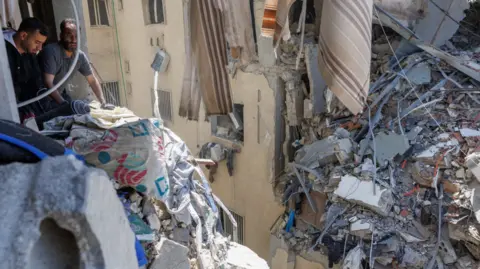
In response, Israel bombarded Lebanon with airstrikes, mainly in the south and Beirut. IDF troops re-entered southern Lebanon in early March, and have remained occupying 10km (6.2 mile) of Lebanese territory.
At least 2,294 people have been killed in Israeli attacks in Lebanon since the latest war began, according to the Lebanese health ministry, whose figures do not differentiate between civilians and combatants. The death toll includes 274 women and 177 children.
Hezbollah attacks have killed two civilians in Israel since then, while 15 Israeli soldiers have been killed in combat in Lebanon, Israeli authorities say.
UN figures show that across Lebanon, more than one million people, roughly one in five of the population, have been displaced in the latest fighting. The majority of these are from the south, where Israel has destroyed homes and villages.
Hezbollah is a Shia Muslim militia and political party in Lebanon.
The US, Israel and many Lebanese have demanded its disarmament, but for now, Hezbollah has refused to discuss the future of its weapons.
Lebanese President Aoun has said disarmament cannot be delivered by force, warning of the possibility of violence, and that it would require negotiations with the group.
Supporters say Hezbollah is the only protection they have in a weak state and, for now, Hezbollah has refused to discuss the future of its weapons.
