Fire service finally leaves Dunwich two weeks later

 BBC
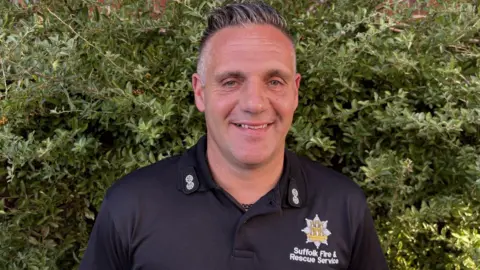
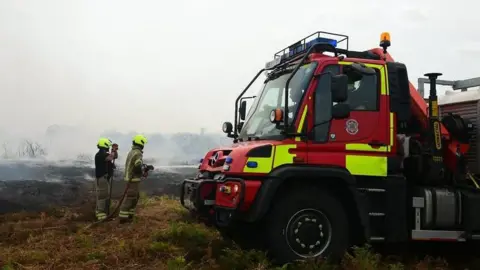
BBCAs Suffolk Fire Service withdraws from the site of a huge heathland fire after two weeks, one of its officers has said it was the most "challenging" experience in his 26 years in the role.
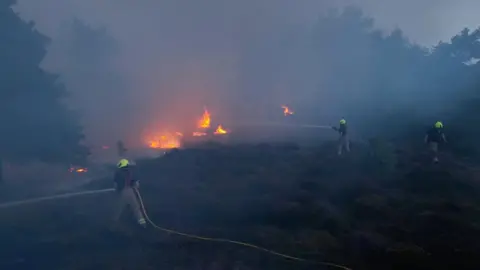
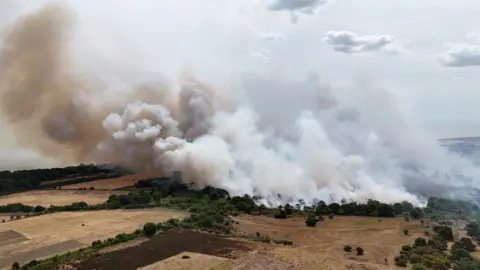
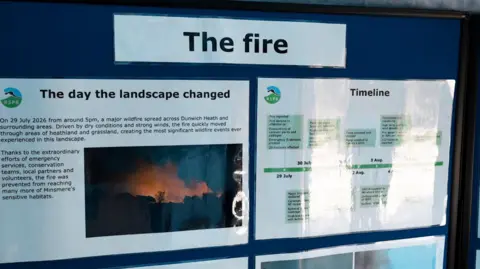
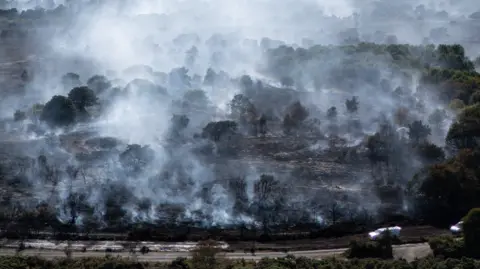
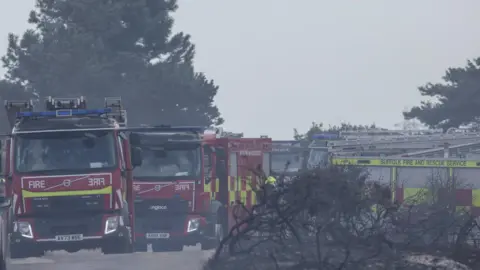
The blaze at Dunwich Heath, which started on 29 July, spread rapidly in the tinder-dry conditions, and about 120 firefighters were involved in trying to extinguish it at its peak.
It was stood down as a major incident on Monday, and the service left the coastal site at 17:00 BST this Wednesday.
Mark Cowling, an operational support officer based in Sudbury, said the changing wind direction had made tackling the fire particularly challenging.
 Ryan Lovejoy/PA
Speaking to BBC Radio Suffolk, Cowling said as the wildfire continued, the service was also having to deal with calls for support for other incidents, "so yeah, it's definitely been a challenging time".
He first arrived to help with the fire on the evening of 29 July, and ended up attending the incident on 14 occasions across the fortnight.
"I'd never seen anything like it in 26 years," he said.
"It was just flames as far as you could see, 10-15m high.
"The flames were right in front of you."
He said 14 fire engines were on site on the first evening, with crews trying to create a break in the fire, but the wind "which kept on changing" and the smoke "just made it harder and harder".
Tackling the fire in the dark and the lack of access made the situation even more complicated, he said.
Alison Borrman, who also works in business support for the fire service and deals with non-emergency calls, said people were calling non-stop to report the wildfire, including worried residents.
The fire did not claim any human lives, but homes and a caravan holiday park nearby were evacuated by the evening of 29 July.
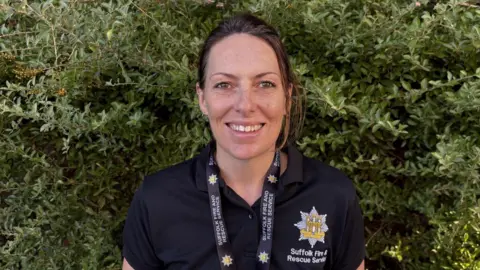
The Debenham crew she serves with arrived to help on the morning of 31 July.
Borrman said: "The access was very difficult and we were having to walk with our portable pump which is very heavy, walking into an area to set up by a pond.
"There must have been about 20 lengths of hoses just to get to certain areas.
"There was still fire sort of spontaneously popping up all over the place.
"There was roots which would just suddenly catch alight and we were trying to deal with these, trying to stop them from spreading to the already saved part, and stop them from jumping the fire breaks."
More stories on the Dunwich Heath wildfire:
- Will tourism suffer following devastating wildfire?
- Suffolk heathland fire stood down as major incident
- Volunteers say work to tackle fire 'relentless'
 PA Media
 SFRS
SFRSCowling said crews worked 10 and 12-hour shifts and his station, which is a 90-minute drive from Dunwich, sent firefighters 22 times to the fire.
"So it's a massive bit of pressure on all the people that are on-call [and] that have other jobs as well," he said.
When asked by presenter Wayne Bavin if the crews ever thought they might not get the fire under control, Cowling said: "At times it feels like it might be going out of control.
"But obviously with the way we're taught, the way we learn and our training, we're obviously going to do the best we can to make sure that we do get on top of it eventually, like we have done now."
 John Fairhall/BBC
Borrman, who has also worked for the RSPB, said she was very concerned for the wildlife.
"It was quite upsetting, seeing what you absolutely love just being burned away in front of you, and it was just ash by the time we got there," she said.
"So to see that, it was quite emotional. It was really frightening to be honest.
"But what was quite nice, in the evening, once the sun had gone down, you could hear a nightjar chirring, which was very nice.
"Me and my colleague, we sat with our thermal imaging camera and we were scanning across and we were watching deer with our thermal imaging camera.
"So that was quite comforting knowing they're still there."
 PA Media
The heathland fire engulfed an area the size of 210 football pitches across the National Trust site in Suffolk and neighbouring RSPB Minsmere reserve.
RSPB Minsmere reopened on Tuesday, with parts of the site inaccessible.
People have been warned to stay away from Dunwich Heath due to unstable ground and unexploded World War Two ordnance uncovered by the devastating wildfire.
A fundraising appeal launched by the National Trust to support Dunwich Heath's recovery has raised more than £600,000.
 SFRS
SFRSDo you have a story suggestion for Suffolk? Contact us below.
Follow Suffolk news on BBC Sounds, Facebook, Instagram and X.
