Rare navigational tool back on islands

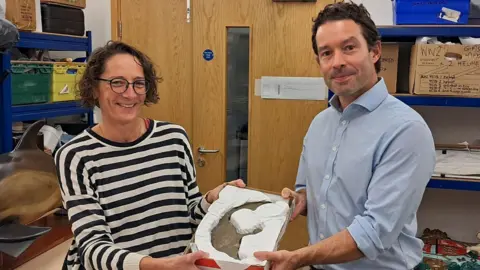 Isles of Scilly Museum
A rare navigational tool is back on the Isles of Scilly more than 400 years after it was lost at sea.
The Pednathise Head astrolabe, dated to 1568, was used by early explorers to measure the altitude of the sun or stars to determine latitude, with only 120 of the devices known to have survived from that era.
The item was discovered in a Spanish shipwreck in the late 1980s, at Pednathise Head, before it was taken across three continents as part of private collections.
The Isles of Scilly Museum said the return of the Pednathise Head astrolabe "brings a captivating chapter of maritime history full circle".
After it was first recovered the astrolabe fell into private ownership, and was later identified in Australia.
It then passed through the collection of an antique dealer, a car salesman in New Jersey, USA, and then to the Mel Fisher Maritime Museum in Florida.
Eventually its true identity was discovered by a research programme at Texas A&M University.
After that, the Mel Fisher Maritime Museum agreed to return the artefact to the Isles of Scilly.
It will now be the centrepiece of a new maritime gallery at the Isles of Scilly Museum.
"We're thrilled to have this rare example of a mariner's astrolabe back on the Isles of Scilly and in the care of the museum," said curator Xavier Duffy.
"It's the object's remarkable journey and unlikely return that makes it truly special.
"We can't wait to share its story with visitors when the new museum opens in autumn 2026."
Follow BBC Cornwall on X, Facebook and Instagram. Send your story ideas to spotlight@bbc.co.uk.
