Why NI students are put off going to uni in the Republic of Ireland

 BBC
BBCThere still seems to be a hard border when it comes to Northern Irish students studying in the Republic of Ireland, with some saying the admissions process is a major hurdle.
In 2025, only 213 students from Northern Ireland started university courses in Ireland.
By contrast, thousands furthered their education across the Irish sea in cities like Liverpool and Glasgow.
Claire, 18, from St Ronan's College in Lurgan, is planning to study building surveying at Dundalk Institute of Technology and said the application process was "very difficult".
"There was not a lot of knowledge on how to actually apply to the uni and how to apply on their website," said the A-level student. "It was quite outdated."
Students in the UK use the University and Colleges Admissions Service (UCAS) to apply for university, while in the Republic of Ireland applications are made through the Central Applications Office (CAO).
The timing of Leaving Cert (Ireland's A-level equivalent) results, the high cost of student housing and the admissions points system have all been cited as reasons for the trickle of students going south to study.
That is despite lower tuition fees - known as the student contribution fee - in the Republic of Ireland.
The student contribution in Ireland is €2,500 (£2,160) in 2025/26 compared to a £4,985 tuition fee in Northern Ireland and £9,535 in England and Wales.
What do A-level students say?

Like Claire, 18-year-old Tiarnan said he had difficulties with the admissions process in the Republic of Ireland, and decided to apply to Ulster University in Coleraine instead.
"With northern universities, you put it in, you put your evidence and there you go," he said.
"In the southern process they want different types of evidence. I found the whole process a lot more difficult."
'It's so expensive'

Sean, who is also 18, is planning to start a Higher Level Apprenticeship (HLA) in construction management.
He had considered going to study in Dundalk, but decided to stay in Northern Ireland.
The timing of results and offers was a big issue for him as pupils in Northern Ireland often receive their A-level results around two weeks before Leaving Cert results are released in the Republic of Ireland.
"When they get back to you, you have your offers, so you've already made plans with your family if you're going up to live in Belfast or Coleraine," Sean said.
"And plus all your mates are making plans as well.
"No-one really looks at the south so much because of the housing, it's so expensive as well."
'Reluctant to gamble on a place'

The careers teacher at St Ronan's College, Olivia Geoghegan, also believes the timing of offers means many students are reluctant to "gamble" and lose a confirmed place at a UK university.
"They like to have their accommodation sorted.
"They want to plan, they want to prep."
She also said for some high-demand courses in the Republic of Ireland, like medicine, students are reluctant to apply unless they have four A-levels.
"The UK and Ireland are on such different pages on this, and it makes it difficult for us because we live in the middle," she said.
'More straightforward than UCAS'

Cathal Ó hÉigeartaigh from Belfast is a civil engineering student at the University of Galway.
He said information about how to apply to institutions in Ireland was "not readily available".
"The focus was all about Queen's and universities in Britain and how to fill out your UCAS forms. But there was almost nothing said about the CAO process."
So he taught himself how to apply.
"It's really not as complicated as it's made out to be," he said. "You don't have to write a personal statement and you rank your preferences from one to ten.
"In some ways it's more straightforward than UCAS."
What do the statistics say?
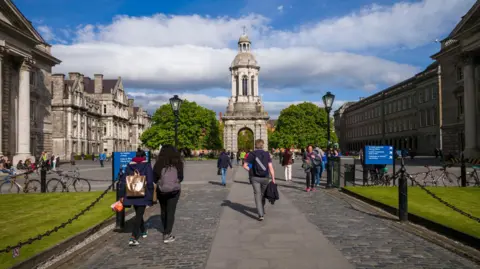 Getty Images
While only 213 students from Northern Ireland accepted places in universities in the Republic of Ireland in 2025, the 2024 figure was even lower, with only 190 students travelling south of the border.
The numbers were outlined at Stormont's economy committee on Wednesday.
Prof Stephen Byrne, from University College Cork, told assembly members the barriers to students from Northern Ireland included "the timing of offers, the cost of living and the availability of places".
Bryne also raised the issue that UK universities make conditional offers of places to students "several months earlier" than offers were made in the Republic of Ireland.
Universities in the Republic of Ireland do not issue conditional offers and wait until Leaving Cert results are confirmed.
He said worries about the cost of student housing also played a role.
Is the university admissions points system to blame?
Another factor which comes into play is the difference in the range of subjects studied, as universities in Ireland have a points system for admissions.
The Leaving Certificate involves studying typically seven subjects and university applicants can score the maximum 625 points by achieving H1 grades in six subjects, including maths.
But as A-level students in Northern Ireland take fewer subjects - usually three - it is more difficult for them to get the maximum points.
That is despite the fact the points each A-level result is worth has increased in recent years.
