Nazanin Zaghari-Ratcliffe says sewing was a lifeline in Iranian prison

 Sam Hardwick/Hay Festival
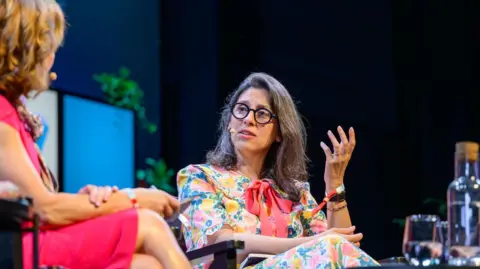
Nazanin Zaghari-Ratcliffe has shared how crafting gave her inspiration and hope in the years she spent detained in an Iranian prison.
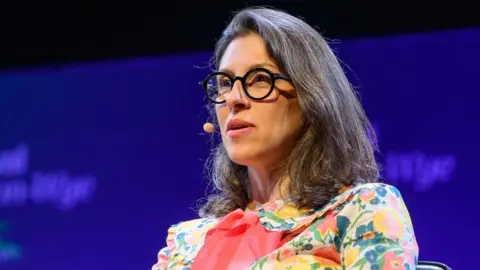
Speaking at Hay Festival on Thursday, she recounted how getting permission to have fabrics sent to her offered a lifeline, not just for her but also fellow inmates.
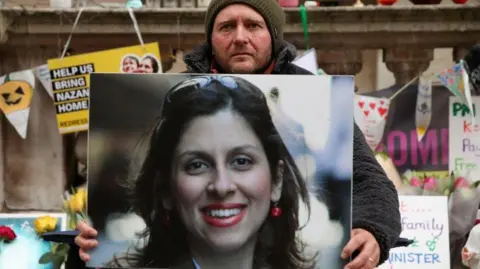
The British-Iranian charity worker was detained by the Iranian authorities in April 2016 and held in a political prison for nearly six years, used as leverage - a diplomatic pawn to put pressure on London.
While incarcerated, Zaghari-Ratcliffe made clothes for her daughter Gabriella and neckerchiefs for the other women there.
"I was not a confident seamstress [before prison]," she told the gathered crowd in Hay-on-Wye, Powys.
"My mum used to do sewing, but she would never allow me to use her sewing machine - and I'll never forgive her for that, because there was this urge in me to sew. We laugh about it now."
She said she used to purchase fabrics from the luxury department store Liberty London and her mother-in-law bought her a sewing machine and encouraged her to sew.
But she felt the fabrics were "too special" to use, and it was only in prison she realised she "could overcome the challenge" and make something.
Crafting was part of rehabilitation activities offered too and the teacher helped her make a dress pattern.
 Family photo
Getting her Liberty fabrics into the prison was no mean feat.
"Fabrics were not allowed in prison. For some reason, they would allow us to have a certain number of garments per season," explained Zaghari-Ratcliffe.
"I had a stash I had kept for a special occasion and my mindset changed when I was inside prison... [it was] the Liberty name, we had a place where we had no liberty."
She got special written permission to bring in her fabric, and her husband Richard "went through some efforts" to send them to her.
Zaghari-Ratcliffe said she started distributing the fabric among her fellow prisoners, "because everyone wanted to have a piece of liberty that they didn't have".
"In prison, everything is just basic. But people would still find ways to beautify themselves and hold on to their identity. People would be creative to make every little thing we would throw away as something to put on themselves."
Zaghari-Ratcliffe added there was only one, old industrial sewing machine in the prison and she was assigned to be in charge of its use.
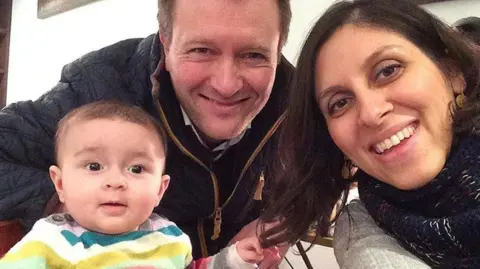
She said when she first had her daughter Gabriella - who was just 22 months old when she was detained - she "dreamed of making matching dresses".
She continued: "It was tragic, because I did make matching dresses and I would send them and she would come to prison to see me and she would wear them, but in Iran I couldn't wear them because you have to cover. We could never wear them together."
She said crafting helped prisoners, by creating a "sense of travel to the world they might be in one day or the world they used to be in".
"When your freedom is restricted - whether you are in prison, in my case, or stuck in a conflict, you're in hospital, there is illness, there is some sort of injustice - creativity creates a form of quick psychological exit for you, it mentally allows you to escape the place you are in."
Zaghari-Ratcliffe also did crafts with her daughter, including origami and making tote bags, during her weekly visits before she had to return to the UK for school in 2019.
 Sam Hardwick/Hay Festival
And sewing has been there for her in recent difficult times too, including receiving the news of US and Israel strikes on Iran on 28 February.
"I think I woke up about five o'clock in the morning... I quickly called my mum, and she said they were all good. The catastrophe hadn't quite hit then," she said.
"I needed to think... I sat at the sewing machine. It reminded me of the time I was in prison in a way. There was a lot going on around us, but we had to do something to take us out of that space.
"I spent five days doing nothing else... the only thing I could do was sew. That was my safe space."
She continued: "It was a very hard couple of months, it was difficult to get in touch with my family. Things gradually calmed down, especially post-ceasefire and I could call my parents through the landline.
"When I was explaining that to my daughter, she said: 'What do you mean? Do you mean WhatsApp?'"
The phone calls reminded her sister of when she was in prison, as they came from unknown numbers and had to be short and to-the-point.
"It was really sad to think even though I am free, there are still things that remind her of that time."
 Reuters
After Zaghari-Ratcliffe's release, Liberty London got in touch with her, initially to invite her to the store after they named fabric lines after both her and her daughter.
This was the start of a partnership, and Zaghari-Ratcliffe has since helped them, alongside the Imperial War Museum, to design a line of fabrics - using Liberty archives and her own experiences to "shine a light on remarkable stories of creativity and craft during periods of war and conflict".
One pattern encapsulates the monotony of prison life, while another represents the rooftops she could see on her twice daily 10-minute walks while inside.
Liberty is donating these fabrics to prisoners, to continue their crafting.
"What was very important to me was to see that circle closing or maybe just going back again into the next circle," said Zaghari-Ratcliffe.
"The moment these prisoners receive these fabrics into their hands when they have no liberty, it's how I felt, except these fabrics represent themselves.
"I felt this was brilliant. They will feel closer to the pattern and this made me feel so happy."
She has also made a quilt, using fabrics which reminded her of her time in prison.
"[It] connects me to a world I both would want to go back to and never go back to at the same time."
She added: "When I came back, it reminded me of the fact that liberty is in every single small thing we have in life. The fact we can walk under the sun, that we can see the full moon once every month.
"Freedom is waking up and having a nice shower, freedom is being able to drink lots and lots of coffee, freedom is being able to go into a supermarket.
"For me, liberty is the joy of being free in that simple sense of enjoying life the way it is."
